
Click on the image to watch the incredible “History of the World” animation by Ollie Bye. Volga Bulgaria appears on 13th minute.
This short animation by Marjani Institute of History succinctly explains the assumed origins of the modern Tatars.
In historical texts, the pastoral nomadic people of the vast EurAsian steppes are referred as ancient Xiongnu, Huns, Scythians, Saka, Kipchak (Polovtsy, Pecheneg), Bulgars – a conglomerate of Turkic/ Hunnic/ Uralic/ Altaic/ Iranian origins, who in 552 CE formed a vast and powerful Turkic Kaganate. It later split into Eastern and Western, that, eventually, broke into myriads of tribes and several state-like entities. Among which was a short-lived Great Bulgaria established in 633 CE that dissolved right after the death of khan Kubrat, but led to formation of the First Bulgarian Empire on Danube River and the Volga (Itil) Bulgaria at the confluence of Volga and Kama rivers (Ibn Fadlan who visited in 10th century also called Volga Bulgars as Sakaliba, which in Arabic means “White Saka” or Kipchak in Turkic languages). In the early 12th century Temujin devastated Volga Bulgaria and consolidated it with other tribal units in (Tatar)-Mongol Empire/ Golden Horde/ Ulus Ulug / Desht-i-Kipchaq.
The modern Volga Tatars are the ancestors of the Volga Bulgars (read here how Volga Bulgars got to be referred as Tatars) whose rich heritage fuels the culture and identity of modern Tatars who populate the indigenous territories now called Tatarstan Republic that is a subject of modern Rossiyan Federation and the centre of the robust and distinctive Tatar culture.
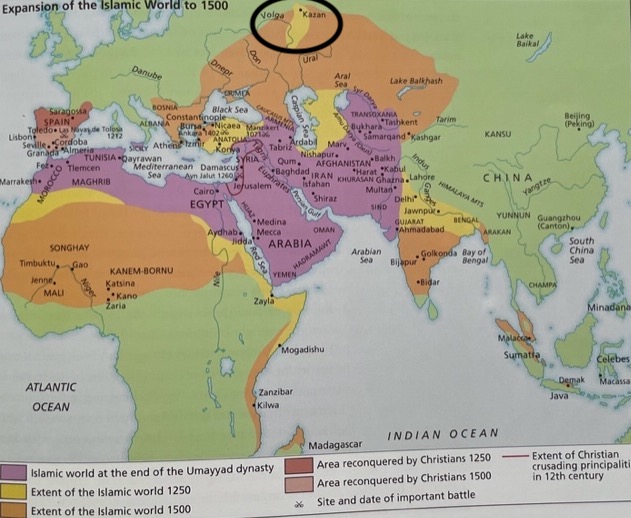
The Medieval State of Volga Bulgaria was a powerful and well-developed state – a major education and trading center connecting Silk Roads and Volga trade roads with many countries. In 922, the people of Volga Bulgaria joined the Islamic umma becoming the northernmost state with Muslim population.
Medieval Volga Bulgaria had established itself as a centre for Islamic education, religion and culture for the vast turkic population of EurAsian steppes. Volga Bulgars were skilled agrarians with highly developed culture, trade and crafts. They became well-known for their handiwork: quality and intricate metal-, gold- and silverwork, pottery, jewellery and leatherwork.
Bulgar leather goods and furs, in particular, became famous all around the EurAsian continent. Since those times the soft leather got referred to as bulgari in Central Asia, Middle East, North Africa, Western Europe (later the leather made by Volga Bulgarian technology were refried as safian, yuft, russian).
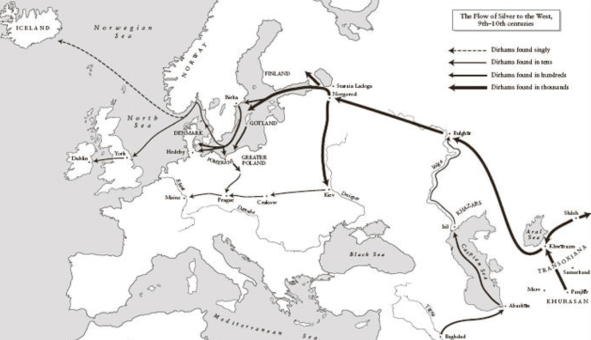
In 1236, Volga Bulgaria was invaded by the Genghis’ army (that consisted of Turkic people referred as “Tatars”), later in 1259 becoming an independent Ulug Ulus/ Kipchak Khanate / Desht-i-Qipchaq/ Golden Horde. In 1396, The Golden Horde broke into small “Tatar” khanates. Since then, the Volga Bulgars and other Turkic (non-Slavic) indigenous people of EurAsia became referred as Tatars by the European sources, and later by the Muscovite ideologists (Interestingly, the modern Tatars used to self identify themselves as Muslims, Bulgars , and only in early 20th century as Tatars). Around those times the Muslims-Bulgar-Tatars started migrating to various areas of the modern Rossiyan Federation. Those Tatars are referred now by the location they had settled in: Astrakhan, Siberian, Tyumen, Nogai, Crimean Tatars.
By 1430s, most of the territory of Volga Bulgaria became part of the (Bulgarian)Khanate of Kazan that inherited wits, skills and crafts of the Volga Bulgars. After brutal siege of Kazan in 1552, Kazan Khanate was turned into Kazan Province of Tsardom of Russia. Over the years, the Tatar Muslim intelligentsia was slowly destroyed. Islamic population had been pressured to change their faith and to convert to Christianity. Despite numerous insurrections, the Bulgars-turned-Tatars became dependents of Rossiyan Empire through early 20th century. During and after the reign of Katherine the Great (1762-1796), Muslim population of Rossiyan Empire was offered some relaxation, was allowed to build mosques, and was delegated to carry trade, education and ideology to turkic population of the Central Asia. After the revolution of 1917, the Union of Soviet Socialistic Republics was created with forced ideology of atheism and equality. The Volga Tatars got their indigenous territory a status of TASSR (Tatar Autonomous Soviet Socialistic Republic) or Tatariya (a region with partial autonomy in Soviet system of governing). Islam practices either went underground or transformed into practical and didactical nature.
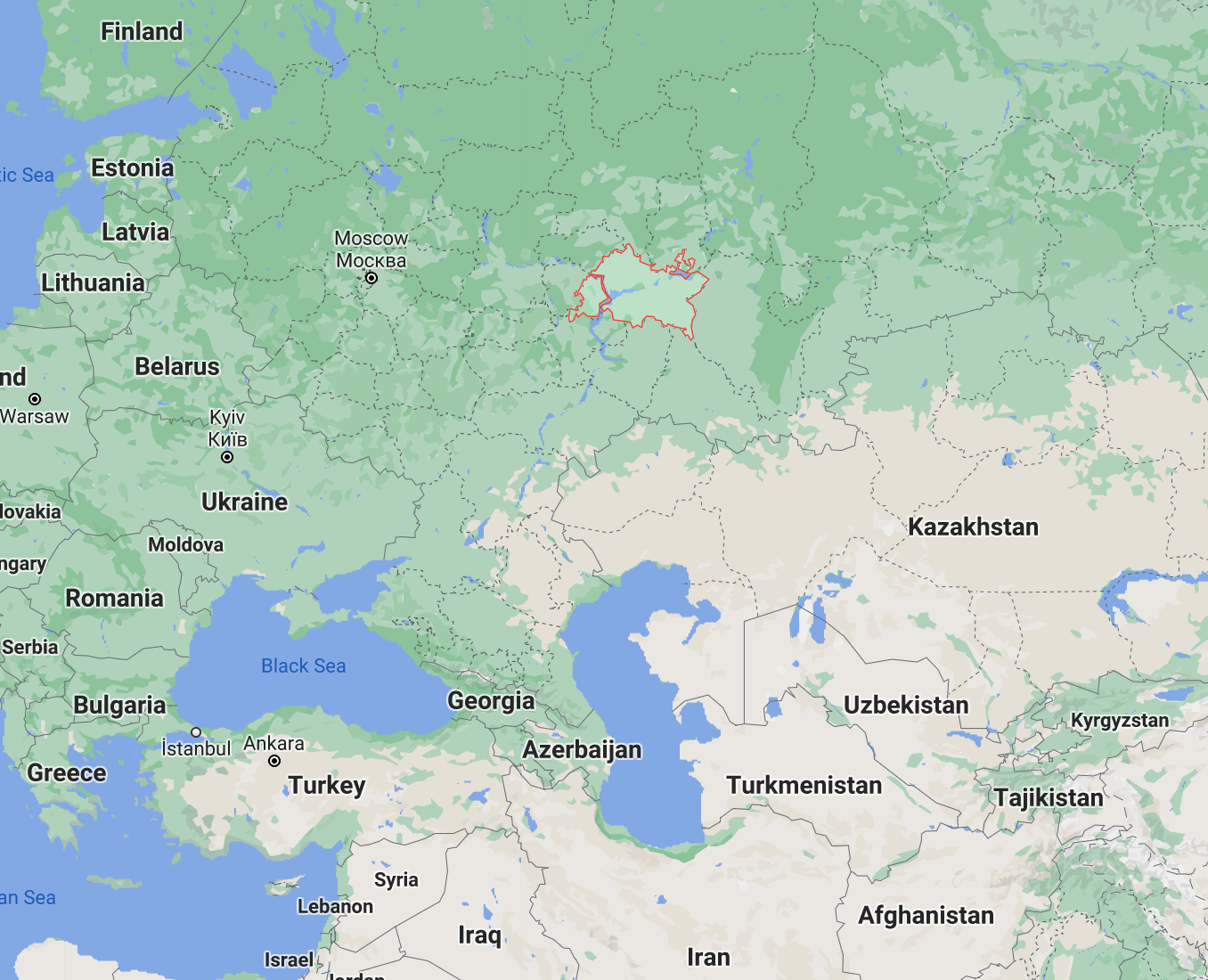
Boundaries of modern Tatarstan (highlighted with red)
On August 30, 1990, after the collapse of the Soviet Union, Tatarstan declared sovereignty, which served to heighten consciousness of its culture and heritage. Tatarstan Republic became a sovereign state within the Rossiyan (Russian) Federation. In 1992, Tatarstan held a referendum on a new constitution supervised by Helsinki Commission staff. In 1994, the Mutual Treaty between the Russian Federation and the Republic of Tatarstan was signed. The Republic of Tatarstan became a constituent of the Rossiyan (Russian) Federation- a federal subject tied with the Russian federal government by the uniform federal treaty. The following passage from the Constitution of Tatarstan had defined the republic’s status without contradicting the Constitution of the Rossiyan (Russian) Federation: “The Republic of Tatarstan is a democratic constitutional State associated with the Russian Federation by the Constitution of the Russian Federation, the Constitution of the Republic of Tatarstan and the Treaty between the Russian Federation and the Republic of Tatarstan On Delimitation of Jurisdictional Subjects and Mutual Delegation of Powers between the State Bodies of the Russian Federation and the State Bodies of the Republic of Tatarstan, and a subject of the Russian Federation. The sovereignty of the Republic of Tatarstan shall consist in full possession of the State authority (legislative, executive and judicial) beyond the competence of the Russian Federation and powers of the Russian Federation in the sphere of shared competence of the Russian Federation and the Republic of Tatarstan and shall be an inalienable qualitative status of the Republic of Tatarstan.”[53]
Relation between the government of Tatarstan Republic and the Rossiyan (Russian) federal government were complex with slow deterioration of Tatarstan’s independence. In 2002, the referendum and constitution of Tatarstan Republic were declared unconstitutional by the Rossiyan (Russian) Constitutional Court. Introduced in 2002, Articles 1 and 3 of the Rossiyan (Russian) Federation Constitution identified Tatarstan as a part of the Rossiyan (Russian) Federation, removing the “sovereignty” term. Power-sharing agreement was renewed on July 11, 2007, with much of the power delegated to Tatarstan reduced. On July 24, 2017, the Mutual Treaty / autonomy agreement signed in 1994 between Moscow and Kazan expired, making Tatarstan the last republic of Rossiyan (Russian) Federation to lose its special status. In 2018, the Tatar language instructions in primary public education were reduced to the minimum and assumed the optional status. In 2022, the Office of Presidency of Tatarstan was reduced to carry the title of the Head or Rais (in Tatar) of Tatarstan. Kazan, the capital of Tatarstan, is announced to be a cultural capital of Islamic world in 2026 by Islamic World Educational, Scientific, and Cultural Organization (ICESCO).
 Unique Leather Mosaic of the Tatars