
The modern Tatars (descendants of Saka/ Sythians/ Turks/ Xingnu/ Huns/ Volga Bulgars) has optimized decorative patterns of proto-Turks to fit and align with a leather medium. The modern Volga Tatars carry ancestral leather artistry of EurAsian nomads as well as prominent skins-hides processing skills of the Volga Bulgars. They have uniquely incorporated natural and spiritual beauty of EurAsian nomads in a manner and with a technique that has no analogy. Meticulously designed patterns of soft colorful leather are skilfully cut and hand-sewn with a distinctive stitch and colorful thread. The stitching creates an illusion of embroidery or appliqué when looked at, but the technique requires a different and unique set of skills rather than the ones in leather embroidery, inlay, outlay.
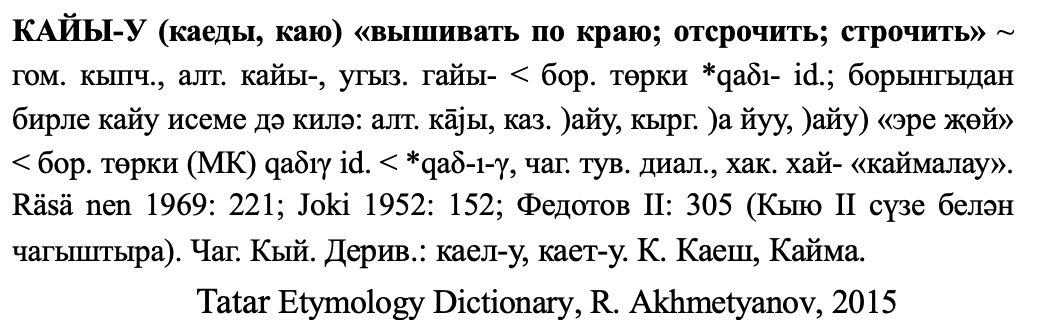
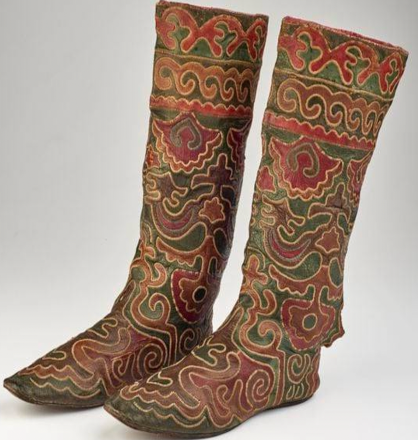
This exceptional technology that aligns colourful leather patterns and twisted threads in intricate play of ornamental designs is called кайылы (каюлы) күн – Kaiyly Kün – in Tatar language: from the Tatar words kaiy meaning “to embellish the edge” and kün meaning “leather”. In English, the best alternative is Tatar Leather Mosaic (such terms as inlaid leather, patterned leather, mosaiced leather, uzornaya kozha are also found in literature).
Uniqueness of Kaiyly Kün technology and its best application shchiteq(ler)- meaning “decorated soft sock-like boot(s)” in Tatar language– is in integrity of three elements: 1) curvy colorful soft leather cutouts, 2) stacked to create complex Turkic-inspired designs, 3) attached with distinct embellished inward stitching. A so-called “Kazan” stitch (named after the place it was mastered and popularized) attaches leather cutouts together in a unique manner that cannot be reproduced by a machine.

The essence of the stitch is three loops of twisted decorative thread circled around a waxed connecting thread and squeezed between the two pieces of soft leather. This type of stitching, that is originated from an ancient inward two-thread/two-needle stitch, can be found in the leather items created in Asia, Turkestan (Central Asia), Middle East, Balkans, North Africa. Although the technique of the stitch is not unique, the way the Volga Tatars have been utilizing the stitch to create complex and intricate designs has no analogy.
Interestingly, the stitch employed in Kaiyly Kün is originated from an ancient inward two-thread/two-needle stitch. A Tatar original word for it is lost (not identified); since mid-19th century it has been recorded to be called as Kazan stitch referring to the epicenter for the unique leather craftsmanship. Instances of leather items created in areas of Central Asia, Middle East, Balkans, and North Africa also employ a variation of this distinct stitching. In particular, it is widely utilized nowdays by Moroccan leather craftspeople and is referred as “sarma”– the word derived from Turkic root “sar-“with meaning to “wrap around”. It is very likely that the Bulgar-Tatars also had used this terminology.

- If you want to visually experience shchiteqler structure and decorations, enjoy this 3D image. Please note that these virtual boots were modelled from the mislabelled (as it frequently happens) kaiyly kün shchiteqler mastered by the Tatar people in the textile (not leather) interpretation with applied/embroidered (not “kaiy”) decorations.
- If you are interested in detailed overview of the Kaiyly Kün Art of the Tatars, access this 3-page publication (in English and Tatar languages).
- If you want to share the key facts about uniqueness of Kaiyly Kün Art of the Tatars, feel free to use the one-pager below.
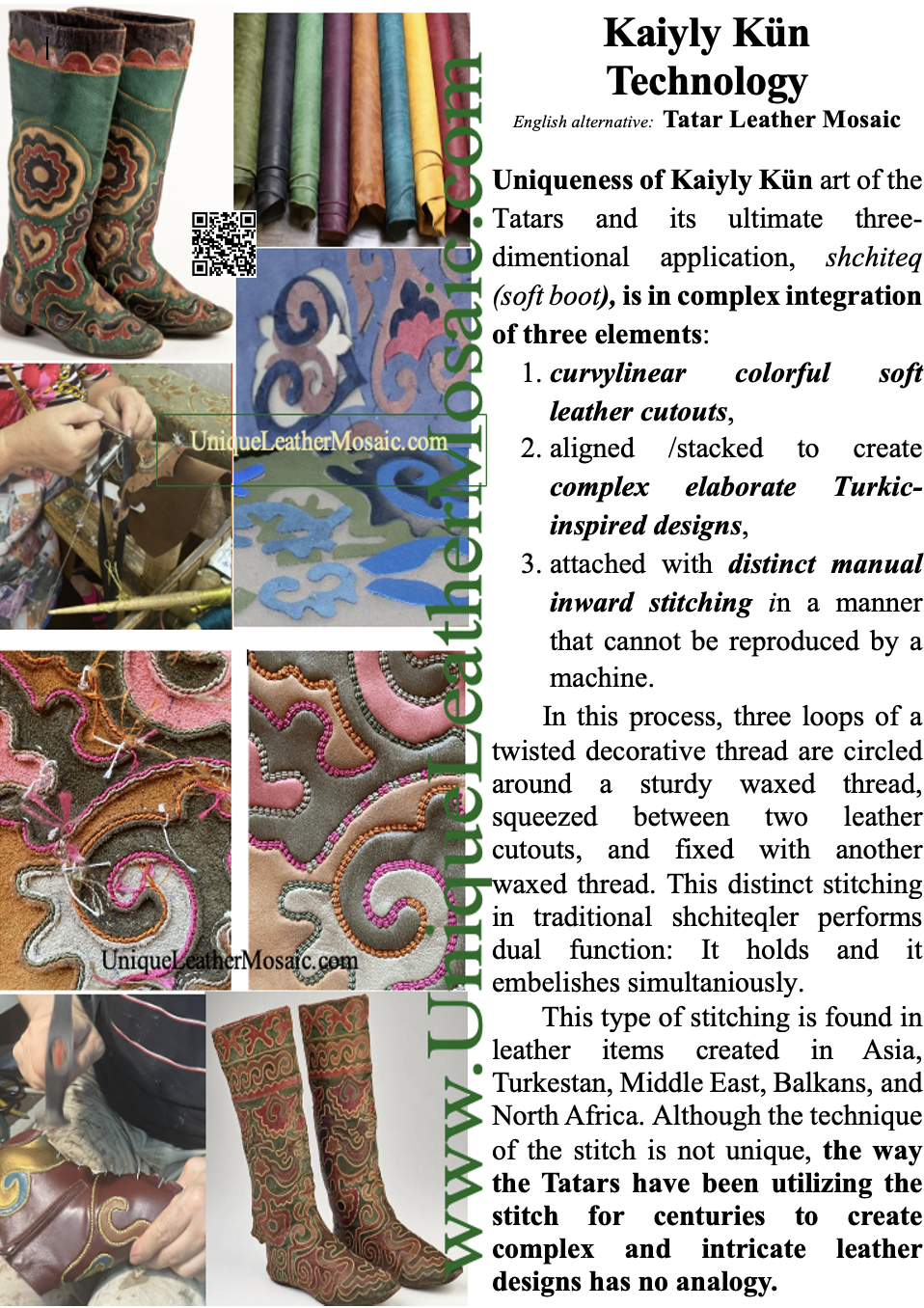
 Unique Leather Mosaic of the Tatars

Pingback: It is time for a hat! One-of-a-kind hat! | Unique Leather Mosaic