Such leather items as buqshchalar (bags), schiteqler (soft boots), shchuweqler (flat shoes), tufliler (heeled shoes), menderler (pillows), wall art and other small items crafted with Kaiyly Kün (English alternative: Tatar Leather Mosaic) technology are being produced for sale mostly in-between Kazan and Arshcha area of Tatarstan by small artisanal ateliers, individual entrepreneurs, branded and unbranded, including Sahtian, Читек, AigelSalakh, Ay.bulgari, KulEse and other unnamed workshops that are keeping the ancient traditional folk art of the Tatars alive. A Tatar-Italian brand Altari creates bags incorporating craftsmanship of two cultures and shipping them worldwide.
Vintage and antique ornamented Tatar leather footwear can be found occasionally on auction sites and marketplaces. Below are some examples of the sales (current and past) on various marketplaces. Each description is quoted from the corresponding marketplace (linked photos are courtesies of each sellers): It can give an idea of difficulties of introducing and labelling the unique Kaiyly Kün technology of the Tatars, as well as the Tatar original terms for decorated leather footwear : a) soft boot – shchiteq, b) flat soft shoe – shchuweq, c) hard outerwear shoe – bashmaq and qewesh.

On sale for $350 as of November 22,2025.
Description quote: “Origin: Russia | Tatarstan | Kazan. Era: Early 20th century (circa 1910-1930). Condition: fair-good; flaking to leather surface; wear along edges; small tears; minimal wear to soles; light general wear; recommended for display only
Measurements: approximately 9″ from heel to toe (marked size 35 on the bottoms)
Additional Note: Traditional pair of women’s ornamental leather shoes from Kazan area of Russia. The shoes feature beautiful leather motifs that are joined using Kazan stitch – extensive additional history of the ornaments can be found line. This type of handmade leather work was practiced in Kazan for centuries and remained an important local craft up until around WWI. This pair likely dates to the final era of traditional production around the turn of the last century. Modern efforts to revive the craft have been somewhat successful, however the volume of production cannot match pre-industrial levels and the designs, colors and styles have of course been adapted for contemporary fashion. Original examples are very scarce. The leather and stitching on this pair has suffered some wear mainly to the toes and around the top of the heels. Deaccessioned from a museum collection with the accession numbers written on the heels. A rare museum artifact not suitable for wear given their age and the fragile condition of the leather”.

on TurkishFolkArt antique marketplace
$575 as of August 2023. Reduced to $400 as of November 22, 2025. Ships from Turkiya for free. Circa: 1960-70. Size:40 EUR/7,5 US.
Description quote: “CENTRAL ASIA Ethnic leather boots. They most probably belong to Tatar society from Uzbekistan or Tajikistan. Many ethnic Tatars live in old Soviet Turkic states. This style of boots is common in Uzbek tribes as well as among Tatars who live with them in many parts of Uzbekistan. They were worn a short time most probably on ceremonial and special celebration days. They have soft leather and fine workmanship.”

on Ebay
SOLD $850 (reduced to $390) as of September 2024, ships from USA. Circa 1910. Size: 39 EUR. Description quote: “Shoes are acquired from the estate sale of Woodrow Wilson (28th U.S. President) and described as “Edwardian” referring to the period of reign of King Edward VII of U.K. Quote: “Fashioned of brown leathered are hand stitched throughout with the vamp and heel having colourful artistic leather appliqués with a stitched edge“.

SOLD $89.65 as of July 2023, ships from Latvia
Circa: 1990. Size: 12,5″/32 cm.
Description quote: “White Blue Genuine Leather Cowboy Western Boots Floral Women’s Dance Boots Leather Cowgirls Booties Festival Boho Shoes”
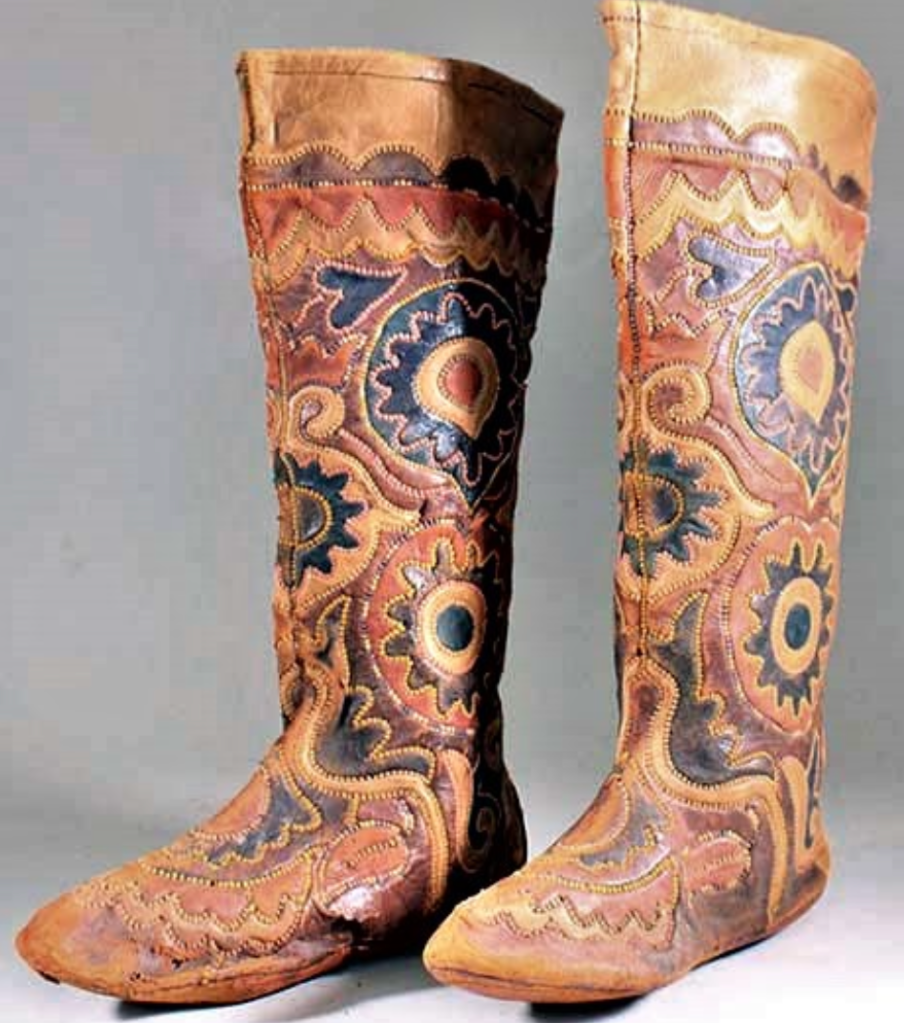
SOLD for $1515 in 2023, shipped from Israel. Circa: late 19th century.
Description quote: “A Rare Pair of Tatar Warrior Boots. (!the rest is a great summery from our website!) Leather goods crafted by Nomad Turkic people who roamed the steppe of today Russia and Central Asia are known from the 7C. BC, from finds in the Altay mountains . Semi-nomadic Turkic Tatars that settled by the banks of Volga and Kama rivers in the 7th century CE established the state of Volga Bulgaria inherited the art of leather craft from the nomads and successfully perfected and traded leather goods throughout Asia and Europe for many centuries.
Beautiful boots made from the soft and aromatic leather called “Bulgari”. Historical documents state the popularity of the leather footwear and the large scale of the leather manufacturing in Kazan Khanate, the state that had inherited the territory of Volga Bulgaria as well as cultural features, arts and crafts. Tatar footwear were gaining popularity among Russian upper-class and became part of well-recognized Russian costume. By the 19th century, the Tatar leather footwear production managed to expand and to blossom. Heavily decorated boots were worn by higher levels Tatar Muslim as well as Russian and aristocrats of the neighboring Ottoman Empire. The beautiful Tatar boots gained further fame after the World Fairs in London in 1851, Chicago, 1893 and Paris 1925. The pair of Tatar boots offered below is from the late 19th century made of the leather mosaic technique with graceful, delicate and intricate combination of floral, vegetative, zoomorphic and geometrical motifs and ornaments that are influenced by traditions and beliefs of Turkic nomads and Islam. The pair presented here comes with soft soles and no heels and it may suggest that this pair was made for horse riders. (Similar examples of Tatar boots are displayed in the collections of the most important museums in Europe and Russia. A very similar example of a single boot is on display in Boston Museum of art accession number 97.166 gifted in 1897. Another very similar example is Museum of International Folk Art Santa Fe, New Mexico, USA accession number A.1967.10.17ab.)“

Auctioned October 2016 in London, UK. SOLD for £320. A pair of embroidered leather Tartar boots, Russian, early 20th century, the green and red leather densely worked with traditional patterns and heart motif, length 25.5cm, 10in (2)
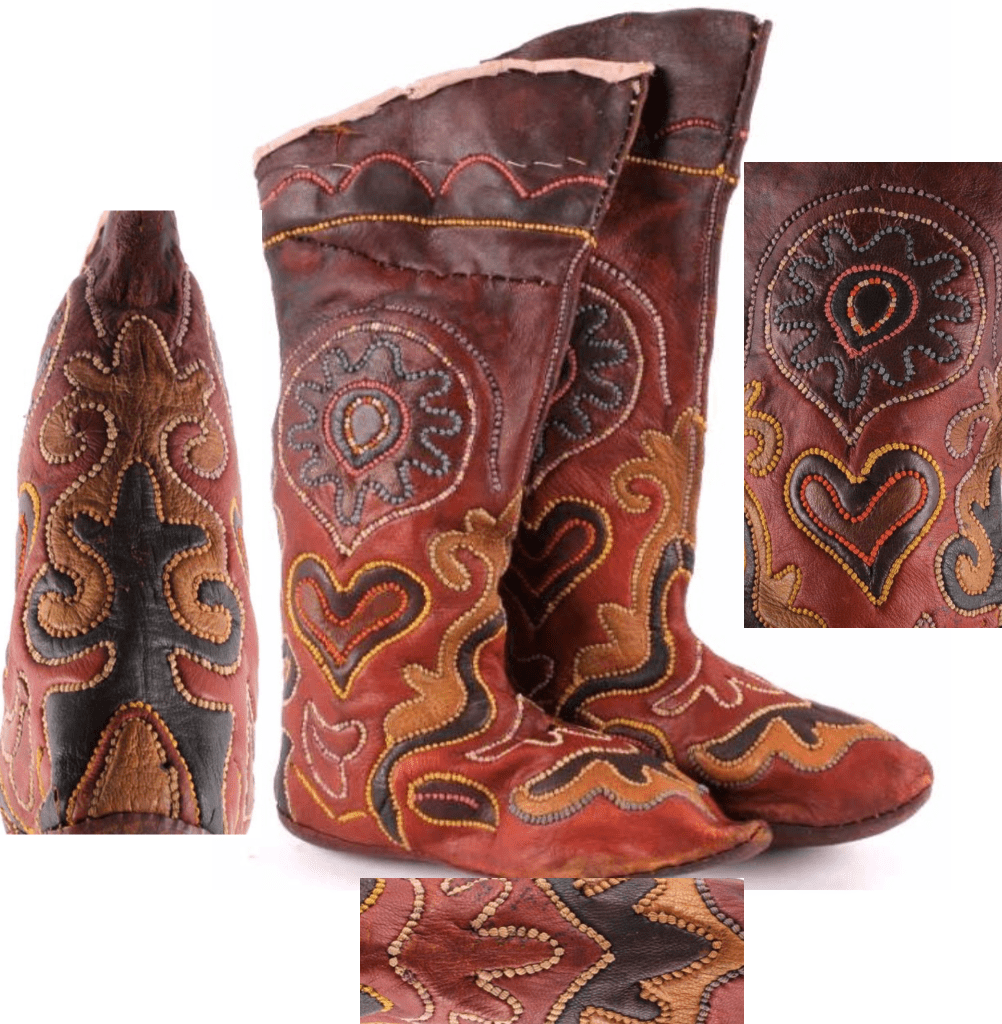
on Invaluable
SOLD for $200 in 2015. Shipped from USA. Description quote: “This is an original set of early Meskwaki Native American Indian high top moccasins. The set is believed to be from circa 1870-1900.The set has an excellent hand embroidered sewn geometric design on Indian tanned and dyed hide. The moccasins have red to dark red or black ocher dye. These have some of the finest Indian sewn geometric designs seen on moccasins. Each measures 9.5″L sole and 14″H. The set is believed to have been made after an Indian warrior saw a set of cowboy’s fancy sewn boots and tried to recreated the style.”
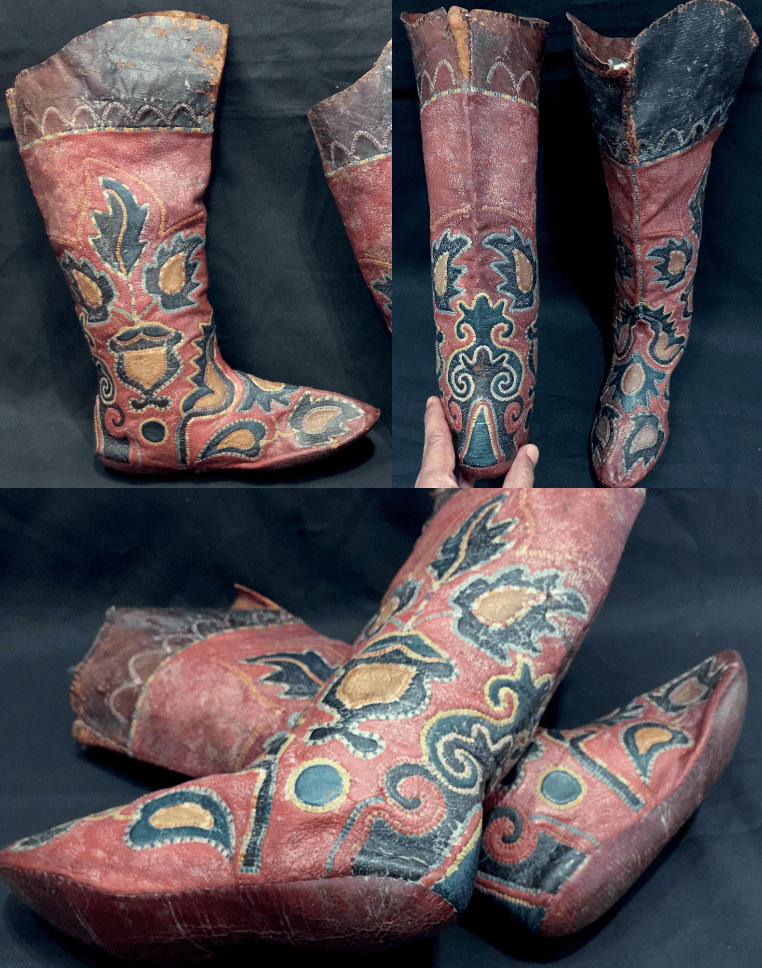
On RugRubbit
SOLD as of ~2018. Description Quote: “An exceptional antique Central Asian leather appliqué boots dating to the second half of the 19th century. This particular is relatively older than most one sees in the market and many of the published examples. When it comes to attribution, it has always been difficult to pin point thenexact tribe or group who made these. Scholars such as Johannes Kalter has attributed them to the rural Uzbek people but they have also been labelled as Kirghiz and Kazakh. The latter attribution makes sense because the motifs and technique resembles kazakh leather appliqué work that was integral part of their tradition.
So it is safe to call them Central Asian. These boots are locally called ‘Masi’ or ”Massi’. Their soft sole can suggest that these were worn indoors. But the intricate and delicate manner they were made, makes one assume they were made for special occasions. The colours and floral designs are so elegant and beautiful.. a rare and important ethnographic piece reflecting the riches of Central Asian culture. In good shape with beautiful patina offered at a reasonable price. size: Heel to tip of the toe: 25cm (10″). Widest part of the sole: 8cm (3 1/4″). Height 38cm (15″).”

On RugRubbit
SOLD as of ~2019.
Description Quote: “Kyrgyz Boots – late 19th C. almost length = 23.00 cm = 9.06″ height = 32.50 cm = 12.80″ width = 5.00 cm = 1.97″”
 Unique Leather Mosaic of the Tatars