Currently, there are two dominant associations that are tagged to the sounds of “tatar“:
- For the most west-oriented mindsets (or most Romance-, Germanic- languages speakers), TaRtar (with rhotic pronunciation of r in the middle) resonate with a 1) type of sauce (sauce tartare) 2) dish prepared with chopped and raw protein (tuna tartare) 3) ingredient for baking (cream of tartar or tartaric acid); 4) yellow-colored and harmful teeth coating (that is calcium phosphate), 5) strong fabric (tartan) used to make Scottish kilts, and 6) vast hard-to-reach area between Caspian Sea, Ural Mountains, Pacific Ocean and the northern borders of China, India and Persia ( In Western European literature and cartography up until the late 19th century the area is referred as Tartary (Tartarie)) and 7) group of nomadic, semi-nomadic Turkic Muslim (non-Slavic) people who have lived in Tartary (and are referred as Tartars).
- For the most east-oriented mindsets (or most Altaic-, Afro-Asiatic-, Sino-Tibetian- languages speakers),Tatar (without rhotic r in the middle) refers to the ethnicity of people who are indigenous to Eurasian steppes: they are ethnic minority in modern Rossiyan Federation, speak Tatar tongue (Turkic language family), have highly-developed culture and mindsets, lifestyle and customs that are rooted in Volga Bolgar / Kypchak/ Turkic/ Saka ancestry and Islamic traditions.
With such a wide span of meanings (from “sauce” to “people”) that sounds of “tatar” evoke, etymologically, there is a possibility that they all are derived from the same root. In regards to connotations (feelings that a word invokes) they all add to the emotional and perceptional load of the current understanding of the word. Here is a summary of major interpretations of origins and perceptions of Tatar/Tartar.

- There are two theories of origin of Tatar ethnonym (a name for an ethnic group) that are succinctly summarised by Azade-Ayse Rorlich. First one suggests that the word “Tatar” comes from ta-tan / da-dan, an onomatopoeic (mimicking the sounds) word of horses-stomping that had been a term of contempt applied by Chinese people to the tribes of Xiongnu (3 century BC-late 1st century AC, later in 4th-6th centuries referred as Huns) who later had been subdued by Genghis Khan and his grandson Batu Khan while establishing Golden Horde / Ulug Ulus (1241-1502). According to V. Thomasen and others, the word Tata mentioned in the Orkhon inscriptions (early 8th century) refers to these tribes. The Xiongnu (Tata) tribes, eventually, assimilated (biologically and culturally) with Turkic semi-nomadic tribes scouting the vast territories of southern Siberia, Central Asia, beyond Ural Mountains and Aral and Caspian seas. The assimilation and unification of myriads of the tribes had not gone without resistance: in 1206, Ginghis Khan declared that all conquered people to be called Tata(r)s making “Tatar” a synonym to “conquered” and later synonymous to “Mongol” (referring to Asiatic people). Second thesis (less supported by the scholars) roots from the dictionary of the Turkic languages compiled by Mahmud al-Kashgari (~1072), where it is mentioned that to the west of the Irtysh river there existed a Tatar branch of the Turkic languages. It made several scholars assume that it was the testimony of existence of Tatar people before the Mongol conquest. But as A.Rorlich states, it is most likely, that the dictionary referred to a language of a Mongol Tatar tribe who might have spoken a Turkic language due to its territorial and cultural contiguity with the heirs of Turkic Kaganat (6-7th centuries).
- There are two etymological connections of non-ethnonym Tartar (with rhotic pronunciation of r in the middle). Chunky condiment (tartar sauce: mayonnaise with chopped pickles and herbs), raw dish (beef tartare made with chopped raw protein), multi-purpose acid (cream of tartar: potassium bitartrate – a byproduct of wine-making) and crusty coating (teeth tartare: combination of mineral and organic components on the teeth) are all tied to a Greek root tartaron (with probable meaning of having “coarseness” and “rigidness”) that, most likely, had been adopted from Chinese through Persian languages that had been tied to the ethnonym Tata(n)/(Dada(n) that originally indicated the people of Xiongnu tribes and, then, all Turkic people of Eurasia. Whether Tartarus (one of the primordial gods in Homer’s and Hesiod’s myths of ~6th century BCE) had been associated with “crustiness” and “coarseness” of Greek “tartaron” or not, it is hard to say. It is worth mentioning that Greek mythological Tartarus also implied the deepest, lowest region of the underworld, where the gods would lock up their enemies (opposite to Elyseum, where happy souls would live after death). This specific association might have influenced the later negative connotations of Tartar and Tatar.
- By mid-13th century forward, knowledge and material culture from EurAsian areas conquered by Genghiiz Khan/ Mongols began appearing in West European narratives through established trade routes, travellers logs, late Crusaders’ interactions (Pian del Carpine ~1245-48, William of Rubruk ~ 1253, Marco Polo ~1298), poets (Dante’s Devine Comedy ~1301-07, Boccaccio’s Decameron ~1349-52, etc.), Pope inventories (1296, 1303, etc). The valuable textile brought from those areas became labeled as panni tartarici so-called Tartar cloth. Some current sources utilize “Tatar“(without r in the middle) as an equal alternative. Explore this Wikipidia page to realize the confusion and mixup of western sources in labelling items and people from EurAsia as “Mongol-Tartar-Tatar”. Both “Tartars” and “Tatars” can be found in written descriptions by the European travellers of people populating the vast areas of Tartarty. For example, Italian G. Botero in 1599 called inhabitants of Tartaria – “Tartari”. A German scientist and traveller J. Gotttlieb Georgi in his 4-volume work of 1776 (translated into Russian in 1799) specified several tribes of “Tataren” populating the same “Tartary” areas during the reign of the Russian Empire.
Likely, the negative connotations of original Tata (as scornful tag for conquered people) and Tartarus (as fearful place for enemies, savages) were merged and picked up by Europeans to name the vast, hard-to-reach, “scary” areas of the Eurasian steppes as Tartary and its habitants as Tartars, who were skilled to produce strong, sturdy wool fabric (tartan) that became the staple of Scottish traditional costume. But a perception of Tartars as harsh, fearful people rather than skilful, creative people left long-lasting implication on modern Tatars who currently are the largest ethnic minority in Russian (Rossiyan) Federation and who carry on DNA of Volga Bulgars as well as myriad of other semi-nomadic tribes.
Original Tata that,
- first, had been utilised to label scornfully specific tribes,
- then, used to refer to all conquered people (incl. Turks, Xionghu, Mongolians, etc.),
- later, turned into Tartar and татарва/татарщина (in Russian historic, literary& artistic sources) as labels for savages/ barbarians/ enemy to bully the indigenous population of Volga Bulgarian ancestry (it is, unfortunately, a common practice of dominant cultures to use derogatory terms for minority ethnic people that, unfortunately, feeds the ethnical and racial systemic biases that, unfortunately, becomes integral part of human-think and AI-think),
- now is stuck with the descendants of Volga Bulgaria who call themselves, proudly nowadays, the Tatars.
The Tatar scholars of 18-19th century (S.Merjani, R.Fahreddin, I.Gasparli) promoted the different names for the indigenous people of Volga-Urals such as Muslims, Bulgars, Turki (as a unified term for all turkic people of Eurasia). Eventually, the reign of Soviet doctrine made a term/ ethnonym “Tatar” the permanent label that was, eventually, accepted by the indigenous people (of the land that now is called Tatarstan, ancient Volga Bulgaria) of Turkic and Muslim “breed”. Due to such loaded and confusing history of the word Tatar (Tartar) and to over 200 years of so-called-in-textbooks of Tatar-Mongol yolk (Ulus Ulug) in the territories of modern Rossiyan Federation and other EurAsian countries, an image of modern Tatars is sprinkled with hues of negative connotations and biased perceptions.

Numerous examples of literary and visual works in many languages, including Russian, express negative attitudes towards Tatars as hostile invaders. Those are still in circulation nowadays fuelling systemic bias towards ethnic minority and confusing the perception of the modern Tatars.
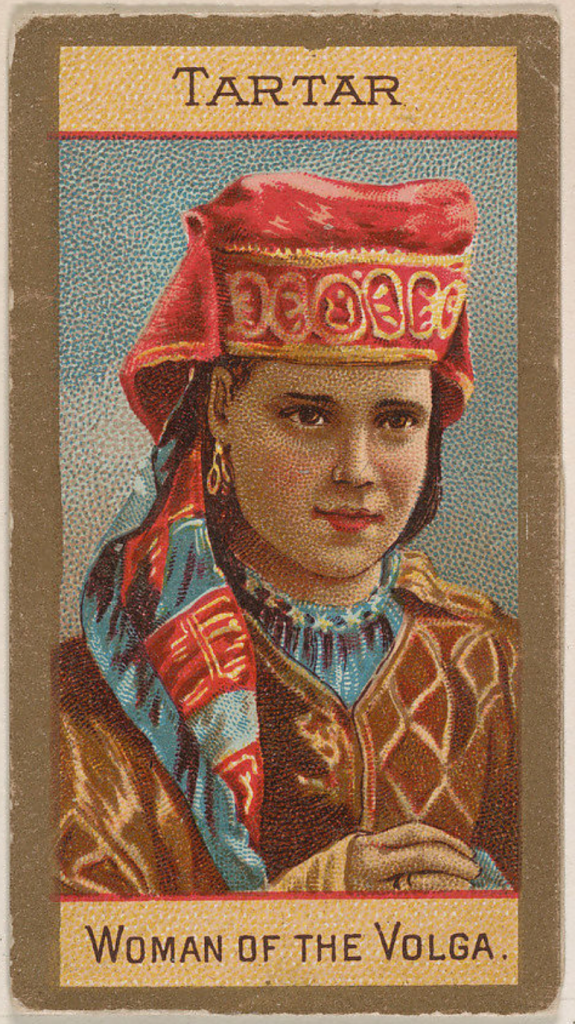
On the left, there is one of the examples of the “treatment” of the Tatar /Tartar that represents American (in this case, Kinney Bros. Tobacco Company’s) view of Turkic man at the end of 19th century.
In the Kinney Bros. company’s Type of Nationalities advertisement collection, the Tartar woman is described as a Woman of the Volga: She resembles a well-to-do Tatar woman of Volga Bulgars’ descent of 19th century.
When searching for “Tartar” in the MET museum collection ,or reading European, Russian literature, historical complexities of linguistic labelling and connotations through a modern perspective is disturbing. The web is also filled with conspiracy theories about so-called Tartar empire that adds to confusion and mar the image of modern Tatars.
Despite of the transfer of associations of “harshness” and historically-driven negative perceptions, the modern Tatars are praised for their hospitality, hard-workingness and humbleness.
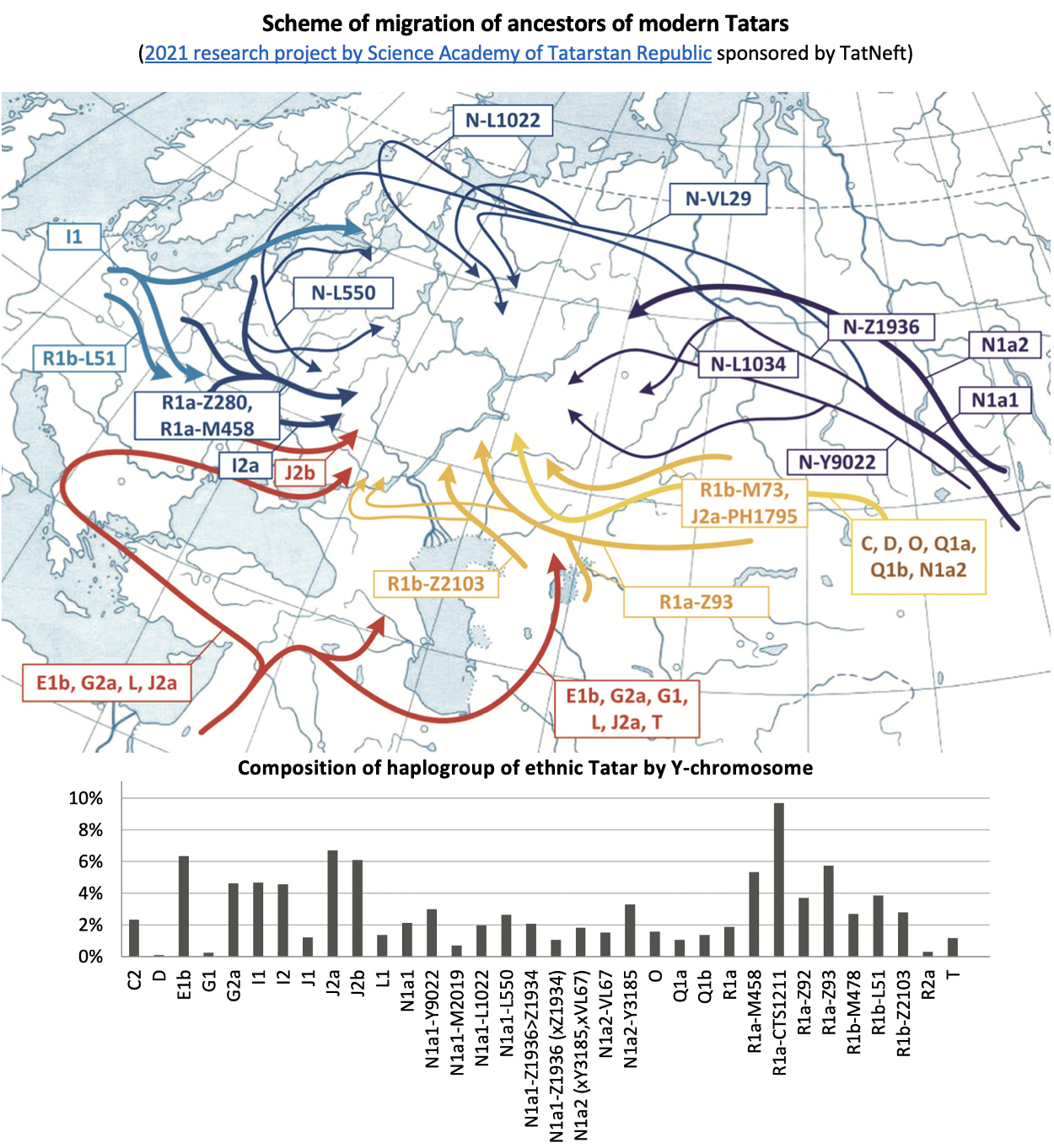
Recent research project conducted by a team of scientists of History Institute of Academy of Science of Republic of Tatarstan, where DNA of modern Tatar descendants of ancient Tatar families were analysed, gives an in-deph picture of the origins of modern Tatars. It is concluded that modern Tatars gene pool was formed in 8-13 centuries. All identified haplogroups are summed in 6 categories (based on geographical migration) that yield the following ethnogenetic picture: East European-30%, Southern-27%, East Asian-13%, Ural-Siberian-11%, Asian-9%, European-9%. TMRCA (time to most recent common ancestor) in East and West European base is between 2500 and 1300 years ago. TMRCA for East Asian and Asian base is 1000 years ago. As a matter of fact, C2 haplogroup that is highly concentrated in Mongols, Kazakhs and small ethnicities of Far East of Russian Federation is only present in 2.3% of the tested modern Tatars.
If origin of humankind is something of your interest, you may find Spencer Wells’ and his research team discovery of genetic history of P1-M45 (haplogroup) appealing to learn. After analysing DNA of Y-chromosome of representative sample of Eurasian population, they concluded that if Africa was the cradle of a humankind then Central Asia was it’s nursery. Authors of the article (2001) trace the ancestors of modern Europeans and Native Americans to the Proto-Turkic nomads of Central Asia (who roamed the Eurasian steppes and started their ancient lineage 40,000 years ago).
 Unique Leather Mosaic of the Tatars