A pair of intricately and skilfully decorated shchiteqler is good enough to feel and look exceptional! But when researching about uniquely decorated Tatar boots, the more the happier! 2025 has been a year of experiencing a great variety of shchiteqler: ~215 years old… ~3 months young…

Ledermuseum in Offenbach, Germany, owns allegedly the oldest pair in their archives; History and Ethnography Museum in Arsk, Tatarstan, Rossiyan Federation has the largest number of shchiteqler on display. These museums, that are located in two small European towns thousand miles away from each other, possess the treasure that unites them: tangible evidence of impressive leather craftsmanship of the Tatars. Both small towns of Arsk and Offenbach also share “gone” big fame of an epicenter of exceptional leather manufacturing: in late 18th-early 20th centuries both places were bustling with production and trade of quality processed skins and leather goods.
Deutsches Ledermuseum has an impressive collection of ~30 thousand leather artifacts, 12 of which are crafted with Kaiyly Kün. This “extremely distinctive” technology identified as “Ledermosaik” in 1967 museum’s catalogue, as “Saffianleder mit Mosaiken, Mosaikarbeit” in 1980 catalogue, and“Lederinlegearbeit (leather inlay)” on the tags that are placed by actual items. On a windy fall day, a museum curator Leonie Wiegand revealed 7 pairs of tall boots, 1 pair of short boots, 2 pairs of boot shafts, 1 pair of shoes and 1 pouch that were acquired in 1939 from a collector Slg.Schmid of Vienna and have been preserved in excellent condition in the museum archives. One pair of the boot shafts are dated 1812 and noted as to be brought from Rossiyan Empire. Those are the oldest known (with exact date) shchiteqler but they look like have just been crafted! Each item in Deutsches Ledermusuem collection is an excellent representation of versatile assortment of products crafted with kaiyly kun technology in late 18-early 20th centuries. The design in each item does not repeat and speaks to incredible creativity of the Tatar individual and collective leather craftsmanship.

Out of 12 items, the only image that is permissible to be presented is the boot on the left that was photographed for the Deutsches Ledermuseum’s catalogue #6 published in 1980. (The copyright is: © Deutsches Ledermuseum, C. Perl-Appl. The caption reads: Boot, Kazan, Tatarstan, early 19th century). Crafted with Kaiyly Kün technology items are in the Deutsches Ledermusuem’s archives: They are neither displayed on the museum floors nor on the website. Hopefully one day, shchiteqler will be showcased digitally and/or physically for visitors to appreciate the craftsmanship of the Tatars.
A collection of Arsk Historical and Ethnographic Museum brings unique Tatar leather craftsmanship to the perspectives that allow assessment of the Art of Kaiyly Kün through the centuries and into the current times. A large number (over 100 by a shy estimate) of Kaiyly Kün items are exhibited throughout two museum floors and are harmoniously weaved in permanent collection displaying rich history and ethnography of the town. The museum curators Gelyusya Khazieva, Alsu Murtazina, Irina Sinichkina, Regina Akhmatgalimova and others have put a lot of efforts in displaying leather items with distinctive Tatar decorations throughout the museum, allowing the visitors to engage and learn. The museum boasts of massive Kaiyly Kün collection because the Town of Arsk (Arshcha in Tatar language, ~30 miles north-east of Kazan) has been a cradle of Kaiyly Kün, the manual technology that has no analogy and has been mastered in this area for centuries. Arsk has been a backbone of Muslim thought and leather craftsmanship: Promotion of Islamic education and laborious manual artistry have been two prominent features of the Volga Bulgars-turned (Volga/ Idel-Ural)-Tatars for millennia.
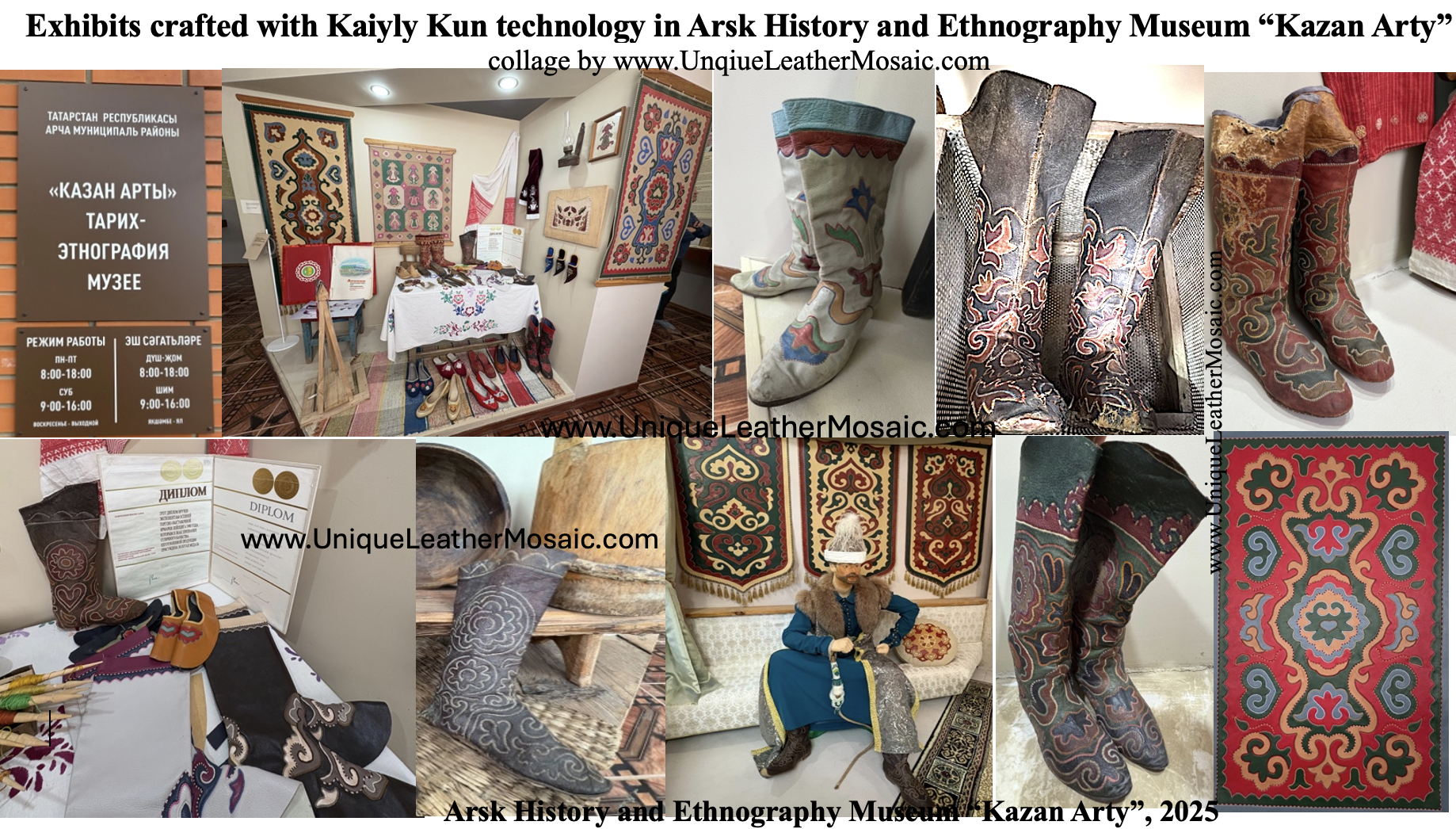
Leather processing and production of shchiteqler became profitable business in 19th-early 20th centuries because of increasing demand among European, American and internal aristocracy of intricate manually crafted work- the elaborately decorated handiwork practiced over millennia by people of various ethnic backgrounds of Eastern Europe, Western, Central Asia (referred as Tartars, Tatars, Muslims, Noghays, Turks, people of Turkistan, Asians, etc.). Up until late 1920ies, large quantities of traditional and customized shchiteqler had been manufactured by individuals and private enterprises in Arshcha (Arsk) and Kazan as well as workshopped far outside of these areas. After ~40 years of hiatus, production of shchiteqler (with simplified designs) continued in less quantities by Soviet state-owned Arsk Footwear factory from 1964 to 2006, the operation of which slowly dwindled in early 2000 due to inability survive novice market economy.
As of now, only a very small number of individual artisans continue producing shchiteqler and building on the legacy of ceased-to-exist Arsk factory. Company “Сахтиян / Sahtiyan” (from Persian ساختيا derived from ساخته “saht” meaning “fit/processed/made), is the only leather goods enterprise that carries reasonable inventory (in their one small shop in Kazan) of elaborately and uniquely designed shchiteqler but with the hides sourced from outside of Arshcha-Kazan. There is one functioning factory that processes leather these days in Kazan-Arshcha area: only cowhides and on a small scale. It is branded as “Сафьян (Safyan/ Saffianleder)”, another way of spelling of sahtiyan: this term carries the legacy of high quality soft colored fragrant leather (originally referred as Bulgari, later as Cordovan, Morocco, Russia) processed with exceptional original technology mastered by the Volga Bulgars, the ancestors of modern Tatars.
Although manually-crafted-with-Kaiyly-Kün shchiteqler are slowly re-gaining popularity, the amount of produced Tatar boots is not even 1% of allegedly estimated annual production of 3 million pairs during primetime. Our dream is that shchiteqler are back on the world stage, in demand so greatly that their supply exceeds the 19th century levels, and that young people are eager to learn, master and benefit from impressive and unique leather craftsmanship of the Tatars.

Curious abut other leather art explorations and connections? Checkout our other postings/ publishings here or just keep scrolling down this page.
 Unique Leather Mosaic of the Tatars