A contemporary writer Nadeem Aslam’s phrase “pull a thread here and you’ll find it’s attached to the rest of the world” has inspired us to explore and pay tribute to myriads of impactful global contributions spanning millennia to shape the staple of human clothing – ornamented footwear. We are pulling the thread that uniquely and distinctly binds all decorative elements of soft leather shchiteqler to discover a continuum of captivating artefacts of material culture in the forms of vessels, stone carvings, organic fragments, paintings, photos, texts, cinematography…
Tall protective footwear enters EurAsian nomadic people’s life during the times of domestication of a horse around 3500 BCE (before common era). The first depictions of people wearing foot coverings appear between 9th and 7th centuries BCE during the time of Assyrian rule (nowadays the territories of Iran, Iraq, Syria and Turkiye). A leather boot from Pazyryk burials (Altai mountains, nowadays in Kazakhstan, Mongolia) of 4th-3d centuries BCE is the earliest example of impressive leather craftsmanship and spiritual significance embedded in ornamentation.

Roughly one millennium forward, in ~7th century CE (common era), the Volga Bulgars carry on the spirit and skills of nomadic predecessors to, eventually, become well-known for their processing of soft colored fragrant leather (reffered as bulgari, saffian, later as morrocco, russian). In 14-16th century, the descendants of Volga Bulgars (nowadays referred as Kazan /Idel-Ural /Volga Tatars of Rossiyan Federation) master Qaiely Kün’ ( referred in English as Tatar Leather Mosaic) technology to create exceptionally-decorated saffian boots –shchiteqler- a desired-by-many footwear.

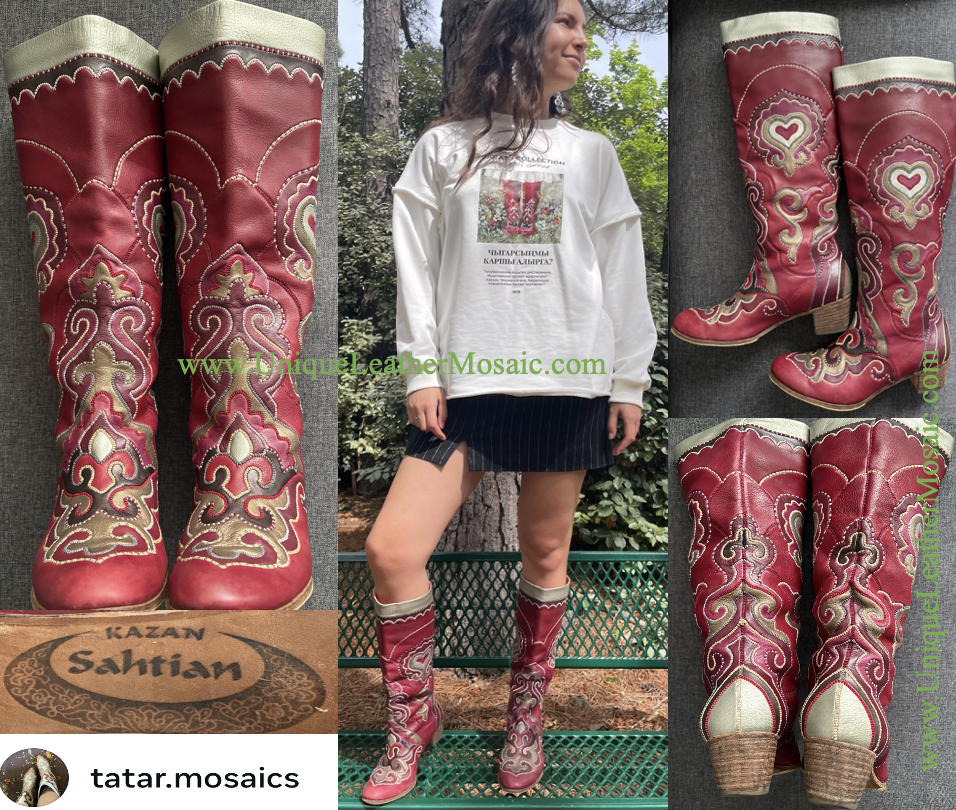
Some 500 years later, in 2025, a boundaries-and-times-transcending look of a modern Tatar girl by @tatar.mosaics incorporates saffian shchiteqler by Sahtian with a SABR sweater featuring a painted version of the boots by Guzel Khaib, and Aigel Salakh leather bag, designed with the same Qaiely Kün technology as shchiteqler, both utilizing a so-called “Kazan” zhoye (stitch) that is featured in a recent eponymous documentary by Mira Rahmat and Bai Khairullin. The look is a synergy of millennium-long human ingenuity, innovation and craftsmanship. It could not be possible without impactful contributions of many creative agents that feed from wisdom of previous generations and impact the future connections.
There wouldn’t be a popular SABR Yaratu Collection sweater without all previous collaborations of human creativity. This sweater impressively empowers the modern wearers through signaling belonging or/and awe: it features two uniquely-Tatar cultural staples – shchiteqler and “mongly zhyr”(soulful poem/song) and offers a new, accessible way of “owning” a Tatar cultural icon. There wouldn’t be a talented Guzel Khaib’s famous painting without social virtual networks and the beloved Tatar song about a heart’s yearning for shared love “Shchygarsynmy Karshy Alyrga?Would you come to greet me?” (lyrics by Damir Garifullin, music by Valeriy Ahmetshin) originally performed in 1963 by legendary Tatar singer Ilham Shakirov. And so on…
We are grateful to all forces and links in the history that inspire creative spirit of modern artists. Reminded by Diana Darke’s “everything is a continuum – nothing just appears out of vacuum”, we promote a respectful and appreciative mindset: different, versatile, distinct people and cultures contribute and inspire the evolution of material heritage that is interconnected, and, thus, the most valuable!


 Unique Leather Mosaic of the Tatars