
Bukhara (pronounced “Bohoro” by locals who speak Tajik, Uzbek and Russian) once was a powerful city-state on the Silk Road. These days,
Bukhara is Uzbekistan’s charming gem with impressive heritage. It excites with plentiful of:
– Islamic historic buildings dating back to 12th century with the original and restored elaborate vegetative and geometric decorations; – medrasas that educated many academicians in Middle Ages; – wooden doors with intricate carvings; – hand-span silk and cotton fabrics with unique designs called abr (from Pesian ابر “cloud“) or ikat (from Malay mengikat “to tie”) ; – impressively detailed hand-woven silk carpets; – hand embroidered suzani (from Farsi سوزن “suzan” meaning “needle”) that became a synonym of Uzbek artistry.
What is hard to find in Bukhara are ethnic shoes.There is barely any visibility of traditional footwear of ethnic people populating modern Uzbekistan (the land of indigenous people -Uzbeks, Uyghurs, Tajiks, Turkmen, Kazakhs, Kyrgyz) on the streets, in the museums, in the stores. Locals, these days, give preference to mass produced rubber shoes. In bazars, a small number of vendors sell masi/maxsi (from Arabic مَسْ “masH” meaning “to wipe”), sometimes called shchiteq (from Tatar “чителгән итек“). Those are soft leather socks (made of halal sheep skin; in Arabic countries, those are called “khuff or kuffain”) that are worn with outer shoes. They are indented to be kept on when entering the mosque for prayer: during ablution it is considered sufficient to wipe those over. Antique shops and ethnographic museums showcase a tiny number of traditional footwear: embroidered fabric boots, full length black leather masi/ shchiteq, hard leather bashmak.

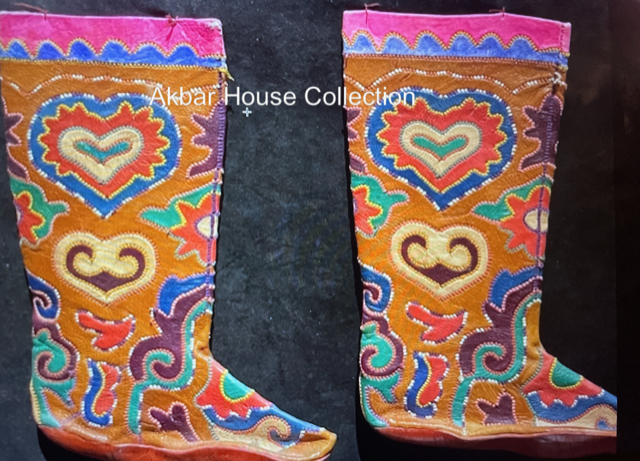
It was a treat to discover a pair of 19th century Tatar boots with ornamental patterns of various colors including vibrant pink (that is super rare) in Akbar House private collection! An antiques collector Akbar Aka mentioned that the boots are one-of-a-kind, not for sale, and that the “appliquéd” leather technique were developed by Volga Bulgars back in middles ages and that the boots like that are not being produced anymore.
We excited Akbar Aka with the fact that the craft is very well alive, that the boots, like his, are referred as Tatar or Kazan boots (shchitekler in Tatar, ichigi in Russian) and have been continuously crafted (although in much smaller quantities and with modernised looks) in Kazan, Tatarstan (the indigenous land of the Volga Bulgars). The ornamental technique of Tatar boots are often mistaken with a well-recognized techniques of appliqué (application of one piece/pattern on top of another) or embroidery. The unique Tatar boot technology (the ones that Akbar Aka owns, or the ones that are housed in Samarkand National Museum, or the ones that are mis-labeled/mis-identified in world museums, auction sites, mass online publications, etc.) aligns the colored leather patterns with twisted silk threads in intricate play of ornamental cutouts (like jigsaw puzzles). It is referred as Tatar Leather Mosaic or “Kayuly Kün”.
Akbar House Collection features this ethnic outfit on its website. It is a masterful compilation of items, details, patterns, materials, attributes that many Turkic and Iranic people consider their own. The featured soft leather boots with elaborate ornamental patterns tell the story of ancient nomads of Eurasian steppes&mountains and of then-Volga-Bulgars-now-Volga-Tatars who embraced a leather medium to showcase exceptional craftiness, mastery, creativity and spirituality.

 Unique Leather Mosaic of the Tatars