
Decorated boot found in Pazyryk
Leather-working had been important part of nomadic peoples’ lives. The artefacts of ornamented leatherwork found in Pazyryk (Altai Mountains) date back to 4th century BCE (before common era) and exemplify the lifestyle and skilfulness of the people of the steppe (Saka/Scythians, Huns, Turks) who had roamed the vast territories of EurAsia (modern Russia, Mongolia, countries of Central Asia).The semi-nomadic Tatars (amalgam of hunnic, turkic people) had settled by the banks of Volga and Kama rivers by the 7th century CE (common era). Along with indigenous habitants of those areas (finno-ugric, turkic, etc.) they had established a sovereign state of Volga Bulgaria.
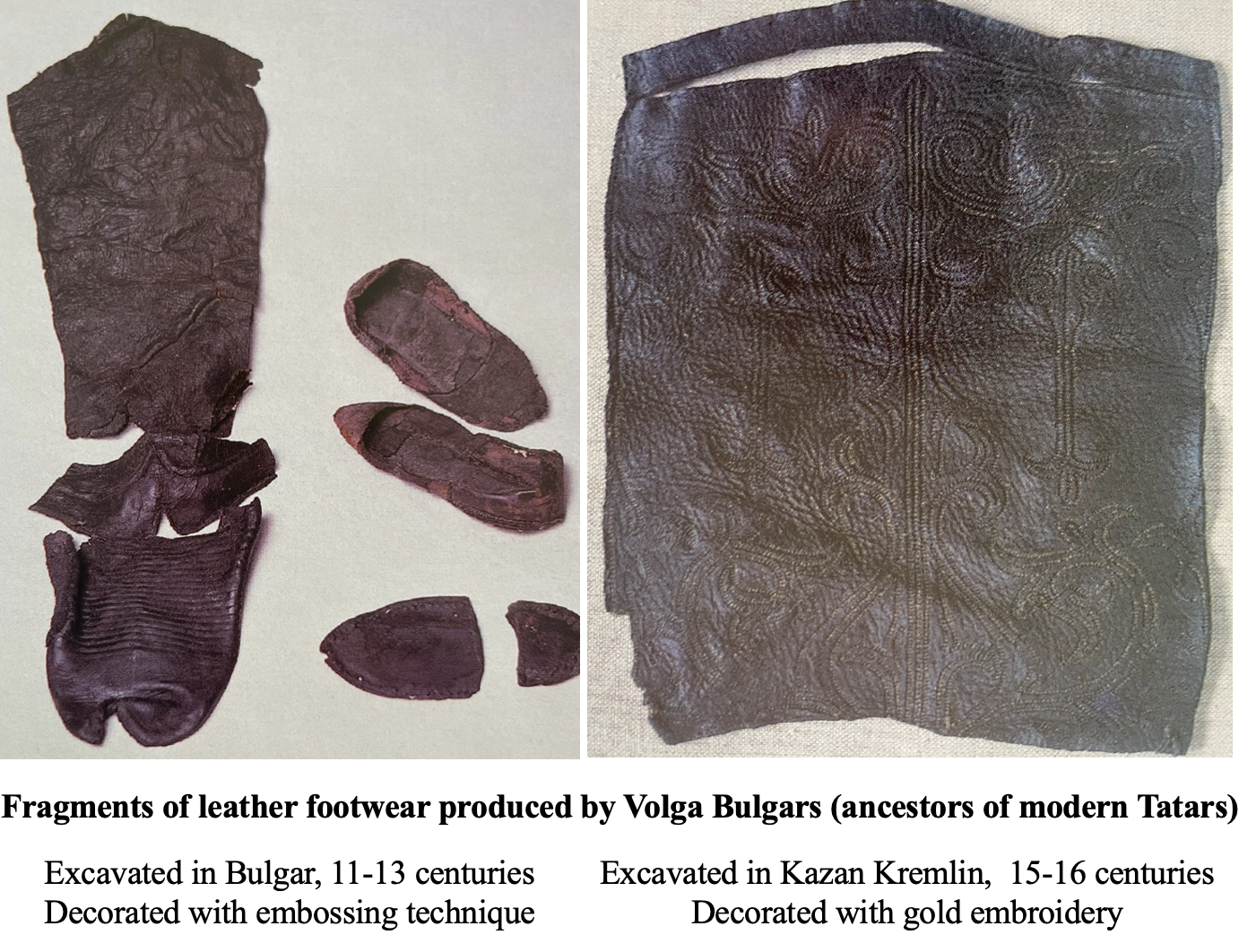 The Volga Bulgars (ancestors of the modern Tatars) inherited skilfulness and creativity from the nomads as well as love of symmetry and natural beauty from the Islamic worldview (Volga Bulgars adopted Islam in 922). They got extremely proficient in all levels of leather goods production and traded successfully an exceptionally-processed aromatic leather “bulgari” and beautifully-decorated soft leather footwear throughout Asia and Europe for many centuries.
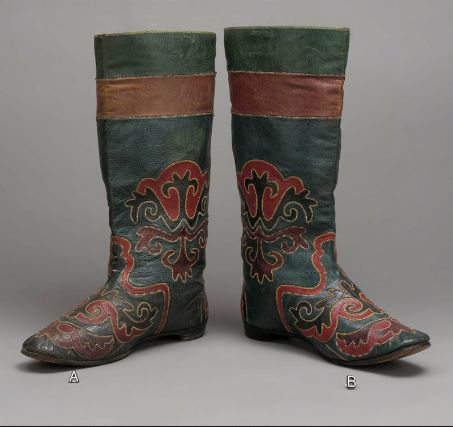
Boston Museum of Fine Arts
Historical documents state the popularity of the leather footwear and the large scale of the leather manufacturing in Kazan Khanate (1438-1552)– a state that had inherited the territory, culture, traditions, crafts of Volga Bulgaria. After Mongol invasion (1236-1438), the Volga Bulgars and other Turkic people of the steppe became referred as Tartars by the Westerners. After the brutal seize of Kazan in 1552 by Muscovite Tzar Ivan the Terrible, Russian Orthodox aristocracy started promoting the ethnonym “Tatar” to refer to the Muslim descendants of the Volga Bulgars (read linguistic exploration and historic connotations of the word “Tatar” here).
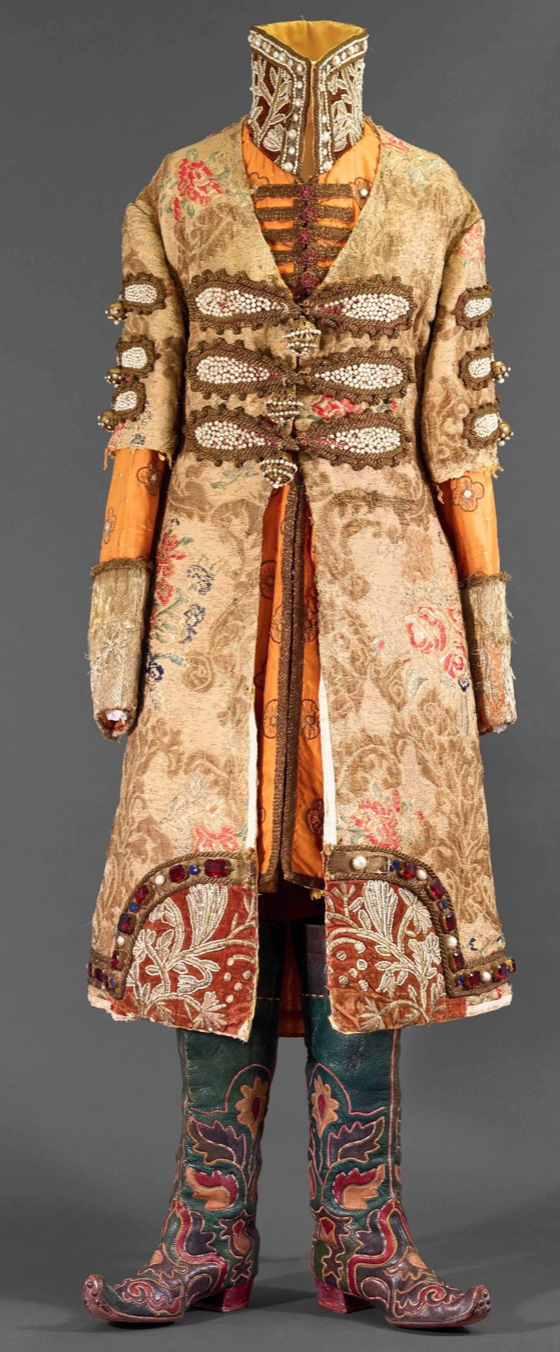

Yusupov in Tatar-inspired costume
Although the leather processing and footwear production had been within “professional artistic tradition” during the rule of the Bulgar, Kazan khans and got shaped by aesthetics of Islam (“Allah is beautiful and He loves beauty”), so-called “folk artistic traditions” based on collective artistic experiences of individual crafters became the way the Volga Bulgars-turned-Tatars practiced and mastered the leather craft.
By the end of 17th century, production of quality leather and ornamented footwear turned into profitable business. The industrious Tatar craftsmen opened up many successful production and shops within and outside of Kazan area: in the towns of Tsardom of Russia (Moscow, Torzhok, Novgorod, Orenburg, Tobolsk), of Central Asia, of Middle East, of the Caucasus.
By the 19th century, the Tatar leather footwear production expanded and blossomed thanks to the successful operation of the large leather processing plants located in Kazan and neighbouring cities. Beautifully decorated shchiteqler (Tatar word for “soft decorated leather sock-boots”, check pronunciation & word etymology here) were worn by the Tatar Muslim and Russian Orthodox aristocracy in Kazan, Moscow, NizgniNovgorod. The Tatar boots/ shchiteqler became popular in many regions of Russian Empire (becoming a part of well-recognized Russian costume) and neighbouring Ottoman Empire (modern states of Uzbekistan, Kazakhstan, Tadjikistan, Turkmenistan, Azerbaijan, Crimea) as well as Europe and America.
 Meticulously crafted exceptional shchiteqler (also Kazan boots, Tatar boots, ichigi / ichitygi – Russified version of Tatar word shchiteqler) of highest quality exemplified popular in early 20th century “Russian Asia” art, which became associated with richness of unique combination of “Asian” (Islamic) vegetative ornamentations and bright colored leatherwork created by the Tatars. The uniquely and skilfully decorated Tatar boots with unique Kaiyly Kün’ technology became undeniable part of many fashionable and powerful people’s wardrobes after being displayed at grand World Fairs in London in 1851, Philadelphia in 1876, Chicago in 1893, Paris in 1925.
With the establishment of the Union of Soviet Socialist Republics (USSR 1922-1991) and due to the industrialization, Tatar footwear manufacturing declined rapidly especially after Stalin’s rule (1927-1953). After initially-planned market-oriented NEP (new economic policy) faded after Stalin gained power, the process of assimilation of cultures, folk arts and traditions of all ethnic indigenous minorities in its territory (that were inherited from then Russian Empire, neighbouring Ottoman Empire, East Turkistan and Chinese Turkistan) were sectioned. Induced sigma of irrelevance had left non-Russian, minority folk arts unsupported by federal authorities, undesired and looked-down by the Russian-majority population. The Tatars were doomed to carry on a systemically biased image rooted in historical prejudice and tropes (read more here or view some examples here).
The cultural boom of 1960s brought increased interest to folk traditions and cultures of 150+ ethnicities populating the vast territory of the USSR. The Tatar leatherwork got its momentum back: Arsk National Footwear state-owned company was established in the outskirts of Kazan-city to produce ethnic footwear for local population and dance companies. European fashion, Yves Saint Laurent, in particular, got inspiration from the unique Tatar boot decorations in his 1976 collection. In 1989, after the collapse of the Soviet Union, the art of Kaiyly kün’ (aka. Tatar Leather Mosaic) is being kept alive by the efforts of several individual craftspeople, designers located majorly in Kazan.
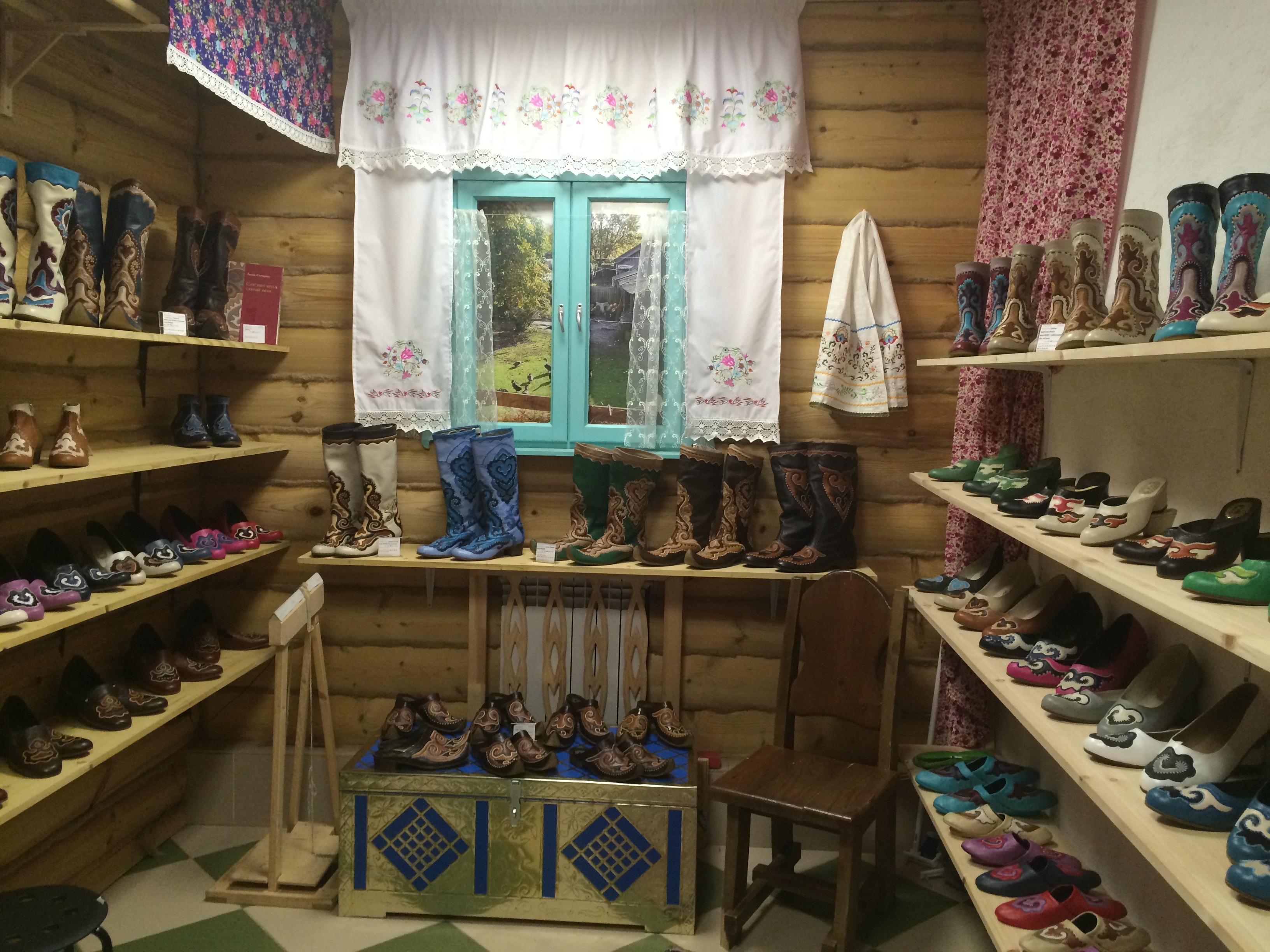
The only Tatar classic footwear store in Kazan, Tatarstan, ~2016
There are several small businesses and masters who have been reviving, popularizing and innovating Kaiyly Kün’ traditions. Aigel Salakh, Ay.Bulgari, Altari, Ilgiz Galimzhyanov, Ildar Shaikhutdinov, KulEse, GanishaStore, Al Bai Artel, Alsu Musavirova, Rustam Adyukov, Rustem Emeleev (VM-Collection), Turan Art, Marianych use traditional ornamental patterns as well as experiment combining the old techniques with modern innovations. Among the artists and professionals creating leather mosaics with Kaiyly Kun technology are Nailya Kumysnikova, Sofia Kuzminykh, Svetlana Garbuzova, Alfia Zamilova, Tatiana Shilintseva, late Flyura Kalmurzina.

Sahtian’s team, 2018
“Sahtian” is the only company on the market that keeps inventory in the store. Sahtian continues the legacy of Arsk Footwear production that seized to exist in early 2000th. “Sahtian” manufactures unique Tatar footwear of highest artistic quality.
There are other few unnamed amateur craftsmen creating mostly bags with kaiyly kun technology in Kazan metro area: they sell their items via Instagram and at the cultural events and fairs.
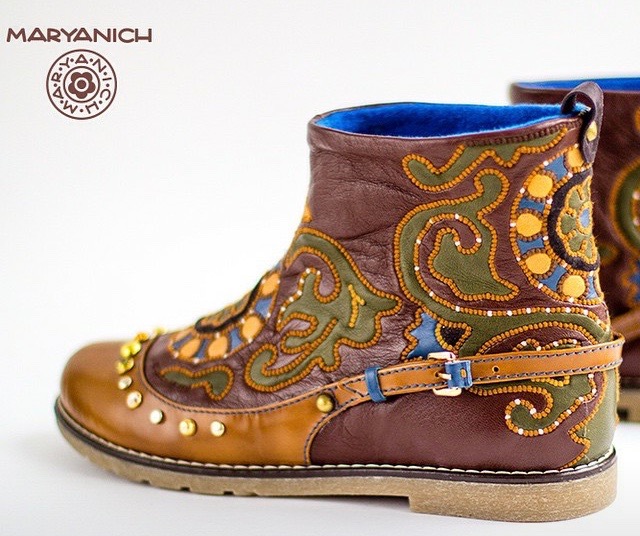
new twist on traditional Tatar boot created by Maryanich, ~2010
 Unique Leather Mosaic of the Tatars
Pingback: Unique Leather Mosaic
Pingback: Dirt or Snow, Tatar Boots are to glow! | Unique Leather Mosaic
Pingback: Unique Leather Mosaic