“What is primary: a line or a circle?” I asked. “The dot” she answered with no hesitation.
Fadhila Al Dhahouri of Global Center of Islamic Art, an impressive young visionary, made it very clear that the dot can undeniably evolve into both the line and the circle, and allow the infinite transformation into the beautiful, the harmonious, the inspiring. Fadhila and exceptionally talented Sandy Kurt empower the world for a “search for knowledge” through engagement of artistic potential within aesthetics of Islamic discourse. In which activation of creativity enables humanity and is connected with the higher power, Allah.
Specifically, the art of practical geometry is connecting individual’s humanity and internal energy through interplay of dots, lines, circles – visible or hidden. This unity is built on paramount importance of symmetry, balance, harmony, precision, order and the internal individual desire to seek for those. For centuries, guided by structure, spiritual energy and eternal potential of geometry, myriads of ornamental solutions have been mastered. They all offer deep engagement to the ones who create them and the ones who seek the learning.
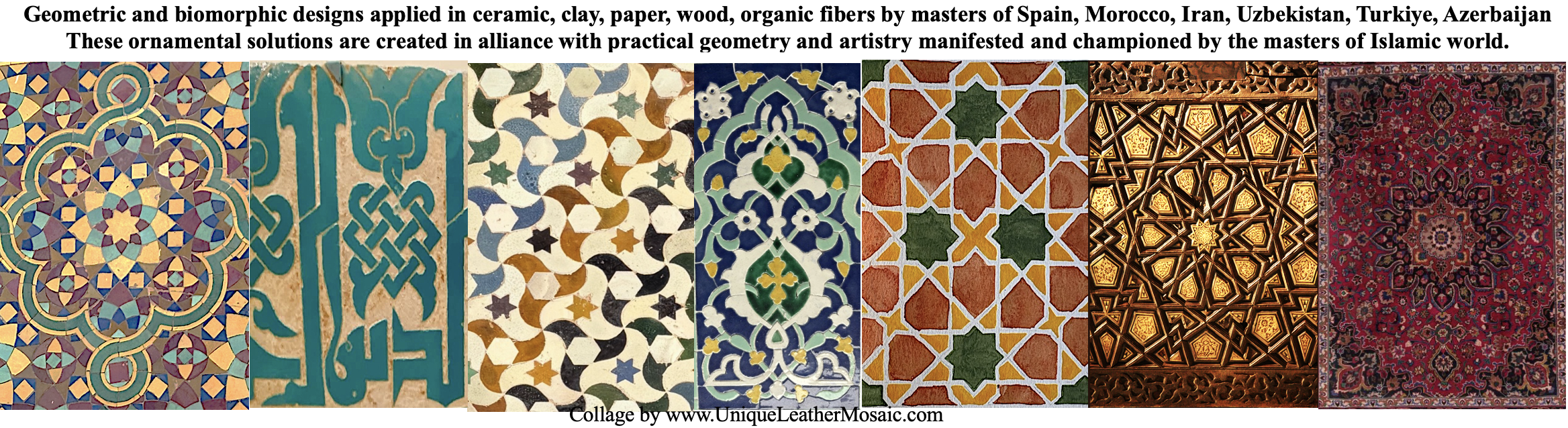
With knowledge that “geometry enlightens the intellect and sets one’s mind right” (Ibn Khaldun’s (1332-1406), we have been exploring the role of Islamic aesthetics and practical geometry in the ancient leather art of the (Volga) Tatars, the descendants of the Turkic nomads of EurAsia (Turkic Khaganates of 6-8th centuries) and the settled Volga Bulgars, whose indigenous lands are referred these days as Tatarstan Republic. Volga Bulgaria were the first northernmost civilization that in 922 officially accepted Islam under the mission of Ibn Fadlan, the envoy of Abbasid caliph al-Muqtadir. In 10-13th centuries, Volga Bulgaria had manifested itself as a powerful center for Islamic education, science, art and lifestyle.
The Volga Bulgars’ Islamic knowledge, esthetics and material culture had been transmitted through immense trading channels of those times, so-called Volga Trade route and Silk Road. People of Volga Bulgaria have continued being a backbone of Muslim networks despite of complex and endless military, political, religious, authoritarian, colonizing processes. The descendants of the Volga Bulgars are now called the Tatars. Representing the largest and the most spread-out ethnic minority in ~17 mln. sq. km. territory of Rossiyan Federation, the modern Tatars have been slowly recovering their collective memory loss of their own impressive Islamic history. The leather art of the modern (Volga) Tatars serves as a vessel that has protected the core from turbulent realities, the vessel that carries a powerful blend of Tengri’s connection with nature and Allah’s empowerment of humanity.

- Want to learn more about unique leather art of the Tatars, Kaiyly Kün, explore this website, and particularly the page “How is it unique?”
- Curious about all the names the modern Tatars were called over centuries? Check out this page or this document.
- Want to experience Islamic aesthetics through the practical applications, participate in Islamic Art Week (November 15-21, 2025) organised by Global Center of Islamic Art.
- If you happen to be in Raleigh, North Carolina, USA, during November 8, participate in local Islamic Festival organised by Muslim Artists of NC.
- Start learning the basics of Islamic Geometry, Biomorphic Patterns and Calligraphy using the guides authored by Global Center of Islamic Art.
- Curious about the efforts in reclaiming lost heritage of Islamic Art, read Fadhila Al Dhahouri’s article in Amaliah.
- Want to explore Islamic Art “not through modern distinction between religion and culture, but as a self-referential interplay of interwoven discourses, rituals, beliefs moving across space and time”? Then reading Wendy M.K. Shaw’s “What is “Islamic” Art?: Between Religion and Perception” is a must! If the book is not accessible, please find here the Dr. Shaw’s key points of interpreting and accepting “Islamic” in term “Islamic Art” as a bigger platform than just a religious basis.

- Two more worth sharing quotes:
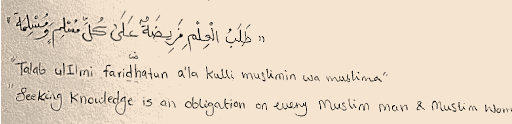
from Quran (hand-written and translated by Fadhila) on obligation of seeking the knowledge by both Muslim man and woman. This motto is worth following by any, fidel or infidel. The modern reality is increasingly and intentionally complex, and the survival in it is possible only with developed critical thinking.
from ibn al-Haytham’s (965-1040) “The Optics” (snapshotted from Windy Shaw’s book) on never-ending complexities of the world. Ibn Al-Haytham’s statement compliments the Quranic wisdom and emphasizes the constant search for the truth using the senses.

 Unique Leather Mosaic of the Tatars