Applauding the Ball and the Stitch

Whether you are happy or sad with the 2026 FIFA World Cup winner, let’s give a round of applause to a true hero of the game – the BALL! Do you know that, on average, the ball was kicked 1000 to 1500 times per match? Have you noticed that 2026 FIFA Adidas Trionda football has featured only 4 polyurethane panels instead of traditional 32 leather ones?
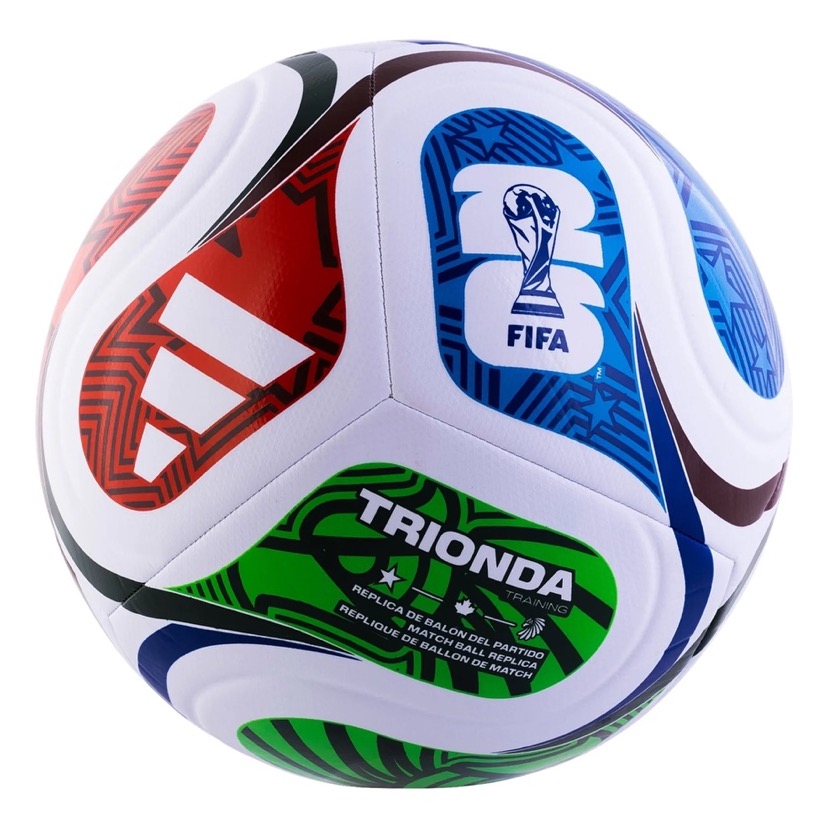
Despite of recent innovative technological manipulations (materials, shape, imbedded sensors) to the staple of the game of football to improve the experience and precision, the three goals of the ball remain the same: A ball makes the game happen, unites people and engages strong emotions! The synthetic fibers, machine stitching, thermal bonding of the modern football are only in place since late 1980ies. Before that, for millennia, humanity used animal leather panels that were stitched manually from the inside, to create round instrument for physical engagement and community-building. Among few types of manual leather panels stitching techniques, the one featured on the football of 1908 in Real Madrid Museum ( Go Spain! ) is performed the same way a so-called “Kazan” stitch on shchiteqler, the Tatar traditional footwear. This type of manual stitch also has three goals: It simultaneously holds, flexes and embellishes.  For centuries, if not millennia, this distinct stitch has been used to support the flexibility of leather shapes and to provide aesthetic appeal to the leather edges.
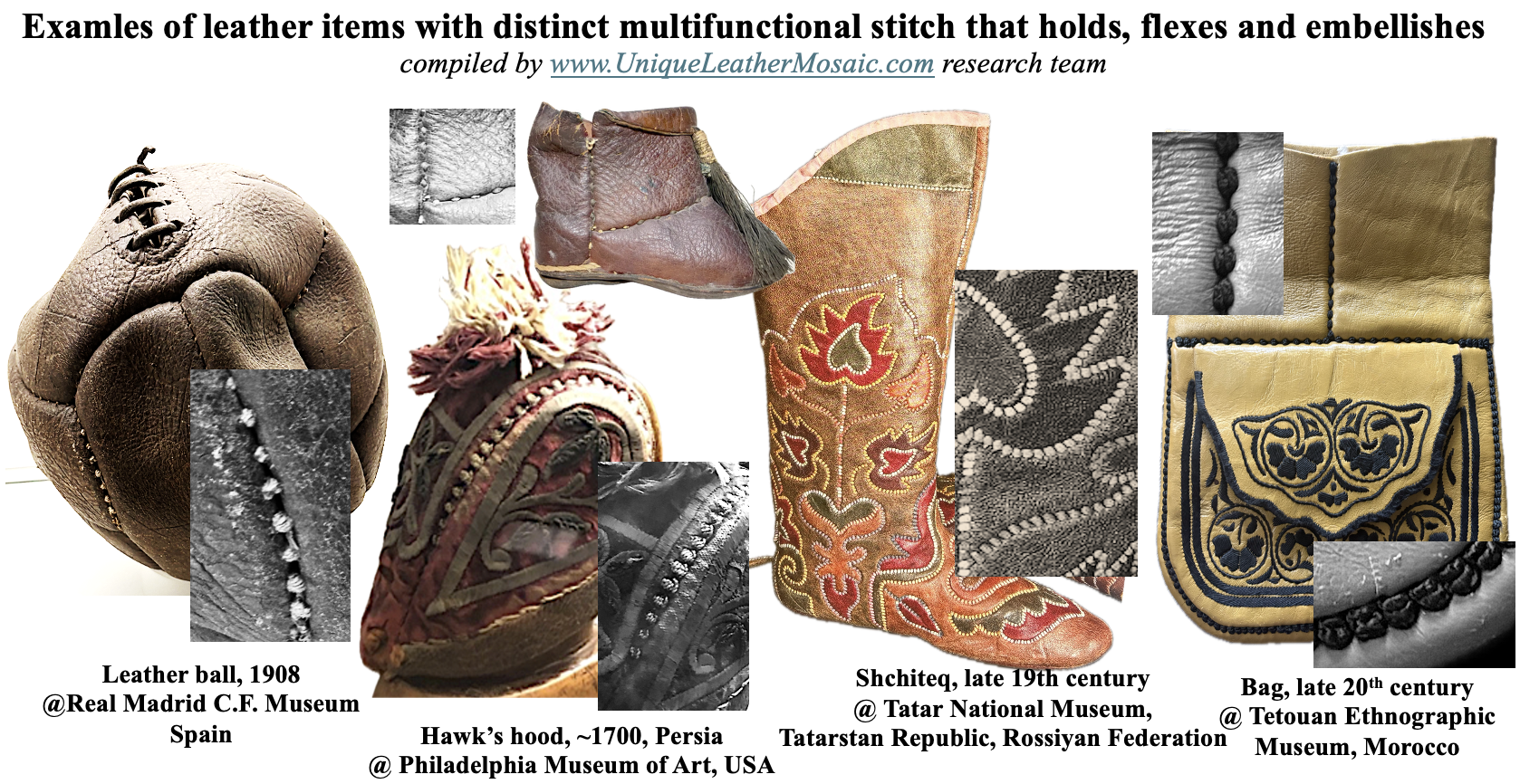
According to our years-long research of worldwide museum collections, auction sites and marketplaces, this distinct stitch has been mastered by Muslim leather crafters: they performed and spread it westward, eastward, northward, southward via various trading routs: all the way from medieval Spain (west) to China (east), Volga (Itil) Bulgaria (north) to Sudan (south).

This type of inner stitching (that looks like embroidery, beadwork, cord-like to a layperson’s eye) was historically employed for leather-made footwear, headwear (e.g. falcon hoods), meal-ware (e.g. drinking vessels), animal gear (e.g., saddles), furnishing (e.g., “ottomans”), carriers (e.g., bags) and curvy objects (e.g., balls). Though an original term for this stitch may have differed in various locations, we believe it was widely referred as “sarma”, a word that stems from an ancient Turkic root “sar/sır” meaning “to wrap”.
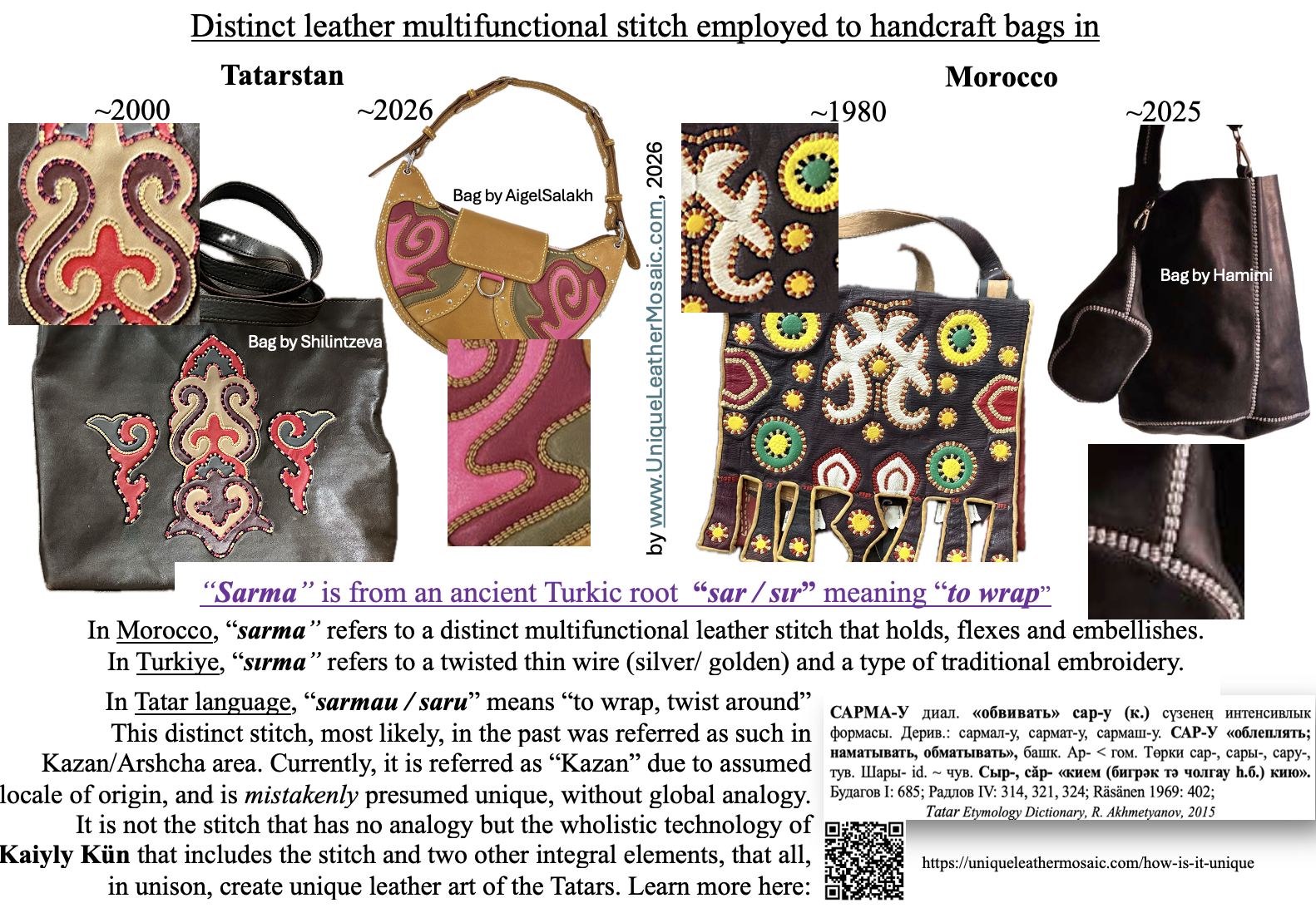
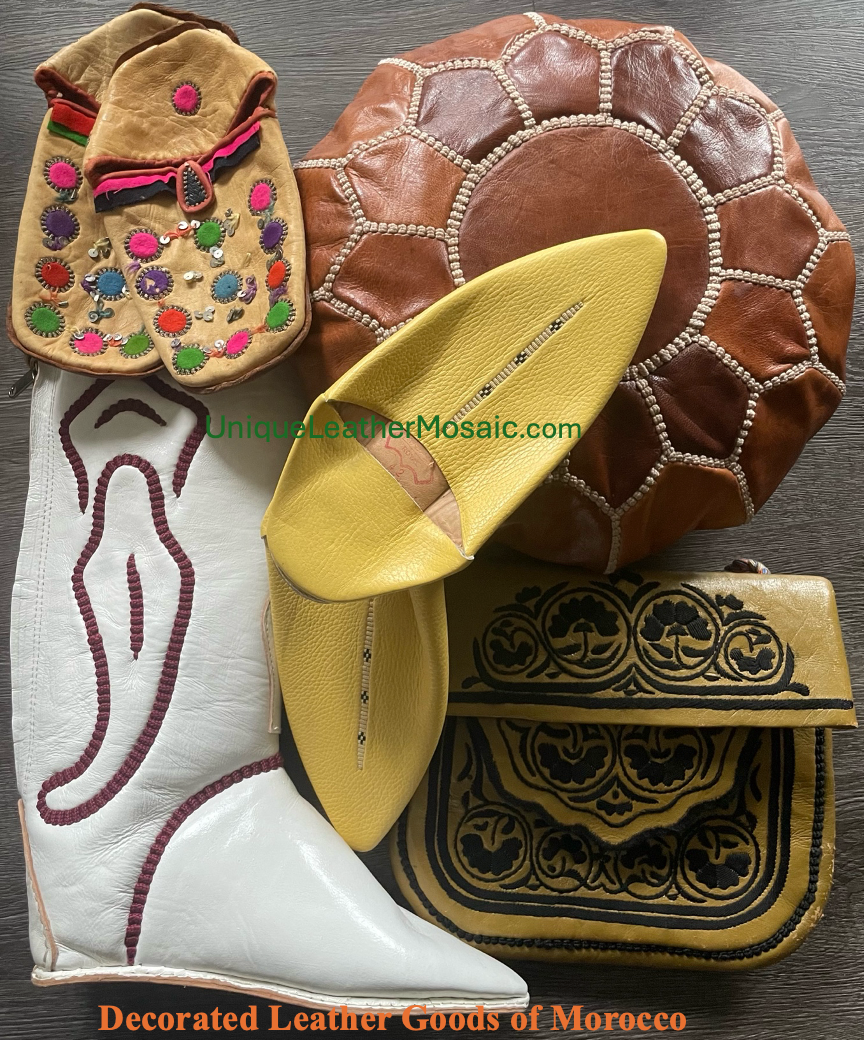
Nowadays, it is referred this way (sarma) in Morocco, the one of the only two locales where the distinct ancient stitch is still being successfully executed, by hands. The second location is Tatarstan Republic of Rossiyan Federation, specifically Kazan-Arshcha area. The original Tatar term for the stitch is lost/unknown and is currently being referred as “Kazan Zhouy” which, most likely, was originally referred as “сар(ма)у/ sar(ma)u”, a Tatar word from the same Turkic root that etymologically corresponds to the essence of the stitch. The essence of this impressively durable, flexible and decorative inner stitch is in several loops of decorative thread wrapped around a carrying waxed thread that adheres one leather piece to another. The technology of performing sarma stitching in Morocco slightly differs from how it is executed in Tatarstan. Check out these variations:
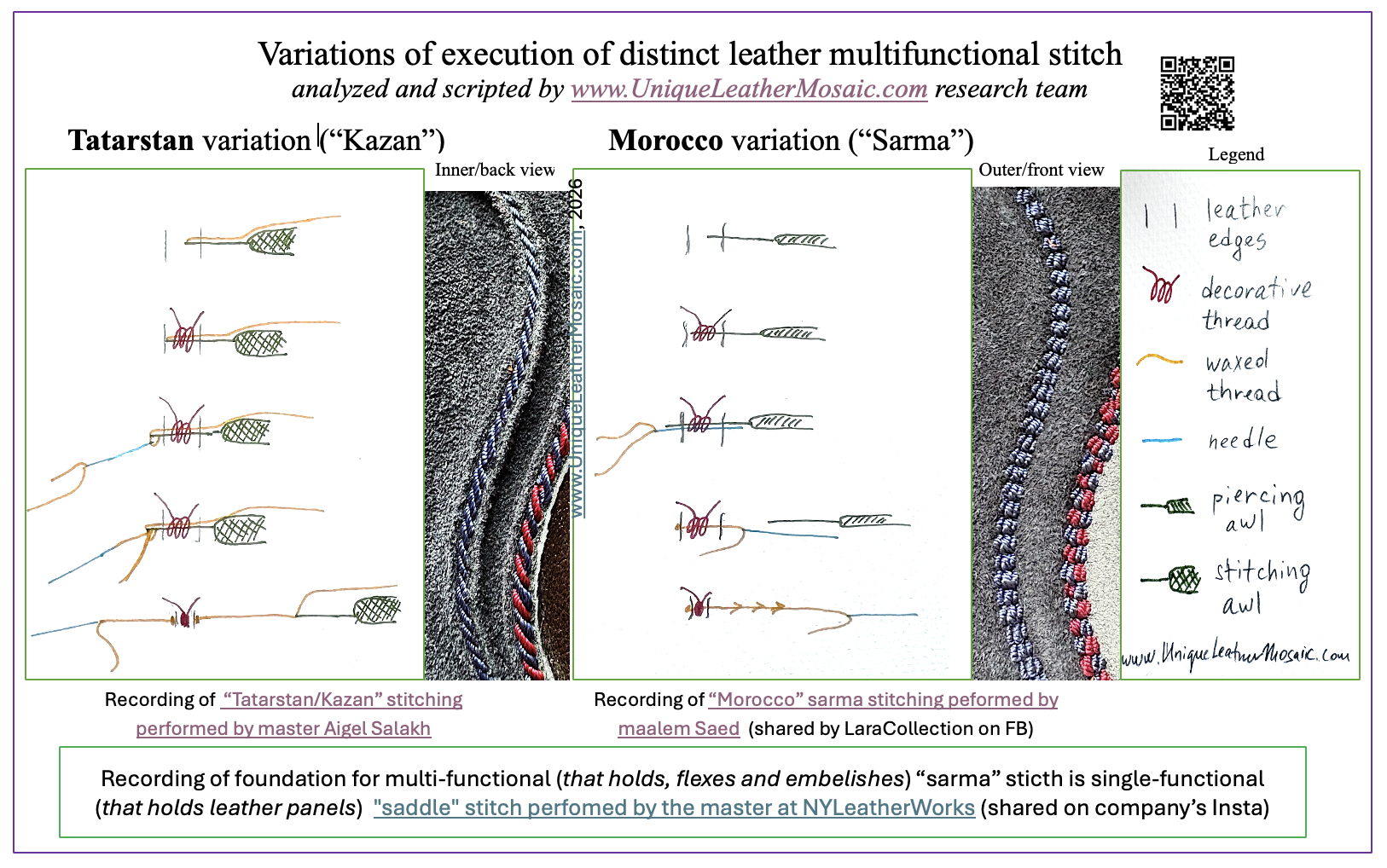
Recordings of the stitch executions: 1) Tatarstan/Kazan” stitching performed by master Sabira; 2) Morocco” sarma stitching performed by maalem Saed; 3) Foundation for the multi-functional (that holds, flexes and embellishes) “sarma” stitch is a single-functional (that holds leather panels) “saddle” stitch.

Can you identify the differences in the stitch execution? Isn’t it curious that people in faraway places (Tatarstan is ~ 3000 mi/ 5000 km away from Morocco) are still actively utilising the same ancient manual distinct leather stitching technique, but with variations in execution? Do you have an idea why? (please share if you do at Tatar.Mosaics) Would you agree that leather work created in Tatarstan is more ornamentally elaborate and intricate?

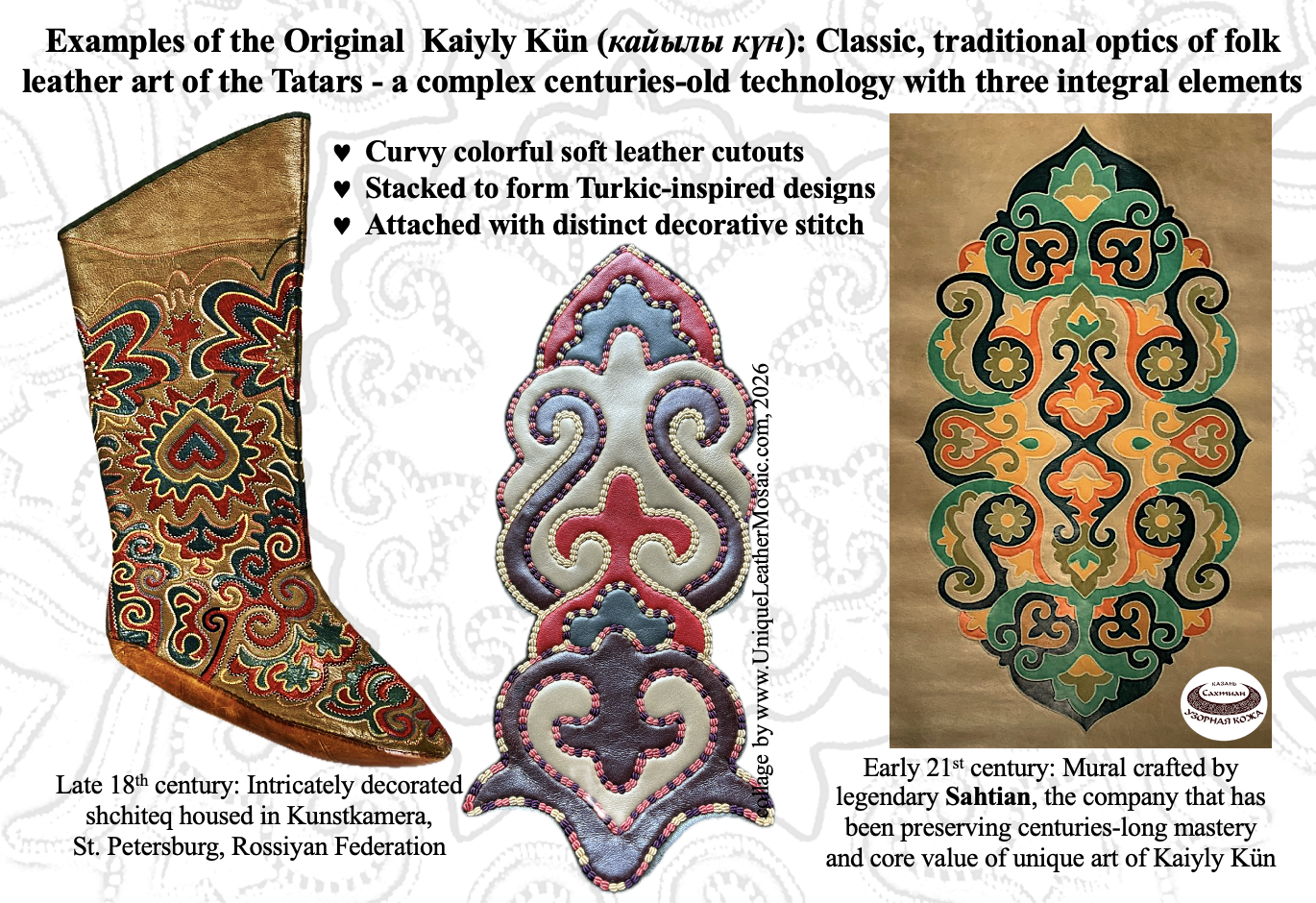
The leather items from Tatarstan are more aesthetically prominent because of creative collaboration of leather color, complex stacked patterns and the distinct stitching that are all integral elements of unique traditional art of the Tatars, Kaiyly Kün.

Examine the leather items hand-crfafted with Kaiyly Kün technology and without it

Innovating the Tradition

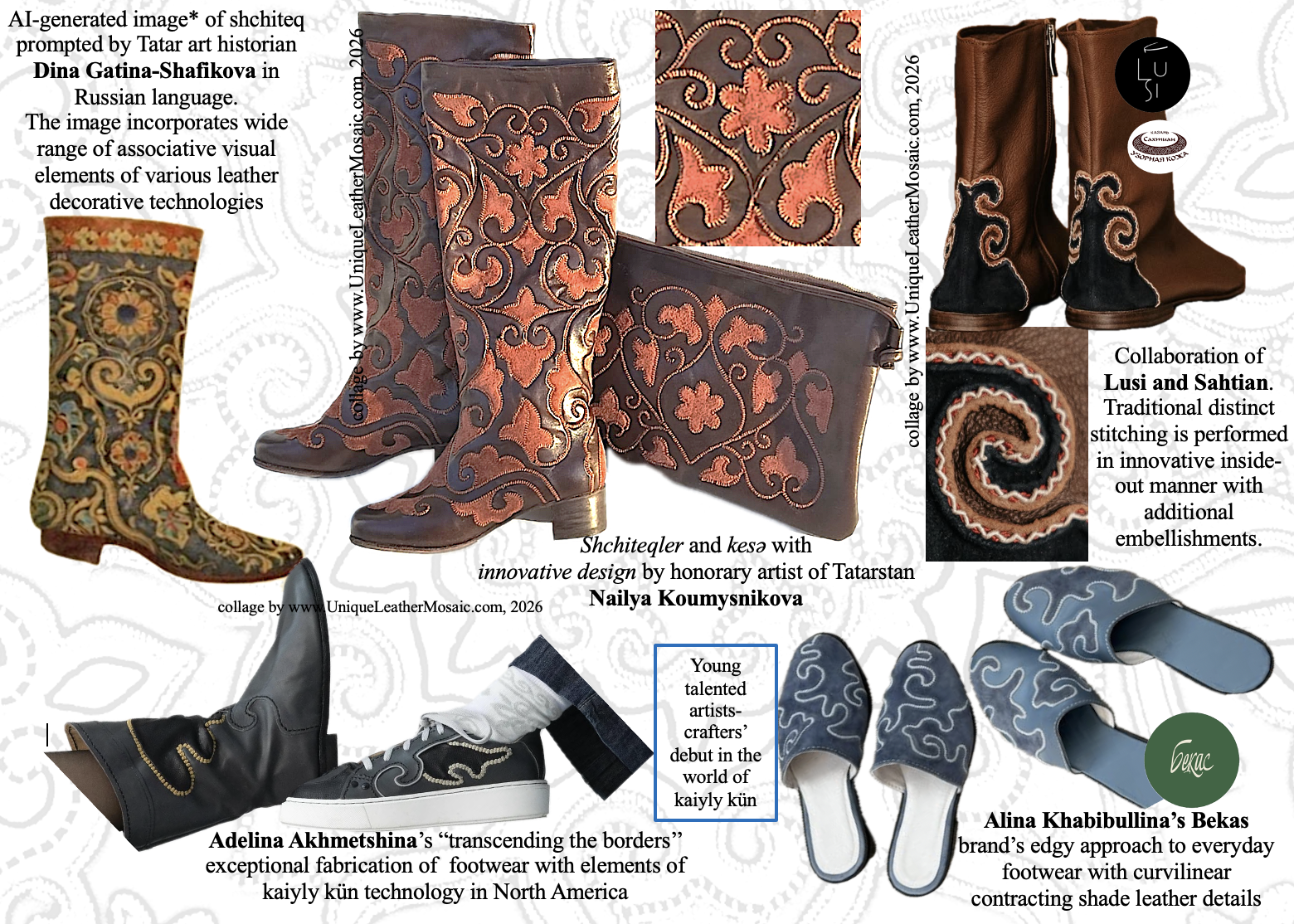
Have you wondered how innovative ideas are born?  When something new comes up, is it an organic development or a reaction to the ever-changing reality? Do you pause to assess if innovative product is manipulating the core, the baseline, the root, the tradition?  Those could be loaded questions, indeed, but they are the important ones when the goal is to preserve the original. Recent years have opened up the doors to artificial intelligence for almost everyone in the internet-empowered world. Recent months have been very active in innovating the Tatar traditional leather folk art of Kaiyly Kün

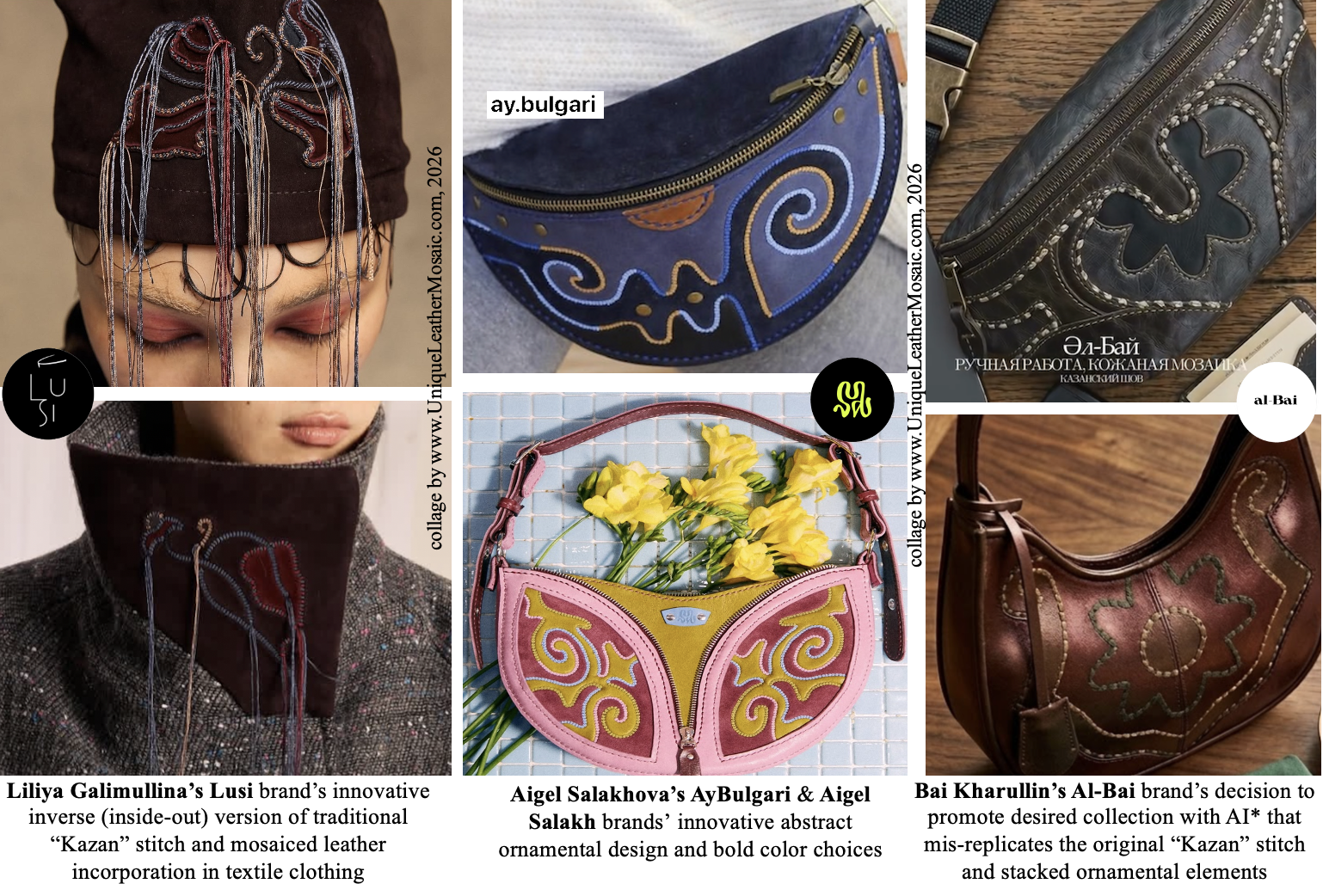
Change is a constant variable of life. It is a powerful mechanism for innovations as well as destruction…especially in the times of upheaval…Is the natural or the artificial in charge of change control – a crucial procedure that ensures the protection of quality and core value? Whether it is an artificially generated image of boots/ bags with the distinct stitch and ornamentation, or natural manual fabrication of leather item with only one element of the technology instead of three, it is becoming harder to detect the distortion of the original core of a complex Kaiyly Kün art. It is important to pinpoint a change that may erase the value and make it unavailable in future (like once-prominent bulgari leather)….It is also essential, without a doubt, to encourage and celebrate the progressive creatives, because art is fuelled by innovations.

Here are some impressively creative innovative interpretations of centuries-old Kaiyly Kün technology. Here is one more loaded, maybe a rhetoric, question for you to ponder: Which item is complex and authentic enough to carry the core of an ancient art as well as is an excellent example of modern interpretation and innovative approach? 

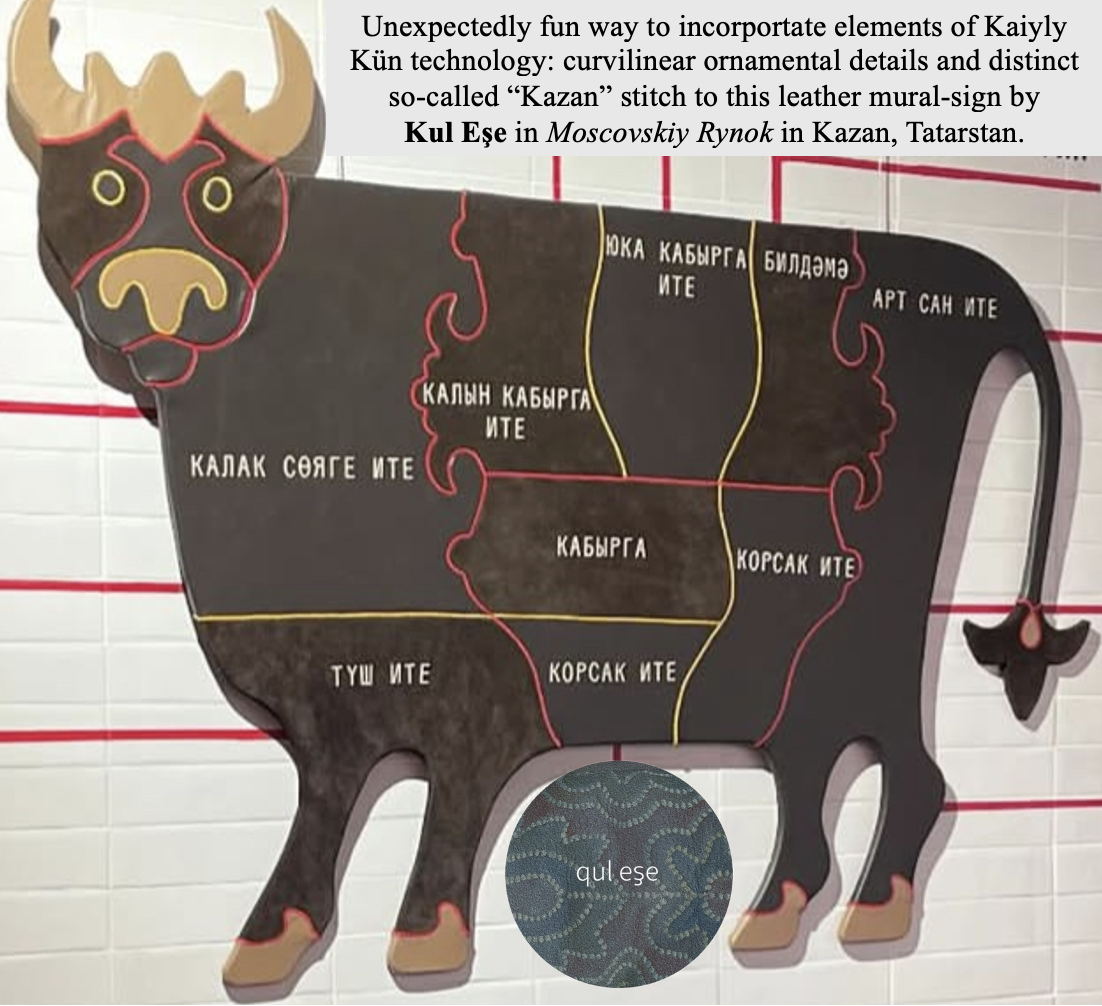
Kul Eşe’s multi-talented founder Mira Rahmat’s cool efforts in embellishing the public spaces with interpretive art based on traditional folk crafts of the Tatars deserve high accolades.

Kul Eşe School is dedicated to promoting and preserving the knowledge and value of manual/ hand work (it is a literal translation of kul eshe / кул эше from Tatar language) of the Tatars.  

In sync, we, here, have been diligently documenting, preserving and expanding the knowledge of unique art of Kaiyly Kün. For over 15 years, we have been offering this freely accessible platform with quality, human-synthesised and researched knowledge of incredible manual Tatar heritage of complex leather mosaic. Our intrinsic motivation is clear: we want the unique leather art of the Tatars with its original integral three elements to be available for many generations and the whole world to enjoy and celebrate!

Credits go to Naılya Kumysnikova, Lusi Brand, Dina Gatina-Shafikova, Aigel Salakh, Ay.Bulgari, Sahtian, Kul Eşe, Mira Rahmat, Al Bai, Bekas, Adelina Akhmetshina

*We intentionally do not use Artificial Intelligence (AI) tools/models to generate images because our priority is a meaningful use of natural resources including electric power supply. Do you know that based on the type of the AI model, generating one image equals to 

  • either charging one smartphone 70-200 times (0.1-0.3 kWh in light models),
  • or brewing water in the coffee/tea pot 5-15 times (0.3-0.7 kWh in mid-range models),
  • or running a refrigerator for up to 1 hour (0.7-2.0 in advanced models)?

The “saved up” energy (thanks to our intentional, meaningful approach) fuels the well-being of local marginalized communities (instead of private data centres). Those are the people who rely on their hands for living.

Connecting the Dots

“What is primary: a line or a circle?” I asked. “The dot” she answered with no hesitation.

 Fadhila Al Dhahouri of Global Center of Islamic Art, an impressive young visionary, made it very clear that the dot can undeniably evolve into both the line and the circle, and allow the infinite transformation into the beautiful, the harmonious, the inspiring. Fadhila and exceptionally talented Sandy Kurt empower the world for a “search for knowledge” through engagement of artistic potential within aesthetics of Islamic discourse. In which activation of creativity enables humanity and is connected with the higher power, Allah.

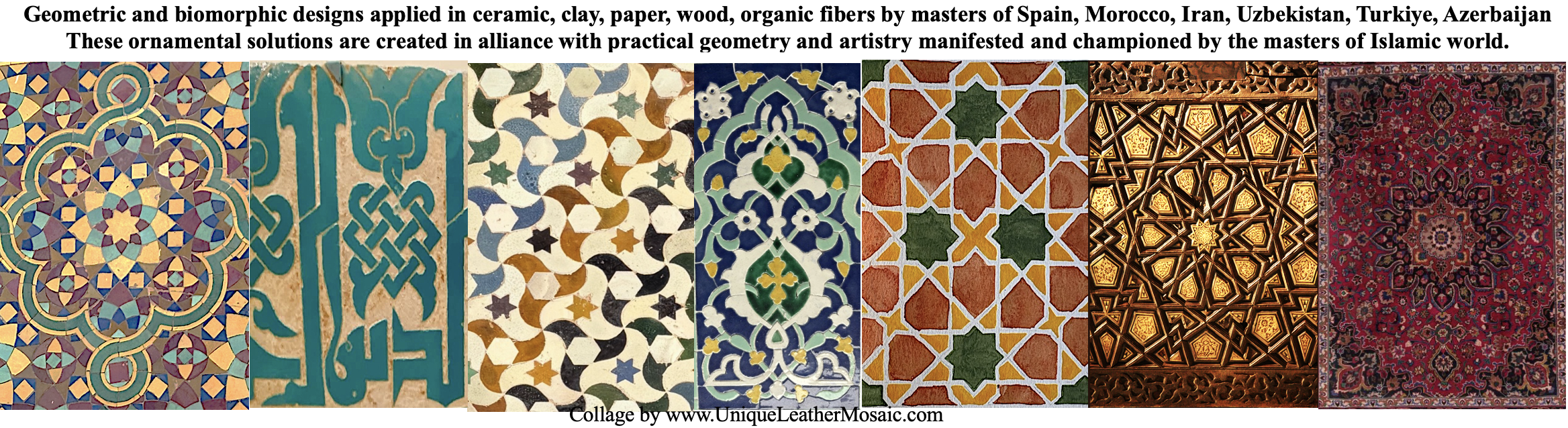
Specifically, the art of practical geometry is connecting individual’s humanity and internal energy through interplay of dots, lines, circles – visible or hidden. This unity is built on paramount importance of symmetry, balance, harmony, precision, order and the internal individual desire to seek for those. For centuries, guided by structure, spiritual energy and eternal potential of geometry, myriads of ornamental solutions have been mastered. They all offer deep engagement to the ones who create them and the ones who seek the learning. 

With knowledge that “geometry enlightens the intellect and sets one’s mind right” (Ibn Khaldun’s (1332-1406), we have been exploring the role of Islamic aesthetics and practical geometry in the ancient leather art of the (Volga) Tatars, the descendants of the Turkic nomads of EurAsia (Turkic Khaganates of 6-8th centuries) and the settled Volga Bulgars, whose indigenous lands are referred these days as Tatarstan Republic. Volga Bulgaria were the first northernmost civilization that in 922 officially accepted Islam under the mission of Ibn Fadlan, the envoy of Abbasid caliph al-Muqtadir. In 10-13th centuries, Volga Bulgaria had manifested itself as a powerful center for Islamic education, science, art and lifestyle.

The Volga Bulgars’ Islamic knowledge, esthetics and material culture had been transmitted through immense trading channels of those times, so-called Volga Trade route and Silk Road. People of Volga Bulgaria have continued being a backbone of Muslim networks despite of complex and endless military, political, religious, authoritarian, colonizing processes. The descendants of the Volga Bulgars are now called the Tatars. Representing the largest and the most spread-out ethnic minority in ~17 mln. sq. km. territory of Rossiyan Federation, the modern Tatars have been slowly recovering their collective memory loss of their own impressive Islamic history. The leather art of the modern (Volga) Tatars serves as a vessel that has protected the core from turbulent realities, the vessel that carries a powerful blend of Tengri’s connection with nature and Allah’s empowerment of humanity.

  • Two more worth sharing quotes:

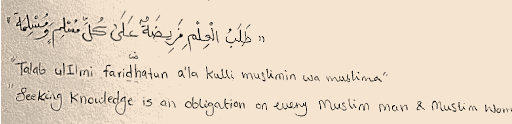
from Quran (hand-written and translated by Fadhila) on obligation of seeking the knowledge by both Muslim man and woman. This motto is worth following by any, fidel or infidel. The modern reality is increasingly and intentionally complex, and the survival in it is possible only with developed critical thinking.

from ibn al-Haytham’s (965-1040) “The Optics” (snapshotted from Windy Shaw’s book) on never-ending complexities of the world. Ibn Al-Haytham’s statement compliments the Quranic wisdom and emphasizes the constant search for the truth using the senses