Innovating the Tradition

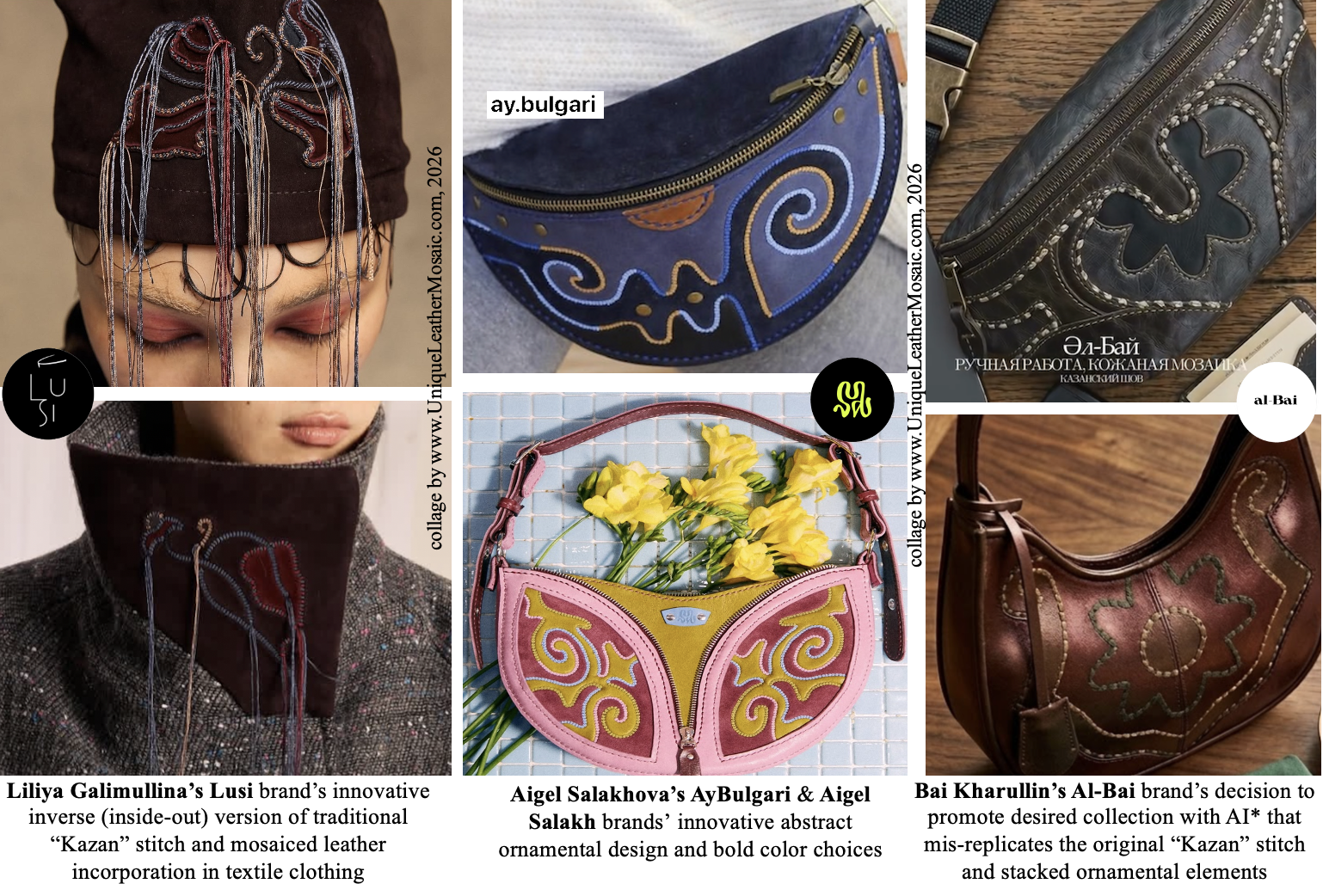
Have you wondered how innovative ideas are born?  When something new comes up, is it an organic development or a reaction to the ever-changing reality? Do you pause to assess if innovative product is manipulating the core, the baseline, the root, the tradition?  Those could be loaded questions, indeed, but they are the important ones when the goal is to preserve the original. Recent years have opened up the doors to artificial intelligence for almost everyone in the internet-empowered world. Recent months have been very active in innovating the Tatar traditional leather folk art of Kaiyly Kün

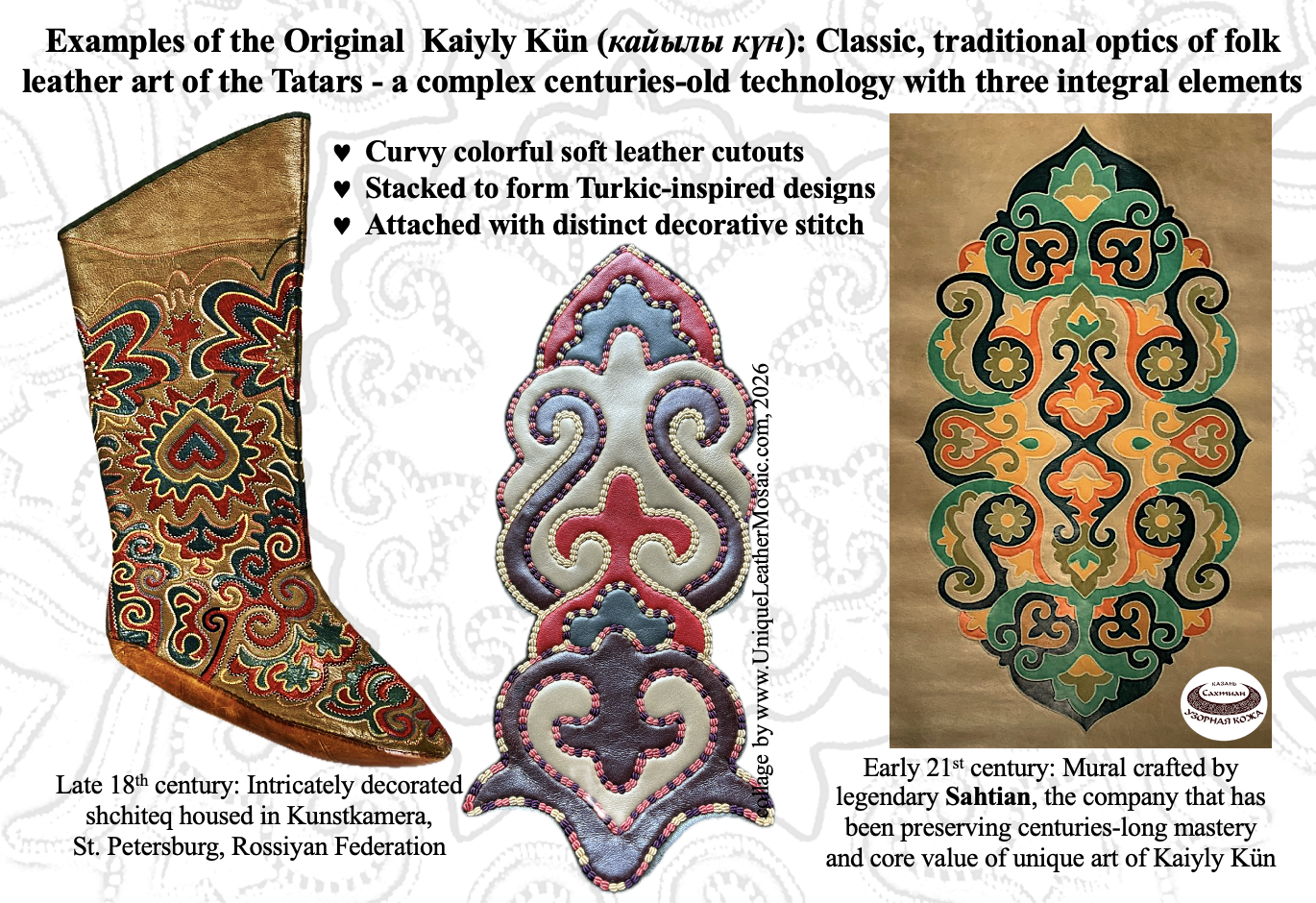
Change is a constant variable of life. It is a powerful mechanism for innovations as well as destruction…especially in the times of upheaval…Is the natural or the artificial in charge of change control – a crucial procedure that ensures the protection of quality and core value? Whether it is an artificially generated image of boots/ bags with the distinct stitch and ornamentation, or natural manual fabrication of leather item with only one element of the technology instead of three, it is becoming harder to detect the distortion of the original core of a complex Kaiyly Kün art. It is important to pinpoint a change that may erase the value and make it unavailable in future (like once-prominent bulgari leather)….It is also essential, without a doubt, to encourage and celebrate the progressive creatives, because art is fuelled by innovations.
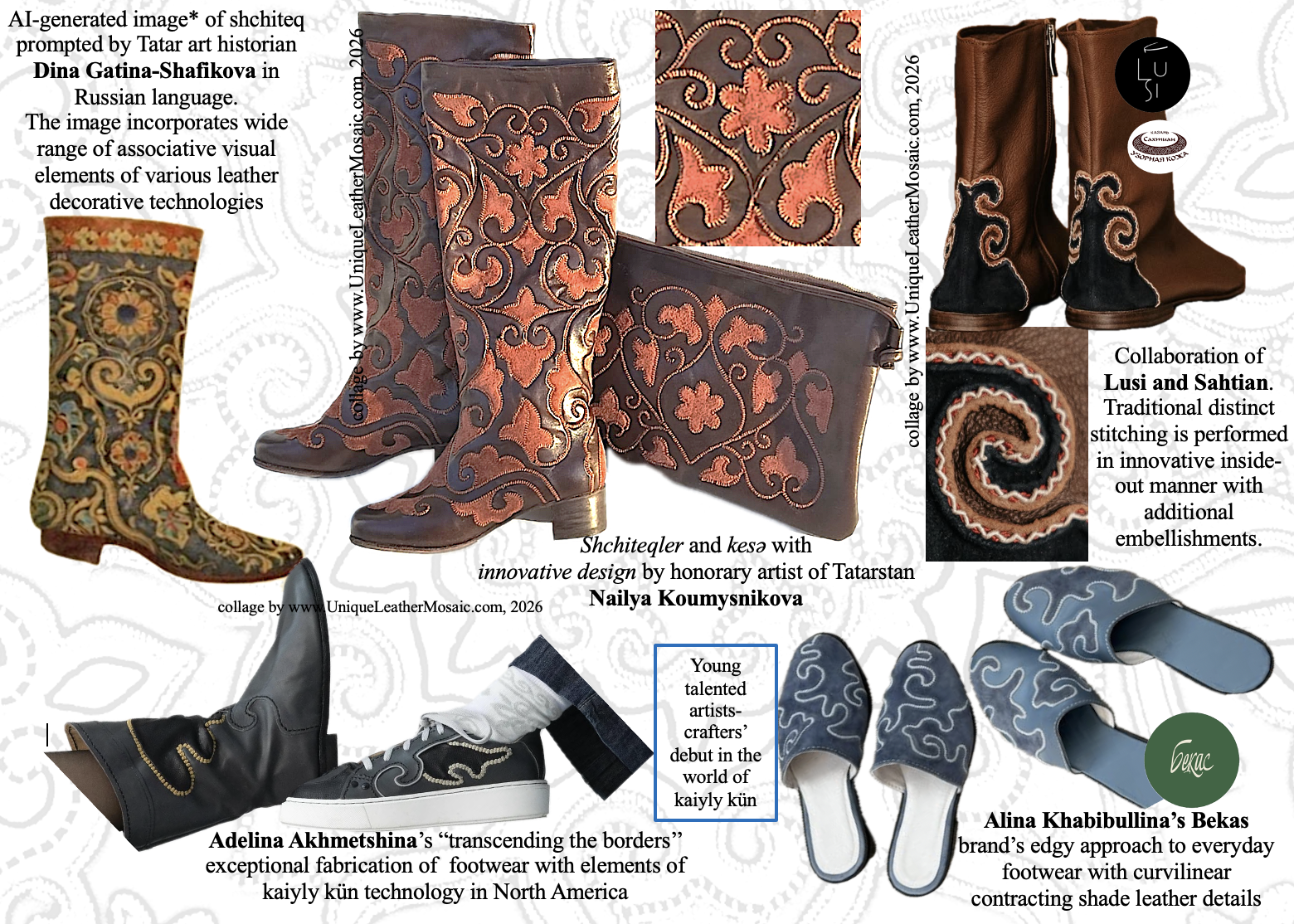
Here are some impressively creative innovative interpretations of centuries-old Kaiyly Kün technology. Here is one more loaded, maybe a rhetoric, question for you to ponder: Which item is complex and authentic enough to carry the core of an ancient art as well as is an excellent example of modern interpretation and innovative approach? 
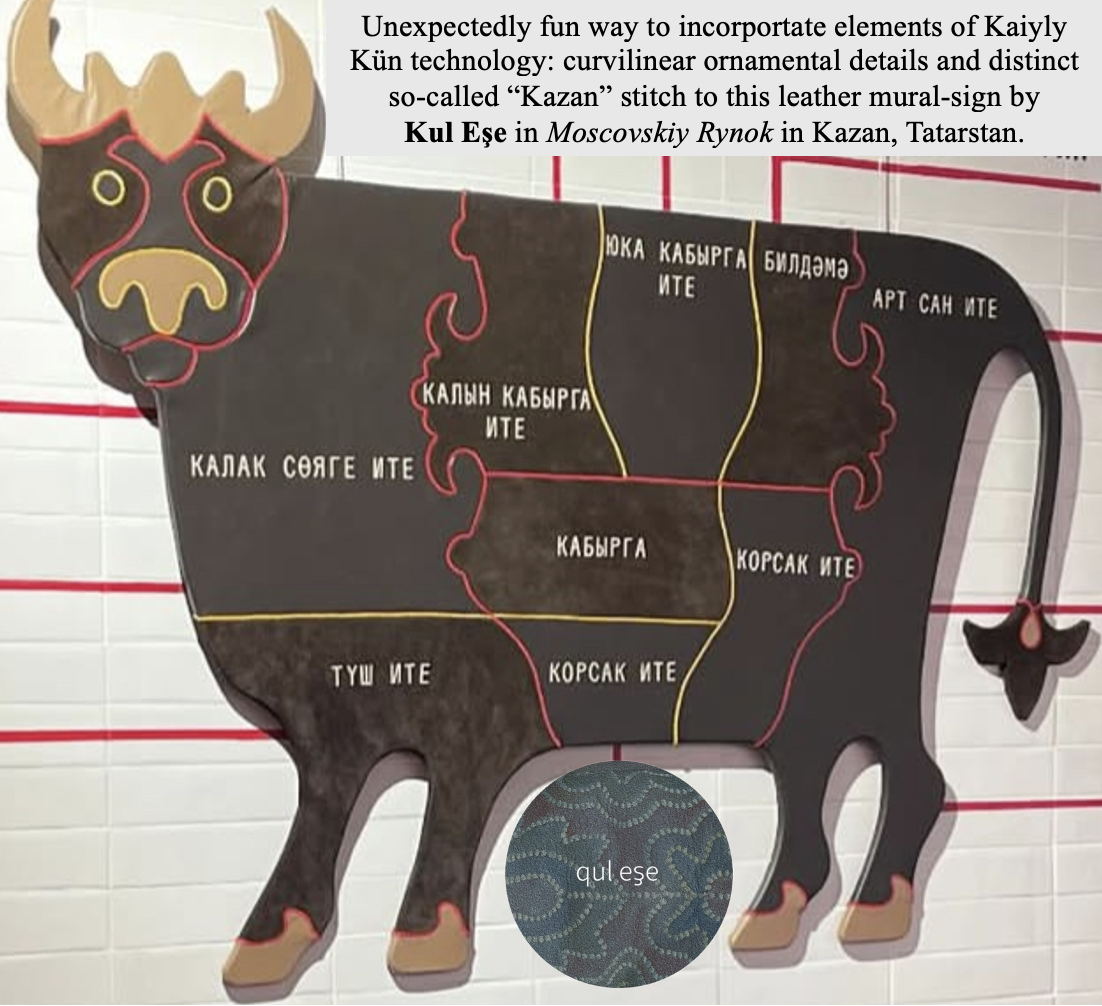
Kul Eşe’s multi-talented founder Mira Rahmat’s cool efforts in embellishing the public spaces with interpretive art based on traditional folk crafts of the Tatars deserve high accolades.

Kul Eşe School is dedicated to promoting and preserving the knowledge and value of manual/ hand work (it is a literal translation of kul eshe / кул эше from Tatar language) of the Tatars.  

In sync, we, here, have been diligently documenting, preserving and expanding the knowledge of unique art of Kaiyly Kün. For over 15 years, we have been offering this freely accessible platform with quality, human-synthesised and researched knowledge of incredible manual Tatar heritage of complex leather mosaic. Our intrinsic motivation is clear: we want the unique leather art of the Tatars with its original integral three elements to be available for many generations and the whole world to enjoy and celebrate!

Credits go to Naılya Kumysnikova, Lusi Brand, Dina Gatina-Shafikova, Aigel Salakh, Ay.Bulgari, Sahtian, Kul Eşe, Mira Rahmat, Al Bai, Bekas, Adelina Akhmetshina

*We intentionally do not use Artificial Intelligence (AI) tools/models to generate images because our priority is a meaningful use of natural resources including electric power supply. Do you know that based on the type of the AI model, generating one image equals to 

  • either charging one smartphone 70-200 times (0.1-0.3 kWh in light models),
  • or brewing water in the coffee/tea pot 5-15 times (0.3-0.7 kWh in mid-range models),
  • or running a refrigerator for up to 1 hour (0.7-2.0 in advanced models)?

The “saved up” energy (thanks to our intentional, meaningful approach) fuels the well-being of local marginalized communities (instead of private data centres). Those are the people who rely on their hands for living.


Memory, Spirit and Legacy

Tатарчаны монда укый аласыз / Tatar version here

The memorial plaque dedicated to “Serp i Molot” plant and its legendary contributors was placed these days on the last remaining wall of the once-powerful plant. Located in historic Bishbalta (Tatarstan) for over 150 years (1851-2015), the plant supplied heavy machinery, conveyor belts and various tools to support livelihood of Russian Empire, of the USSR, Tatarstan, Russian Federation. 

Putting the plaque up is an idea of Garafutdin Minegaziz uly Khisamutdinov, a labor veteran who dedicated over 20 years of his career to the plant. Starting as a locksmith at the age of 17, Garafutdin contributed his skills, excelled, and moved up the ladder to make the plant a success. The collapse of the Soviet Union turned the progressive industrial complex as well as the whole livelihood setup of the USSR upside down.

Many state ventures could not survive the turmoil and, thus, seized to exist.  “Serp i Molot” plant’s fate was not an exception. Although the change opened new opportunities for Garafutdin, his heart has been aching for such a powerful establishment with long history to come to an end on his watch. The plaque commemorates the plant’s existence and its contribution to the history of the city. It also pays a tribute to Garafutdin’s youth that was dedicated to “Serp i Molot” full-heartedly! 

Garafutdin’s partner and supporter of over 50 years, a mathematician by training and a teacher by trade, Zaituna Gafi kyzy Khisamutdinova took the pressure of caring for the household and three children while Garafutdin served in the leadership positions in the plant and the local district government.

Nowadays, the smile and the spirit, the most persistent attributes of Garafutdin and Zaituna, keep them energized to share and preserve the Tatar heritage and the history of Bishbalta.

A bitter story of “Serp i Molot” plant is not the only one. In one of the used-to-be-industrial-heavy districts of Kazan, Kirovskiy, from mid- 19th to late 20th century, there were many large manufacturing and industrial plants supplying various goods to the vast country. Most of them ended their operations in early 21st century including the ones that were dedicated to leather production using tanning and dressing technologies developed in Volga Bulgaria (predecessor of Kazan Khanate and Tatarstan). At the verge of 19th and 20th centuries, the leather manufacturing was the second (after fabric weaving) high-volume-high-profit business in Kazan (“Tatar Industrialist”, S. Belov, 2017, p.5-6). By mid-20th century, only two leather processing and leather goods manufacturing plants operated in Kirovskiy district of Kazan city. Nowadays, the one that produces leather goods ranks 165th out of ~400 in Russian Federation, the leather-processing plant is mostly out of business. 

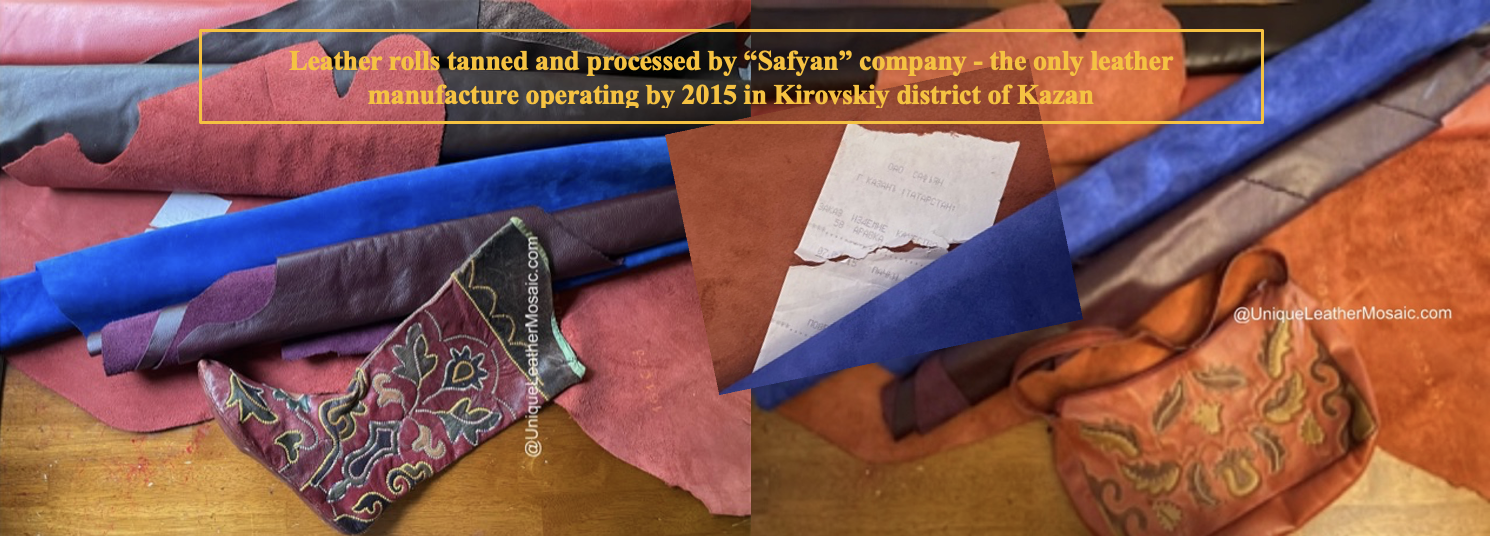
The legacy of famous high quality soft aromatic leather mastered in Volga Bulgaria that once were pride and fame of the Volga Bulgars (now referred as (Volga) Tatars) has been slowly vanishing in history. The leather tanned using the exceptional technology developed by the Volga Bulgars had been referred as bulgari in Middle Ages in Asia, Europe and America (“The Patterned Leather of Kazan”, L. Sattarova, 2004, p. 7-23). The word “bulgari” had been utilized as an umbrella term for the two types of leather: 1) “juft/yut (either from Persian جفت meaning “pair” or from Bulgarian «ӳт» meaning “leather”), and 2) “safyan/ sahtiyan” (from Persian ساختيا derived from ساخته “saht” meaning “fit/processed/made). Those terms, originally and primarily, had been referred to goat (safyan) and sheep (yut) hides tanned with sumac and willow bark, colored by plants-derived dyes and oiled by birch tar. In 18th – early 20th centuries, soft leather with distinctive aroma (acquired during the tanning and oiling with birch tar) that was manufactured using the technologies of the Volga Bulgars got referred as “Russia” leather in American and Western literature (“The Manufacture of Leather”, C.Davis, 1885, p.65-68).  

Leather processing is not a profitable business in Kazan anymore. The last leather manufacturing plant in Kirovsky district of Kazan (the successor of various pre-Soviet era profitable leather-tanning establishments of Azmetyev, Yunusovs, Apanayevs, etc.) has been operating on the smallest percentage of its capacity since the collapse of the Soviet Union. It was in-and-out-of-business for the last decade. The hope is on for the famous-aromatic-soft leather bulgari and the exceptionally-decorated-leather-sock-boots shchitekler to gain their momentum again, to be the staple of local economy, and to be a  celebration of (Volga Bulgar) Tatar legacy and handiwork.