Applauding the Ball and the Stitch

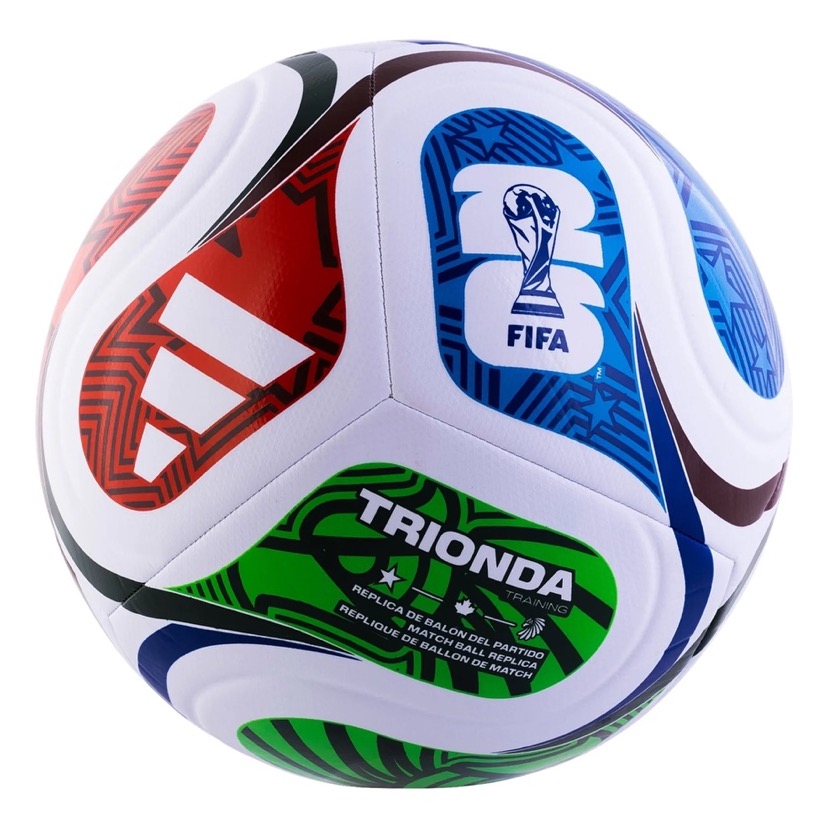
Whether you are happy or sad with the 2026 FIFA World Cup winner, let’s give a round of applause to a true hero of the game – the BALL! Do you know that, on average, the ball was kicked 1000 to 1500 times per match? Have you noticed that 2026 FIFA Adidas Trionda football has featured only 4 polyurethane panels instead of traditional 32 leather ones?
Despite of recent innovative technological manipulations (materials, shape, imbedded sensors) to the staple of the game of football to improve the experience and precision, the three goals of the ball remain the same: A ball makes the game happen, unites people and engages strong emotions! The synthetic fibers, machine stitching, thermal bonding of the modern football are only in place since late 1980ies. Before that, for millennia, humanity used animal leather panels that were stitched manually from the inside, to create round instrument for physical engagement and community-building. Among few types of manual leather panels stitching techniques, the one featured on the football of 1908 in Real Madrid Museum ( Go Spain! ) is performed the same way a so-called “Kazan” stitch on shchiteqler, the Tatar traditional footwear. This type of manual stitch also has three goals: It simultaneously holds, flexes and embellishes.  For centuries, if not millennia, this distinct stitch has been used to support the flexibility of leather shapes and to provide aesthetic appeal to the leather edges.
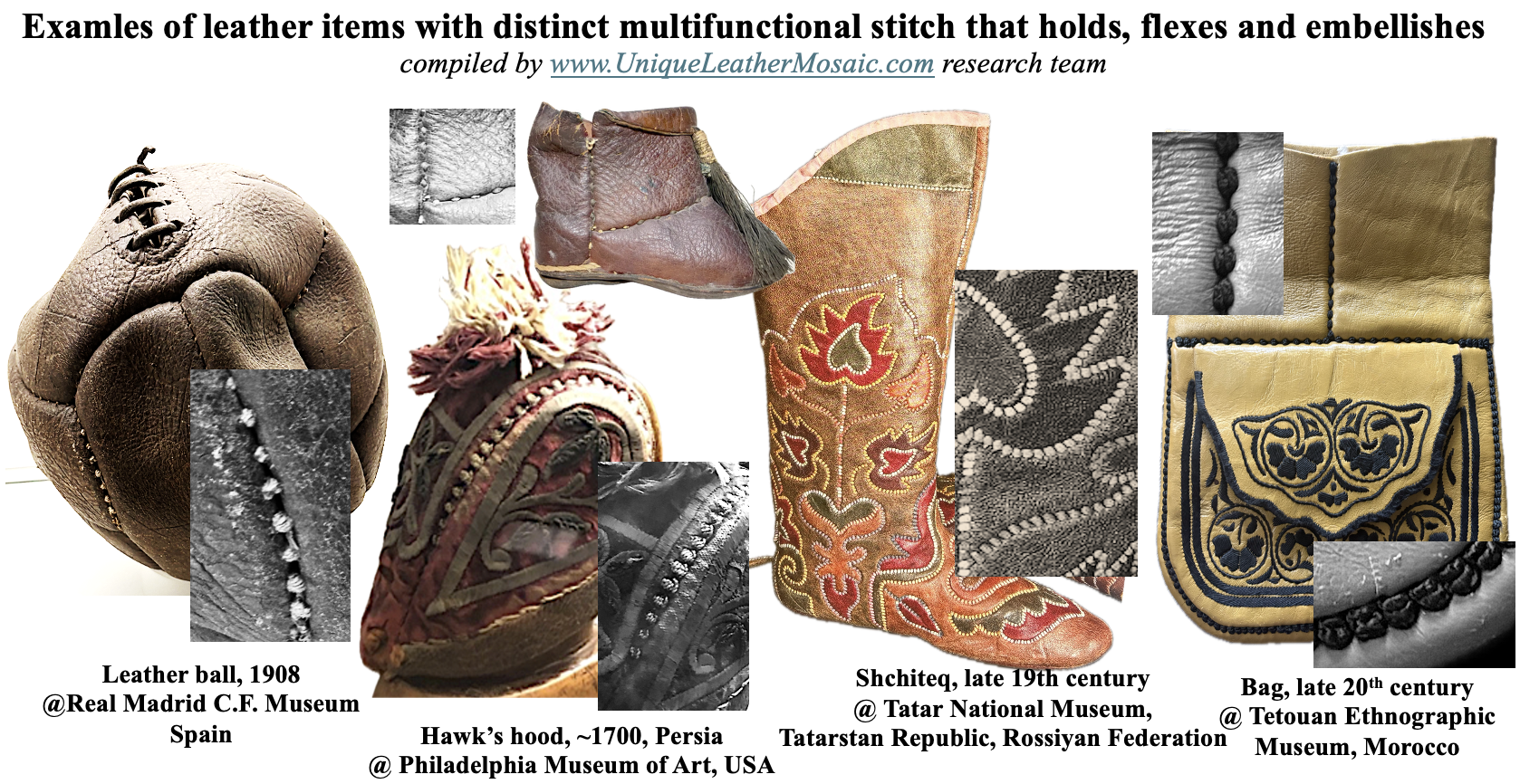
According to our years-long research of worldwide museum collections, auction sites and marketplaces, this distinct stitch has been mastered by Muslim leather crafters: they performed and spread it westward, eastward, northward, southward via various trading routs: all the way from medieval Spain (west) to China (east), Volga (Itil) Bulgaria (north) to Sudan (south).

This type of inner stitching (that looks like embroidery, beadwork, cord-like to a layperson’s eye) was historically employed for leather-made footwear, headwear (e.g. falcon hoods), meal-ware (e.g. drinking vessels), animal gear (e.g., saddles), furnishing (e.g., “ottomans”), carriers (e.g., bags) and curvy objects (e.g., balls). Though an original term for this stitch may have differed in various locations, we believe it was widely referred as “sarma”, a word that stems from an ancient Turkic root “sar/sır” meaning “to wrap”.
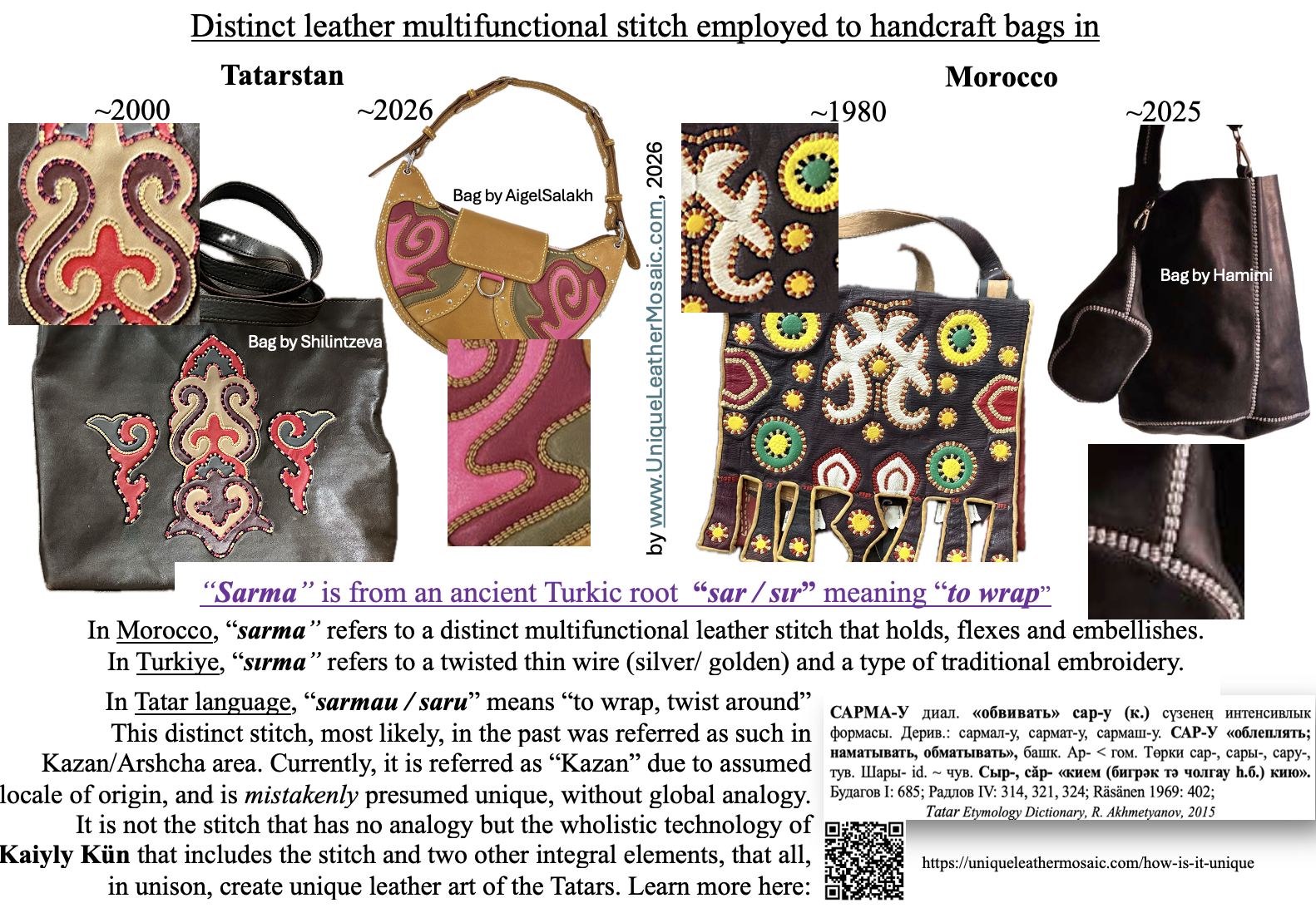
Nowadays, it is referred this way (sarma) in Morocco, the one of the only two locales where the distinct ancient stitch is still being successfully executed, by hands. The second location is Tatarstan Republic of Rossiyan Federation, specifically Kazan-Arshcha area. The original Tatar term for the stitch is lost/unknown and is currently being referred as “Kazan Zhouy” which, most likely, was originally referred as “сар(ма)у/ sar(ma)u”, a Tatar word from the same Turkic root that etymologically corresponds to the essence of the stitch. The essence of this impressively durable, flexible and decorative inner stitch is in several loops of decorative thread wrapped around a carrying waxed thread that adheres one leather piece to another. The technology of performing sarma stitching in Morocco slightly differs from how it is executed in Tatarstan. Check out these variations:
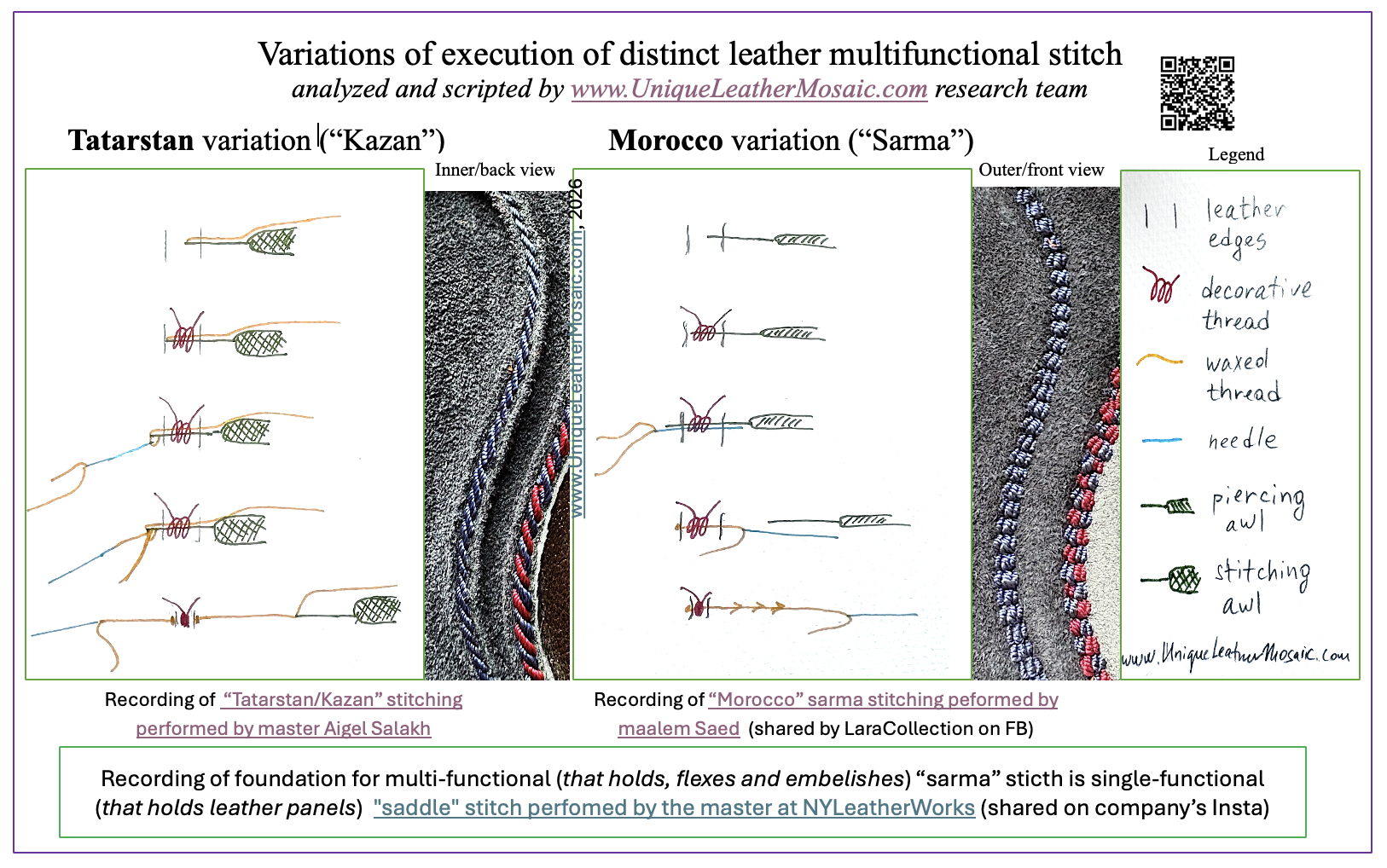
Recordings of the stitch executions: 1) Tatarstan/Kazan” stitching performed by master Sabira; 2) Morocco” sarma stitching performed by maalem Saed; 3) Foundation for the multi-functional (that holds, flexes and embellishes) “sarma” stitch is a single-functional (that holds leather panels) “saddle” stitch.

Can you identify the differences in the stitch execution? Isn’t it curious that people in faraway places (Tatarstan is ~ 3000 mi/ 5000 km away from Morocco) are still actively utilising the same ancient manual distinct leather stitching technique, but with variations in execution? Do you have an idea why? (please share if you do at Tatar.Mosaics) Would you agree that leather work created in Tatarstan is more ornamentally elaborate and intricate?

The leather items from Tatarstan are more aesthetically prominent because of creative collaboration of leather color, complex stacked patterns and the distinct stitching that are all integral elements of unique traditional art of the Tatars, Kaiyly Kün.

Examine the leather items hand-crfafted with Kaiyly Kün technology and without it

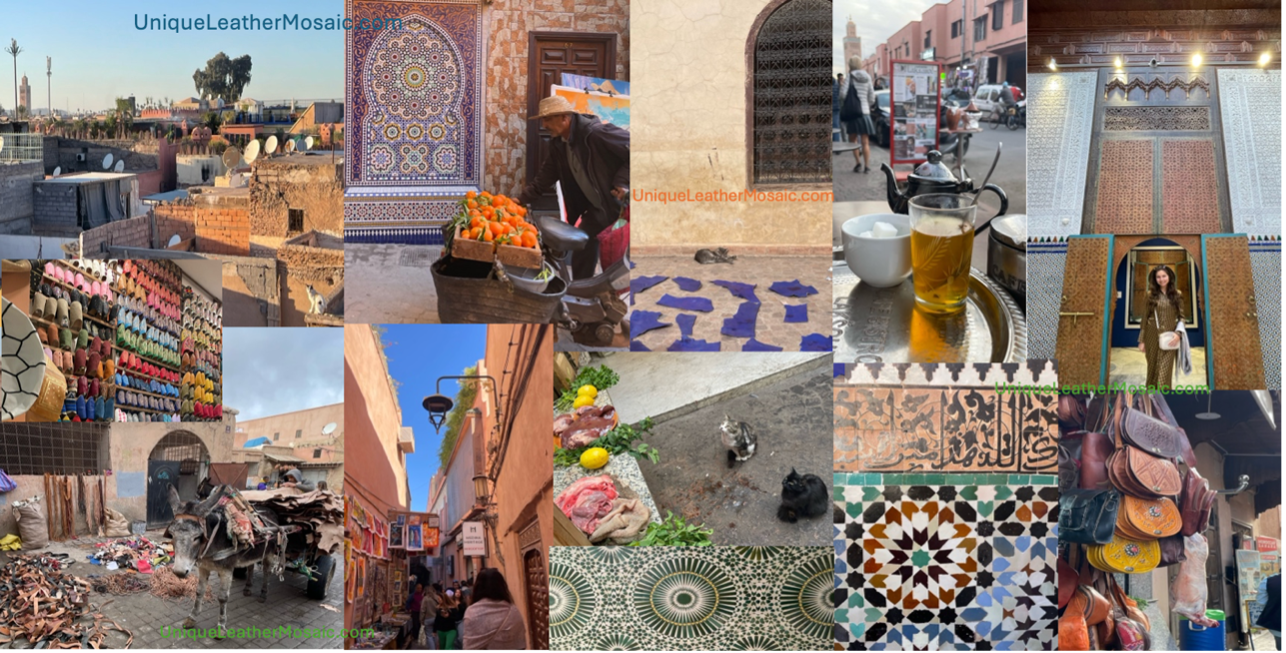
Exploring Labyrinth In Marrakesh

It is a fact that overwhelming reliance on technological advances is eroding our memory. So, finding engaging activities to hone cognitive abilities is a must! What can be more engaging for the brain than challenge of finding your way without GPS (global positioning system)? One of the best places to be lost and search for the way out without a map are the mazes of Marrakesh Old Medina.

Rows of eye-catching, fragrant, colorful, locally sourced goods made of leather, fibers, brass, clay, straw. Endless flow of sellers, buyers, donkeys, cats, bikes. Mesmerizing geometry of shapes, blasts of vivid colors, clouds of fragrant aromas of simmered-for-hours dishes, soothing sounds of call for prayers and chatting in Amazigh, Arabic, French. Moroccan labyrinth of souks captivates and educates. Our goal of “not to be lost” were successful the more we practiced it. Although, the other goal, fueled by our passion to leather craft, was not so much.  We were on a mission to observe and document the decorative leather stitching technology that looks like “Kazan” stitch that has been utilized and mastered for centuries in Tatarstan. It is roughly 5000 km of air distance between Tatarstan and Morocco, but those are the places where, up to this day, this distinct manual decorative stitch is being actively used despite of pressing lures of mechanized world. 

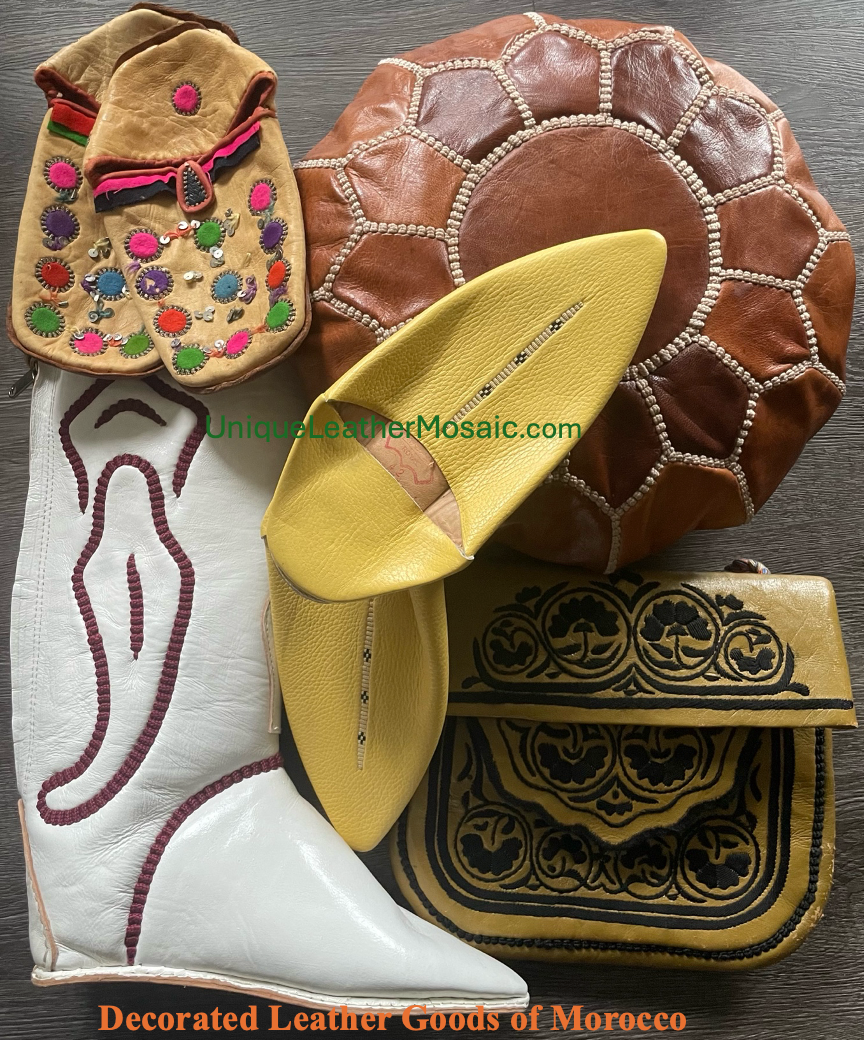
In Marrakesh, we explored myriads of tiny workshops that had leather merchants and crafters working the magic of creating and attuning to the leather goods (Ottoman poufs, Berber bags, babouches), but every time we wondered about the leather decorators (stitchers and embroiders), there were silence, suspense, mystery around it. We were told that all decorative stitching happens in the female cooperatives in the Atlas Mountains.

When we asked to arrange for the compensated educational tour, various excuses were offered with subtle intention of pretense. We left Marrakesh without being able to see the stitching in action, but we got excited to find the only workshop that sells Tbourida boots. The boots that are worn during famous annual festival of riding horses and firing riffles that has been a Moroccan tradition since Middle Ages.

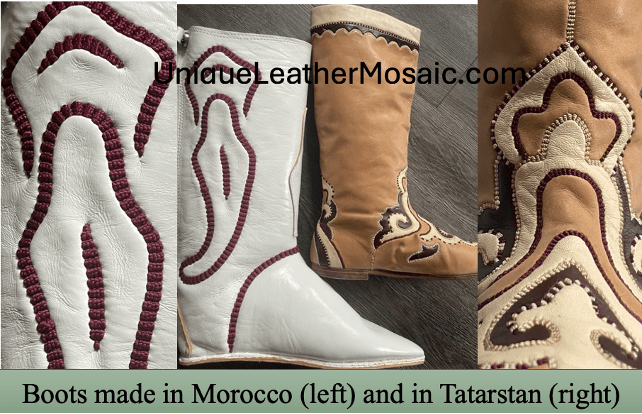
The decoration of these boots is made with the technology of leather mosaic that also the Tatar boots (shchiteqler) are made with. The decorative pattern cutouts and their attachment with distinct decorative stitch are similar, but shchiteqler are created with much more sophisticated technology of Tatar leather mosaic that is unique in its design complexity and intricacies of ornamental patterns and colors. 

The inquisitory nature of our short trip to impressive Morocco led us to having more questions than answers, specifically: How the exchange of leather crafting technologies happened in the time of Volga Bulgaria, Ulus Ulug, Kazan Khanate, Kazan Guberniya of Russian Empire (the earlier state names of current Tatarstan, the subject of Rossiyan Federation)? Is there any reason for the distinct manual decorative stitch to be deliberately guarded in Morocco? What do the Arabic words “sabra” and “sarma” referred in the souks mean? We might be digging for the answers to the first question for some time, but answers for the other two yielded some results thanks to…well… technological advances: internet. It seems that in a middleman economy of Morocco, creating an enticing enigma and baseless mysteries are the ways to keep the tourists coming. It turns out that:

An Arabic صبر  “sabra/sabr” (meaning “patience”) is referred to the cactus and the thread that is used to decorate the leather goods. It is widely believed that the thread is made from cactus, but is it really?: Here is an investigative story on searching the puzzling “sabra” silk.

An Arabic سارما “sarma” (from Ottoman Turkish صرمه  meaning “golden or silver thread, wire; wrapping”) is a term for the stitch that we have been looking for: It is performed similarly to the “Kazan” stitch. This compassionate FB page LarahCollection introduces the artisans of the Altai Mountains and their craftsmanship without the “burden” of the middleman. Sarma stitching is described as “a special embroidery work on leather that consists on sewing two pieces of leather together with special knots in the junction. All this work is done on the back of the leather”.

The page offers a video of the stitching that is performed almost in the same manner as “Kazan” stitch with a little difference. Can you engage your brain to identify this little difference by comparing the process of creating the Tatar “kazan” stitch and the Moroccan “sarma” stitch?

Decorated Leather Goods of Tatarstan and Morocco