Applauding the Ball and the Stitch

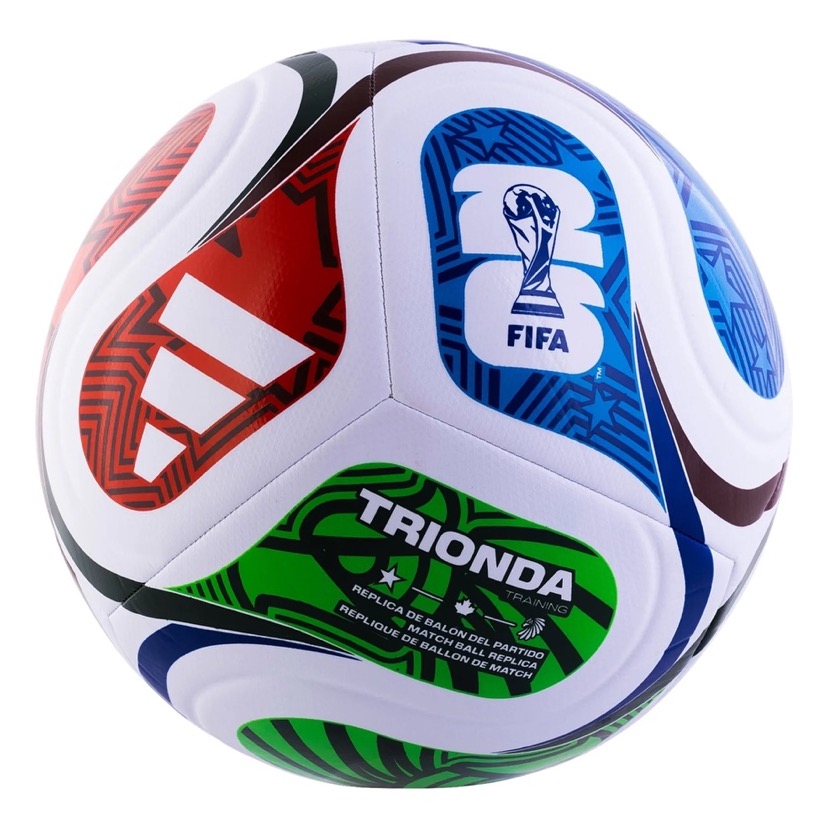
Whether you are happy or sad with the 2026 FIFA World Cup winner, let’s give a round of applause to a true hero of the game – the BALL! Do you know that, on average, the ball was kicked 1000 to 1500 times per match? Have you noticed that 2026 FIFA Adidas Trionda football has featured only 4 polyurethane panels instead of traditional 32 leather ones?
Despite of recent innovative technological manipulations (materials, shape, imbedded sensors) to the staple of the game of football to improve the experience and precision, the three goals of the ball remain the same: A ball makes the game happen, unites people and engages strong emotions! The synthetic fibers, machine stitching, thermal bonding of the modern football are only in place since late 1980ies. Before that, for millennia, humanity used animal leather panels that were stitched manually from the inside, to create round instrument for physical engagement and community-building. Among few types of manual leather panels stitching techniques, the one featured on the football of 1908 in Real Madrid Museum ( Go Spain! ) is performed the same way a so-called “Kazan” stitch on shchiteqler, the Tatar traditional footwear. This type of manual stitch also has three goals: It simultaneously holds, flexes and embellishes.  For centuries, if not millennia, this distinct stitch has been used to support the flexibility of leather shapes and to provide aesthetic appeal to the leather edges.
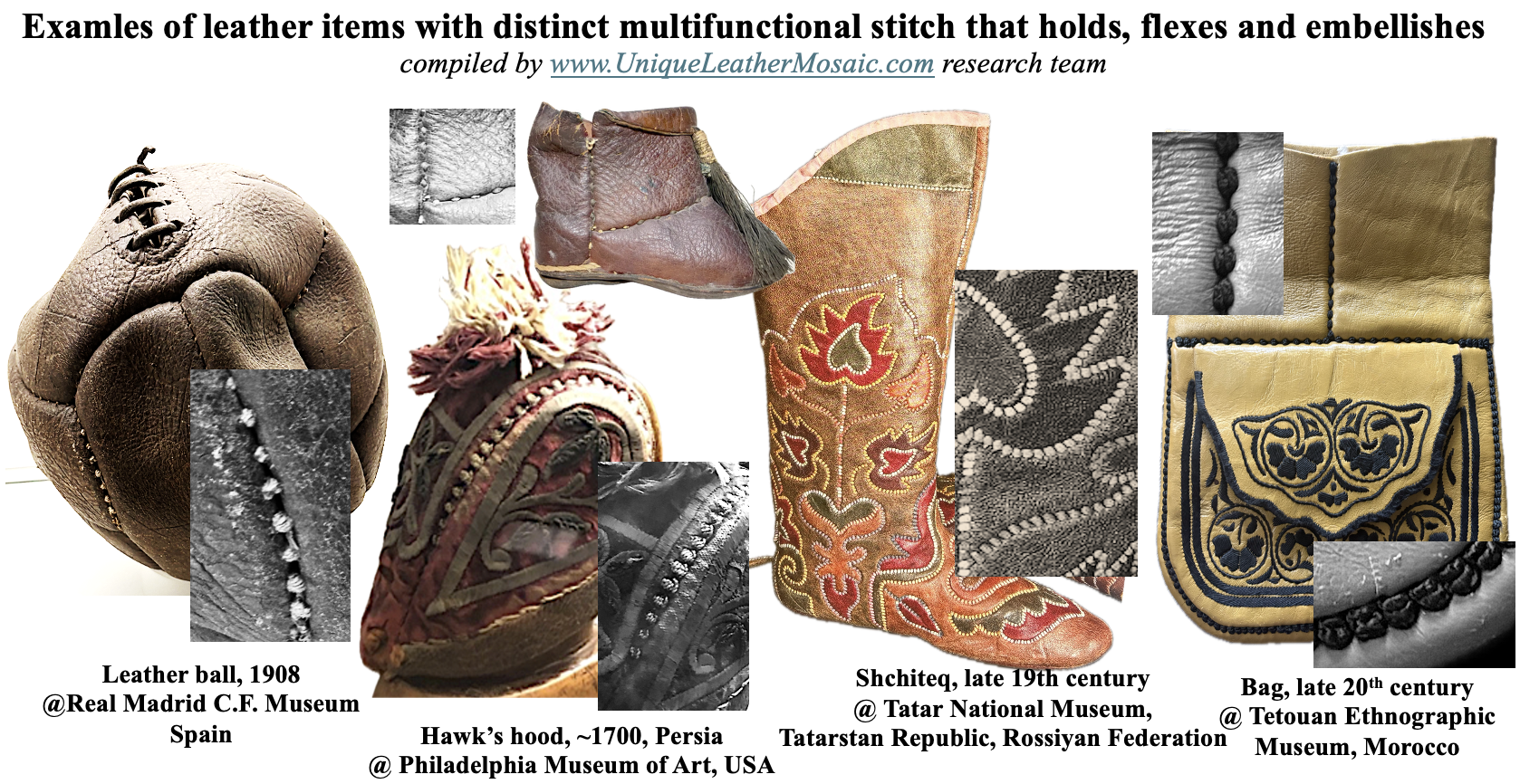
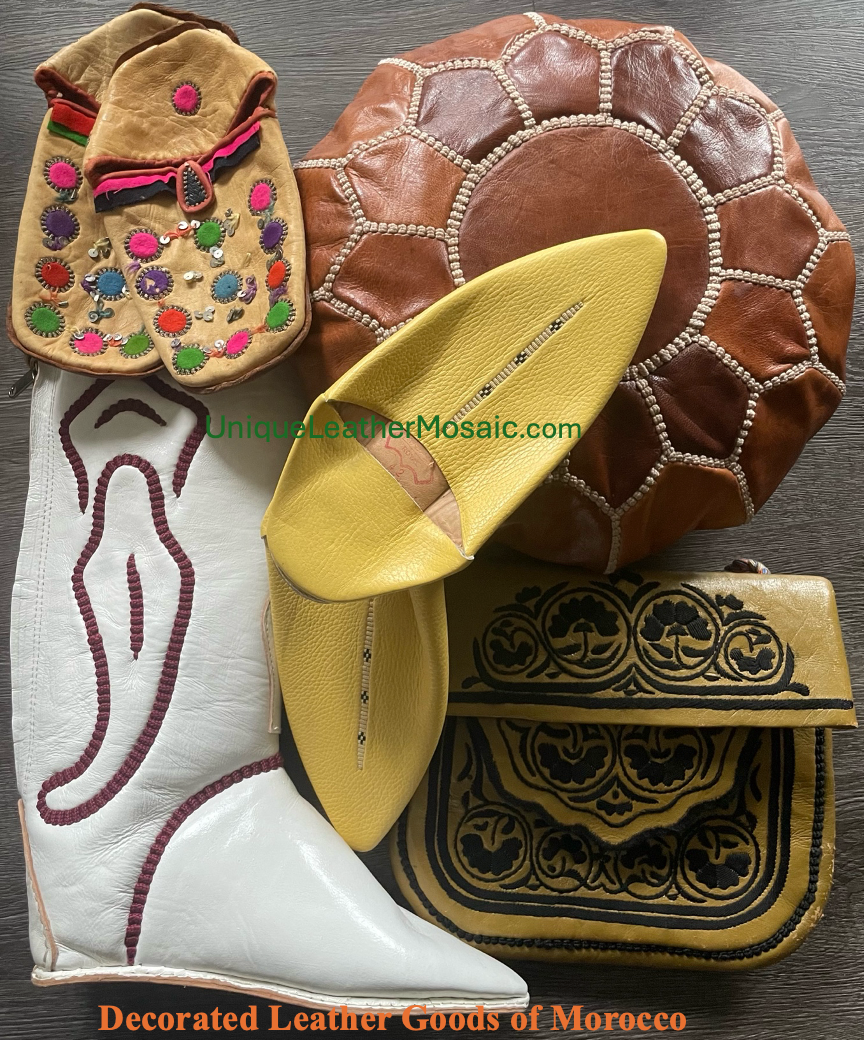
According to our years-long research of worldwide museum collections, auction sites and marketplaces, this distinct stitch has been mastered by Muslim leather crafters: they performed and spread it westward, eastward, northward, southward via various trading routs: all the way from medieval Spain (west) to China (east), Volga (Itil) Bulgaria (north) to Sudan (south).

This type of inner stitching (that looks like embroidery, beadwork, cord-like to a layperson’s eye) was historically employed for leather-made footwear, headwear (e.g. falcon hoods), meal-ware (e.g. drinking vessels), animal gear (e.g., saddles), furnishing (e.g., “ottomans”), carriers (e.g., bags) and curvy objects (e.g., balls). Though an original term for this stitch may have differed in various locations, we believe it was widely referred as “sarma”, a word that stems from an ancient Turkic root “sar/sır” meaning “to wrap”.
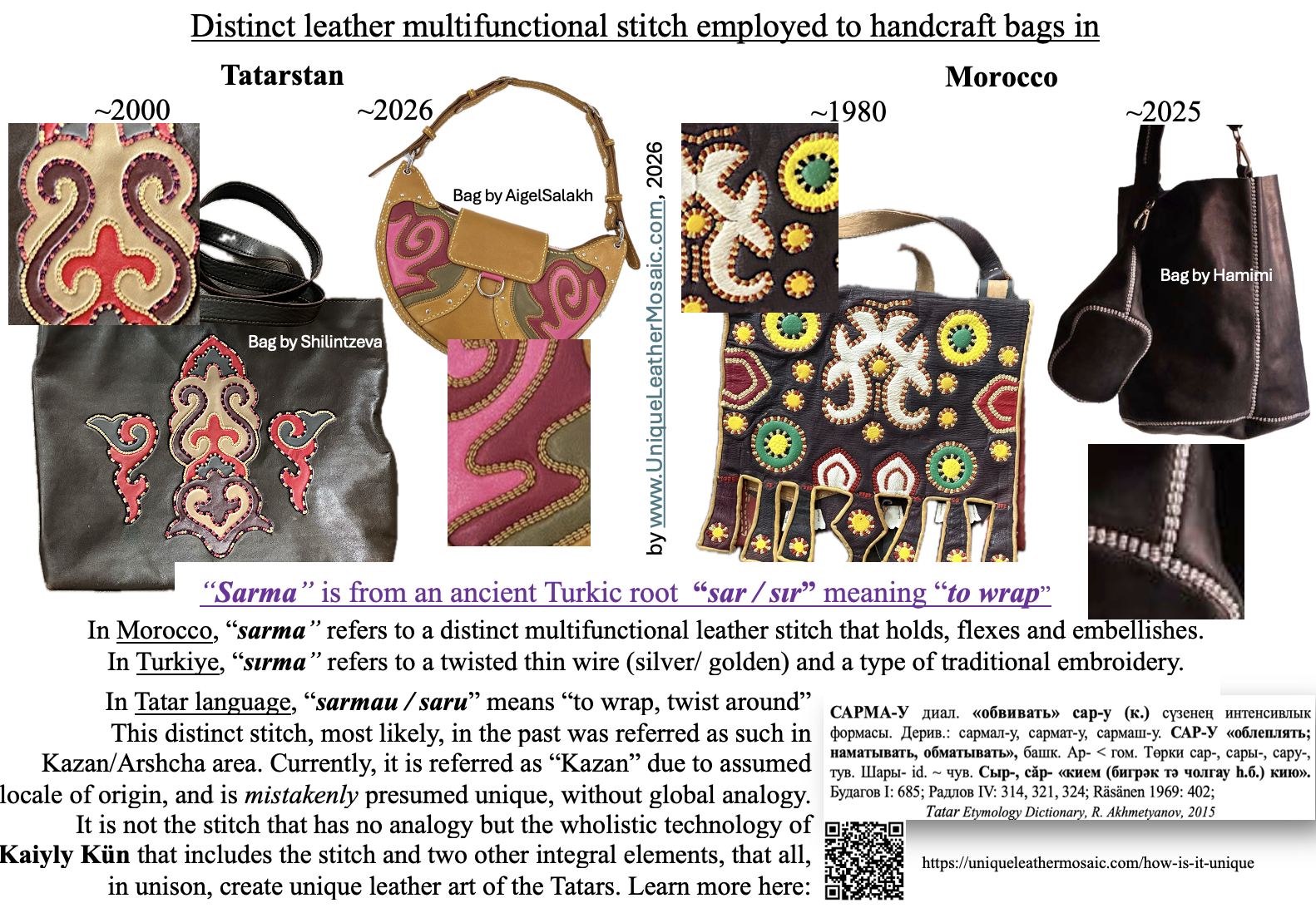
Nowadays, it is referred this way (sarma) in Morocco, the one of the only two locales where the distinct ancient stitch is still being successfully executed, by hands. The second location is Tatarstan Republic of Rossiyan Federation, specifically Kazan-Arshcha area. The original Tatar term for the stitch is lost/unknown and is currently being referred as “Kazan Zhouy” which, most likely, was originally referred as “сар(ма)у/ sar(ma)u”, a Tatar word from the same Turkic root that etymologically corresponds to the essence of the stitch. The essence of this impressively durable, flexible and decorative inner stitch is in several loops of decorative thread wrapped around a carrying waxed thread that adheres one leather piece to another. The technology of performing sarma stitching in Morocco slightly differs from how it is executed in Tatarstan. Check out these variations:
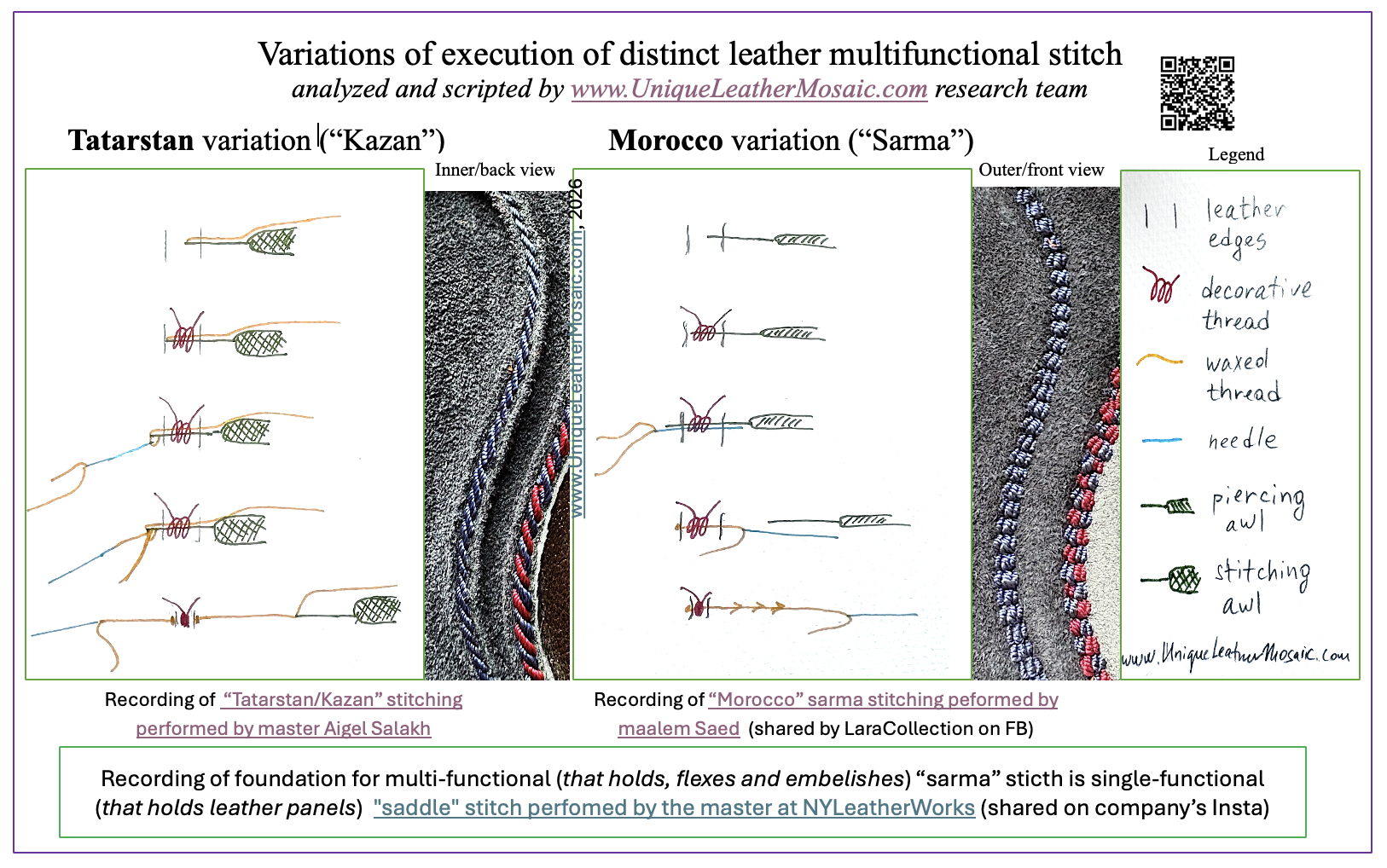
Recordings of the stitch executions: 1) Tatarstan/Kazan” stitching performed by master Sabira; 2) Morocco” sarma stitching performed by maalem Saed; 3) Foundation for the multi-functional (that holds, flexes and embellishes) “sarma” stitch is a single-functional (that holds leather panels) “saddle” stitch.

Can you identify the differences in the stitch execution? Isn’t it curious that people in faraway places (Tatarstan is ~ 3000 mi/ 5000 km away from Morocco) are still actively utilising the same ancient manual distinct leather stitching technique, but with variations in execution? Do you have an idea why? (please share if you do at Tatar.Mosaics) Would you agree that leather work created in Tatarstan is more ornamentally elaborate and intricate?

The leather items from Tatarstan are more aesthetically prominent because of creative collaboration of leather color, complex stacked patterns and the distinct stitching that are all integral elements of unique traditional art of the Tatars, Kaiyly Kün.

Examine the leather items hand-crfafted with Kaiyly Kün technology and without it

Inaugurating Turkic Languages Day!

The day of December 15th has recently been proclaimed by UNESCO (United Nations Educational, Scientific and Cultural Organization) as a World Turkic Language Family Day. In 2025, we are celebrating it for the first time!

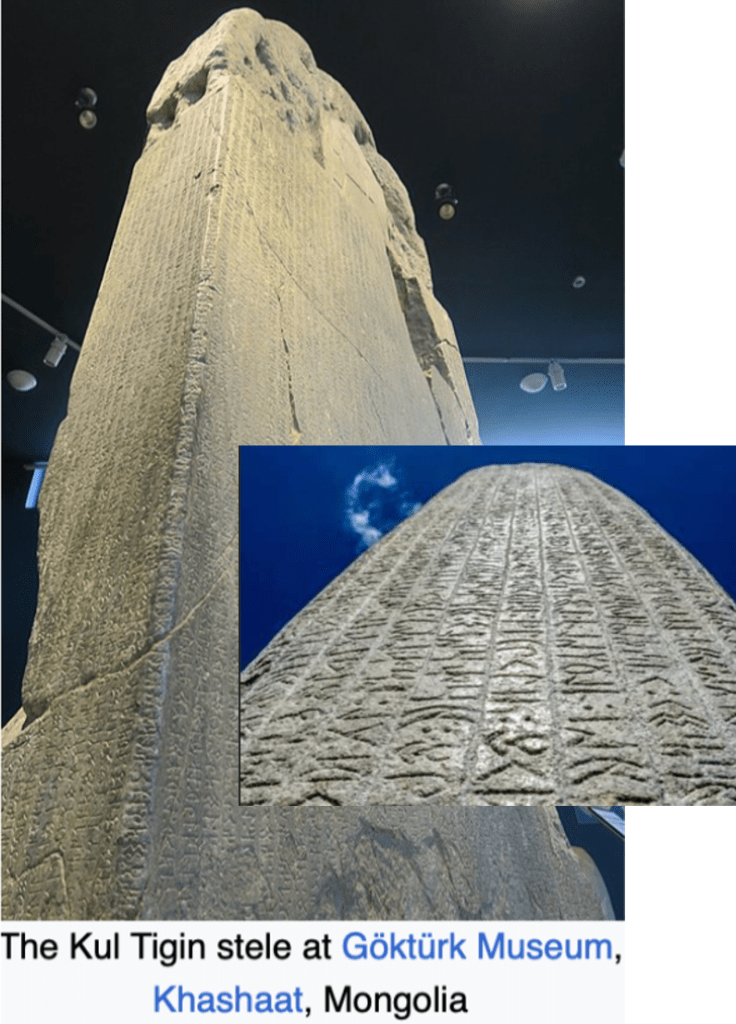
On this day in 1893 a linguist and turkologist Vilhelm Thomsen (1842-1927) made a very anticipated announcement that the text of the Orkhon Inscriptions (discovered in 1889 during the expedition of Nikolai Yadrintsev (1842-1894)) was deciphered (translation here). The 1300 years old inscriptions, also referred as Kul Tigin (684-731)  steles and Bilge Qaghan (683-734) inscriptions, found in Orkhon valley of modern Mongolia, are the oldest known written records of the Turkic language.

Out of ~8 billion people worldwide, roughly 200 million are speaking Turkic languages, ~7 millions of whom are the Tatar language speakers/ carriers, active and passive. Although the usage of the Tatar language is diminishing due to the prevalence of various lingua franca in the areas of modern habitats, there is a great interest in learning and preserving the Tatar language these days, simply because it connects to the roots (incredibly rich oral, written, material heritage) and to the other Turkic people.

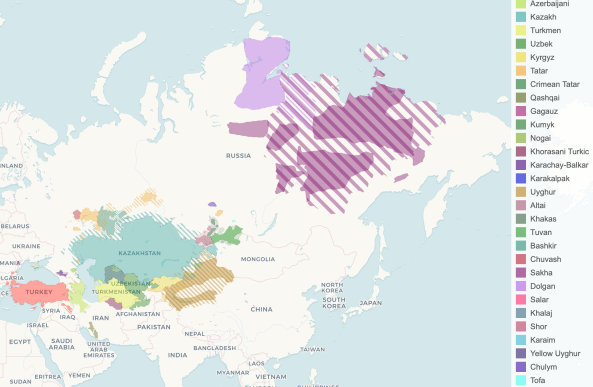
Turkic languages are characterized by the vowel harmony and agglutinative nature of grammatical relations between the words. According to the lexicostatistical matrix of Turkic languages and the article in Journal of Language Evolution, the Tatar language exhibits more than 50% of basic lexical similarities with most of the Turkic languages including Azerbaijani, Bashkir, Gagauz, Kazakh, Karakalpaq, Karachi, Khakas, KirimTatar, Turkish, Turkmen, Tuvan, Uyghur, Uzbek. To have an idea how closely they sound, just give a listen to Bulat Shaymi’s short song where he sings in 12 Turkic languages!

For several millennia, in the vast territories of central EuroAsia, impressive networks have been connecting, non-stop, the flow of goods, skills, thoughts through the well-established trading routes (Volga Route powered by the Volga Bulgars, ancestors of the modern Tatars, and Silk Road) that had been managed by various influential forces, including nomadic Saka/ Scythian EmpireTurkic KaganatesMongol Empire evolved into several Turkicized khanates later become referred as Turkistan (Turan by Persian sources, TransoxaniaCentral Asia by western sources) -the ethnonym represents a conglomerate of many Turkic-speaking states/“-stan”s-, Rossiyan Empire through 1917. 

Although Tatarstan is not a part of Turkestan geographically, the linguistic, customary and historic baseline of the Tatars (originally, Volga Bulgars) of the Volga-Ural area of modern Rossiyan Federation is linked to all Turkic people. The intelligible wide-spread Turkic languages have eased up the channels to carry on business, policies, thoughts, innovations, and the Tatars were instrumental in promoting successful collaborations and opportunities for the Turkic languages-speaking world and its neighbours creating so-called Tatar Empire, a term coined by Danielle Ross in her book.

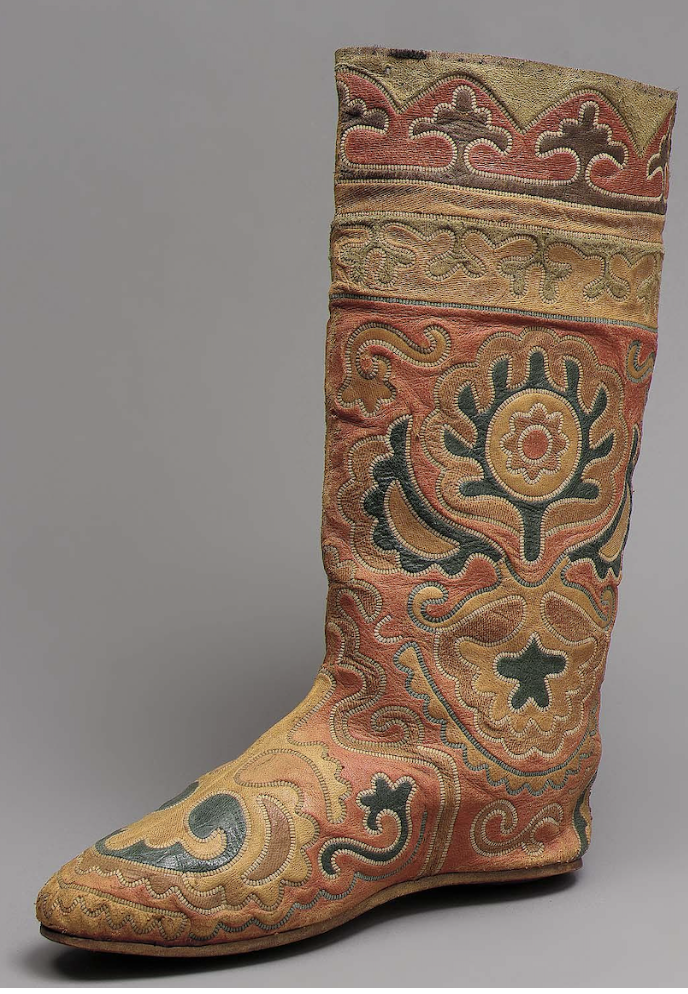
Material cultures of the Turkic people have many common features that speak to the unified sources of inspirations and beliefs (a subject for a separate post), the distribution of which showcases the collaborative nature of the networks. The simple fact that shchiteqlerboots uniquely decorated with Kaiyly Kün technology mastered by the Volga Tatarsexhibited in collections of many museums worldwide and labeled as originated from various Turkic-speaking places (such as Asia, China, Crimea, East & West Turkestan, Europe, Georgia, Indonesia, Hungary, Kazakhstan, Kyrgyzstan, Mongolia, Tajikistan, Tatarstan, Russia, Ukraine, Uzbekistan) speaks volumes.

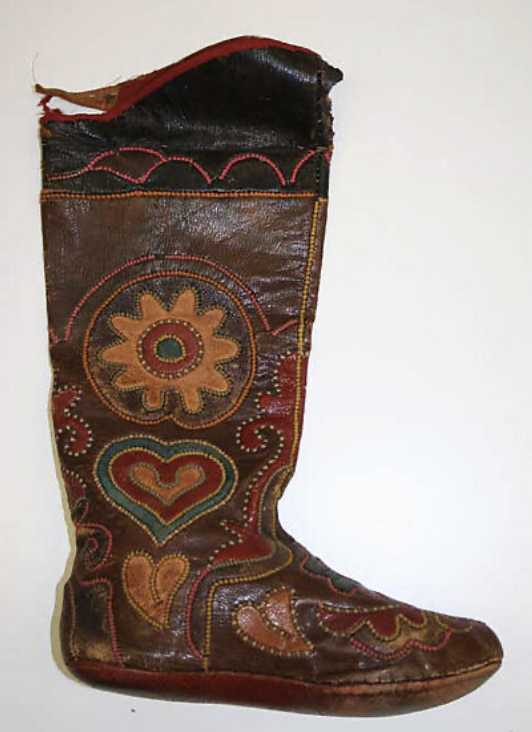
The above Images of shchiteqler are courtesy of online collections (linked further) of PennMuseum of University of Pennsylvania, USA, Museum of Ethnography of Hungary, Museum of Fine Arts in Boston, USA, Metropolitan Museum of Art, USA, Ethnography Museum of Sweden, British Museum of Great Britain.

The due credit and appreciation are not always given to the skilful developers of the unique art in those museum collections: Successful Tatar leather artisans and entrepreneurs had not only manufactured uniquely decorated footwear in its “birthplace” Kazan-Arshcha area of Tatarstan to sell globally, but also had travelled far to trade and open workshops in Central Asia/Turkestan, Caucasus, Eastern Europe, cities of Rossiyan Empire. They shared their exceptionally-processed leather technology inherited from the Volga Bulgars (referred as bulgari/ safiyan/ sahtiyan/ yuft’) and unique decorated footwear making skills, they trained apprentices throughout European and Asian continent for centuries up until early 20ies century.

Let’s celebrate, promote and practice the

Arts of Native “Skilled Tongues” and “Skilled Hands” everyday