A Force of Transcending Inspirations

A contemporary writer Nadeem Aslam’s phrase “pull a thread here and you’ll find it’s attached to the rest of the world” has inspired us to explore and pay tribute to myriads of impactful global contributions spanning millennia to shape the staple of human clothing – ornamented footwear. We are pulling the thread that uniquely and distinctly binds all decorative elements of soft leather shchiteqler to discover a continuum of captivating artefacts of material culture in the forms of vessels, stone carvings, organic fragments, paintings, photos, texts, cinematography…

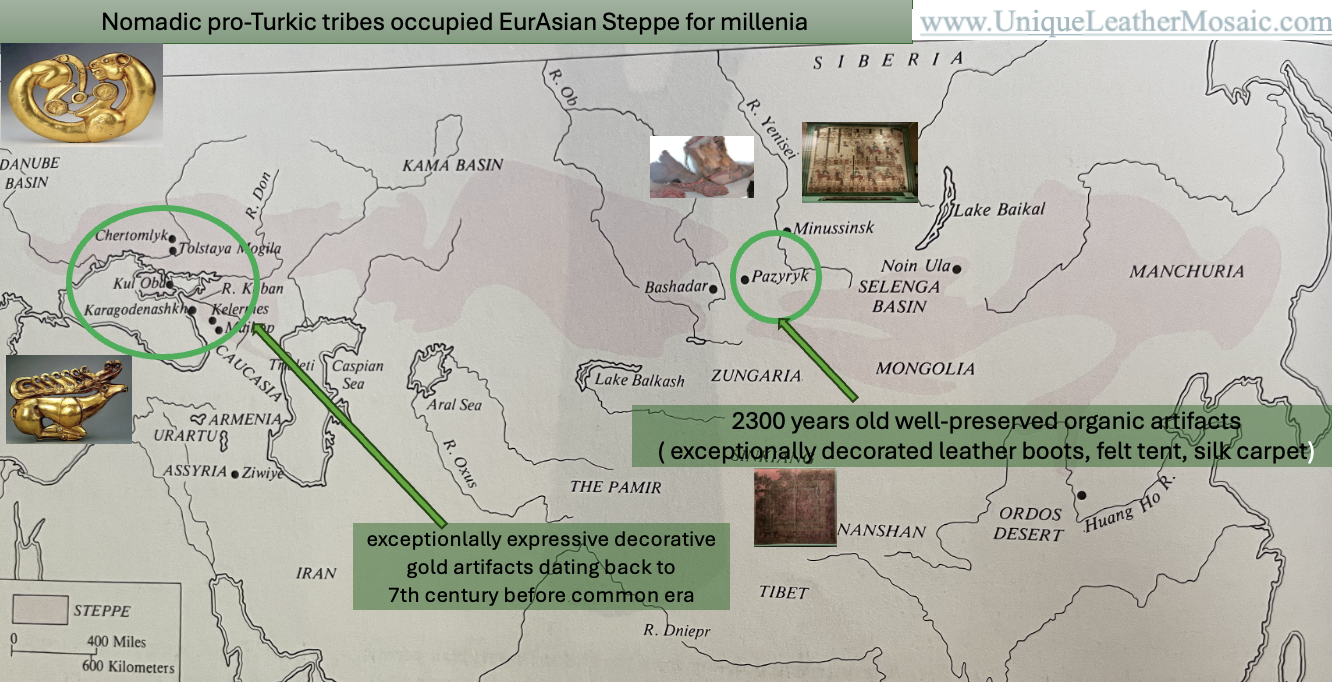
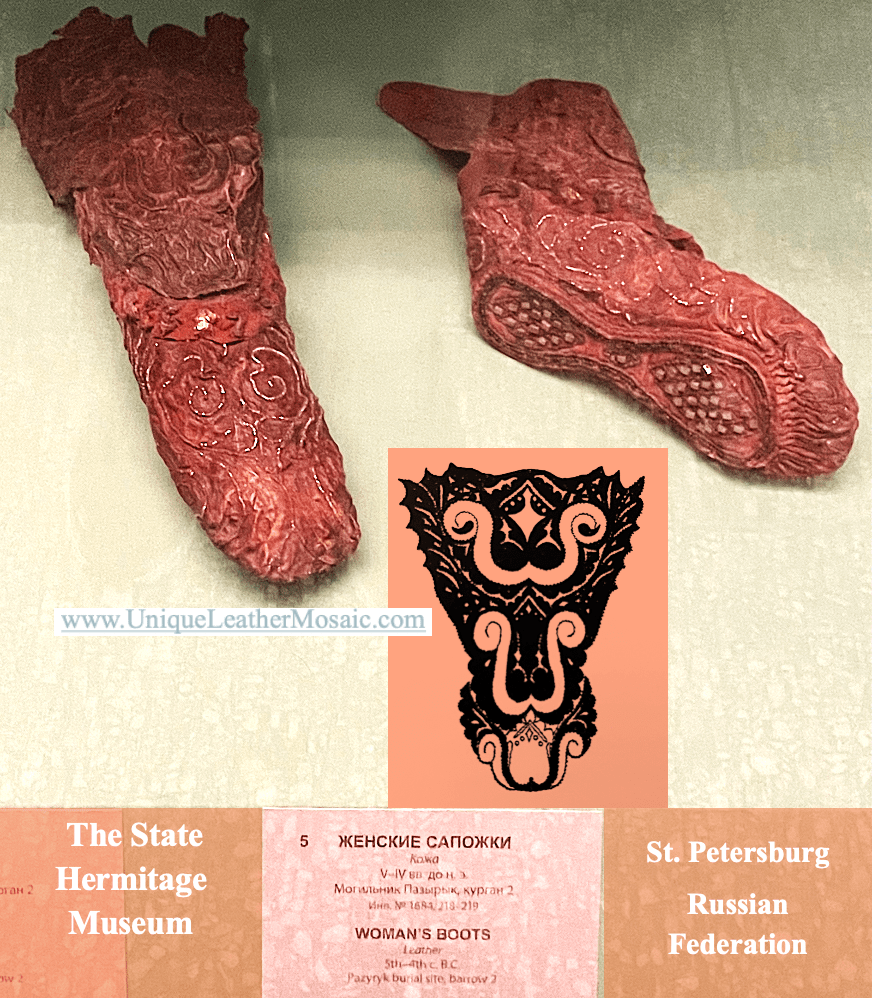
Tall protective footwear enters EurAsian nomadic people’s life during the times of domestication of a horse around 3500 BCE (before common era). The first depictions of people wearing foot coverings appear between 9th and 7th centuries BCE during the time of Assyrian rule (nowadays the territories of Iran, Iraq, Syria and Turkiye). A leather boot from Pazyryk burials (Altai mountains, nowadays in Kazakhstan, Mongolia) of 4th-3d centuries BCE is the earliest example of impressive leather craftsmanship and spiritual significance embedded in ornamentation.

Roughly one millennium forward, in ~7th century CE (common era), the Volga Bulgars carry on the spirit and skills of nomadic predecessors to, eventually, become well-known for their processing of soft colored fragrant leather (reffered as bulgari, saffian, later as morrocco, russian). In 14-16th century, the descendants of Volga Bulgars (nowadays referred as Kazan /Idel-Ural /Volga Tatars of Rossiyan Federation) master Qaiely Kün’ ( referred in English as Tatar Leather Mosaic) technology to create exceptionally-decorated saffian boots –shchiteqler- a desired-by-many footwear.

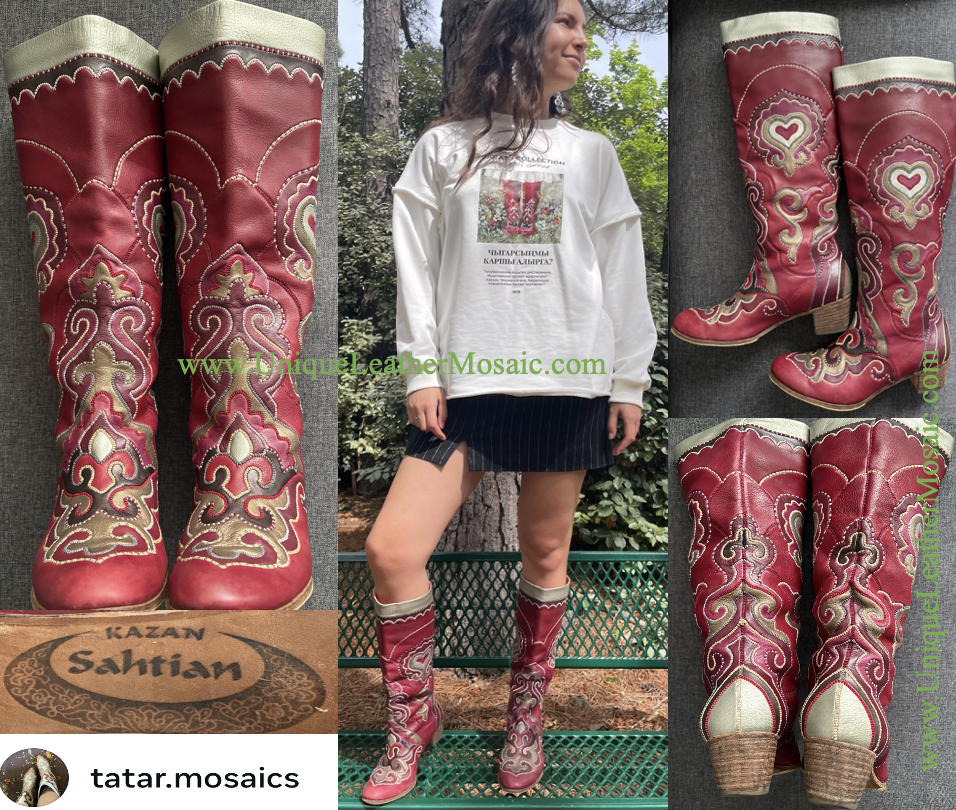
Some 500 years later, in 2025, a boundaries-and-times-transcending look of a modern Tatar girl by @tatar.mosaics incorporates saffian shchiteqler by Sahtian with a SABR sweater featuring a painted version of the boots by Guzel Khaib, and Aigel Salakh leather bag, designed with the same Qaiely Kün technology as shchiteqler, both utilizing a so-called “Kazan” zhoye (stitch) that is featured in a recent eponymous documentary by Mira Rahmat and Bai Khairullin. The look is a synergy of millennium-long human ingenuity, innovation and craftsmanship. It could not be possible without impactful contributions of many creative agents that feed from wisdom of previous generations and impact the future connections. 

There wouldn’t be a popular SABR Yaratu Collection sweater without all previous collaborations of human creativity. This sweater impressively empowers the modern wearers through signaling belonging or/and awe: it features two uniquely-Tatar cultural staples – shchiteqler and “mongly zhyr(soulful poem/song)  and offers a new, accessible way of “owning” a Tatar cultural icon. There wouldn’t be a talented Guzel Khaib’s famous painting without social virtual networks and the beloved Tatar song about a heart’s yearning for shared love “Shchygarsynmy Karshy Alyrga?Would you come to greet me?” (lyrics by Damir Garifullin, music by Valeriy Ahmetshin) originally performed in 1963 by legendary Tatar singer Ilham Shakirov. And so on…

We are grateful to all forces and links in the history that inspire creative spirit of modern artists. Reminded by Diana Darke’s “everything is a continuum – nothing just appears out of vacuum”, we promote a respectful and appreciative mindset: different, versatile, distinct people and cultures contribute and inspire the evolution of material heritage that is interconnected, and, thus, the most valuable!
Symbolic Power of Footwear

When your dream comes true and you, finally, can “touch” (…well…stay in front of ) the 2300 years old organic exhibit – the leather boots of a noble Altai woman -, a sensible connection with the past starts pulsating through your veins. You can actually feel the rhythms and visualise the reality of those times through the impressively intricate and symbolic decorative handwork captured on the boots. They have been waiting for so many years to be appreciated, interpreted.

The worldview of early EurAsian steppe nomadic people of Turkic background (ancestors of Bulgar-Tatars) dwelled on a strong belief  in procreation and progression of life as well as promotion of marriage and healthy offsprings. This core belief was protected by Tengri and Umai – the spiritual deities of well-being, wellness, family unit and woman health.

In artistic interpretation, the Bulgars-Tatars have been illustrating the code of wellbeing in the form of a stylised progression from the ground towards the sky. The creative way of showcasing this code was mastered in shchiteqler – a unique artistic form of Tatar people. A traditionally decorated shchiteq composition has four parts that corresponds to stages of human life: birth, growth, blossom, and afterlife. Each part is depicted through specific stylised symbolic elements that tell a story of the boot’s creator or owner. 

Emotional attachement

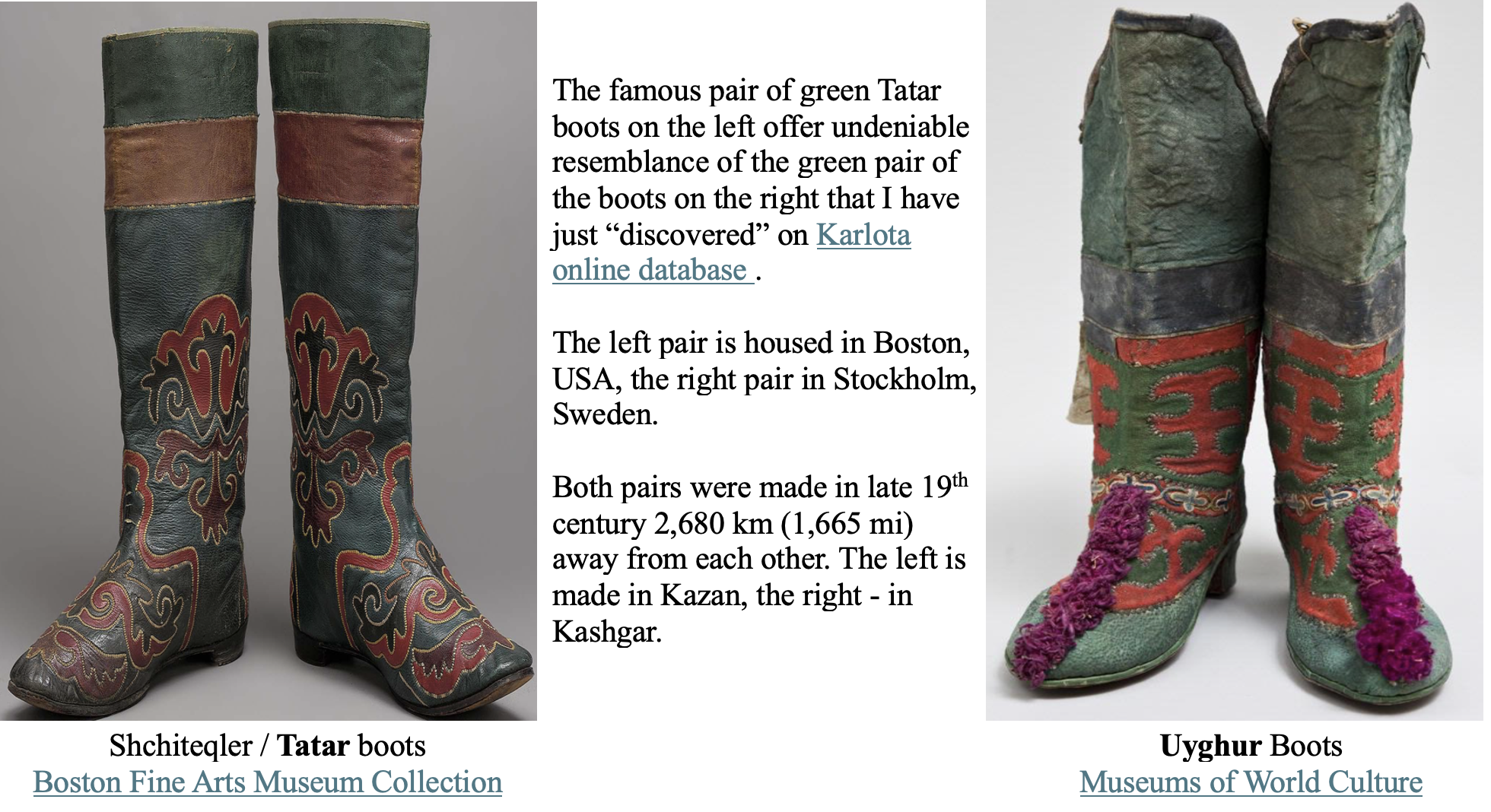
Human emotions present themselves regardless of time, distance, matter, subject. The strength of an emotion, though, depends mainly on internal depth of connections between self and an emotion “evoker”. For me, an acute yearning of a mother, whose children are reaching maturity and starting their independent life, is as prominent as a jaw-dropping surprise of incidental discovery of a pair of boots that carry heritage of myriads of networks that have been tying and uniting the world for centuries. 

Despite of geographical distance, both pairs share similarities that tie them to one origin – the EurAsian nomadic people (Saka/Scythians) who were impressively skillful leathercrafters. The Volga Tatars of then-Russian Empire mastered the decorated leather footwear craft to the levels unprecedented – the Tatar leather mosaic technique is unique in nature. The Uyghurs of then-Turkestan utilized the knowledge of boot composition and stitching shared between the skillful Tatars and Turkic people (trading routs had been buzzing, people had been mingling for ages). But, as one can notice in the pair from Kashgar, the Uyghurs ventured in different direction when putting creativity in decorating their boots. I.e., the Uyghurs placed colored fabric cutouts on top of the leather, put embroidered elements around shin and embellished the top with the bright pompons. All those elements are common features of the leather footwear created by the people dwelling over 6,991 km (4,344 mi) away, in the areas of Northern Africa (Morocco, Algeria, Egypt, etc.).

A desire to intricately decorate the wear that protects the foot is rooted in us (impressive designs found in Pazyryk burials date back to 4th century BCE) as deeply as emotional attachment to own children. Those two unite, connect, and tie us for centuries to come.

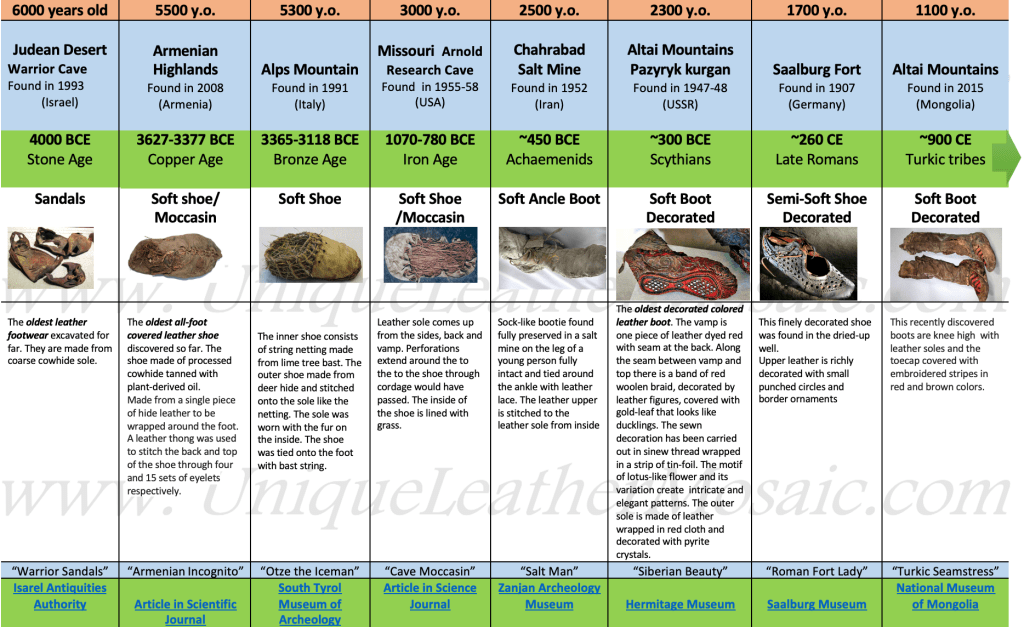
How Old Is the Oldest Leather Shoe?

The oldest (found so far) leather sandals were worn 6000 years ago! They were discovered in Cave of Warrior in Judean Desert in 1993.

The oldest all-foot covered leather soft shoe was found in the cave of Armenian Highlands in 2008.

The exceptional discovery was made by Soviet archeologists in 1947 in Pazyryk kurgans of Altai Mountains (south of modern city of Novosibirsk in Russian Federation), when the oldest ornamented leather boots were excavated from the burrows of Scythian nomadic tribes that had been waiting to be found for over 2300 years. All three recovered boots are decorated with intricate patterns and ornaments that bore sacred meaning for the owner.

The Tatar boots tradition is keeping the spirit and the leather craftsmanship of the nomadic heritage.

“Warrior Sandals”“Armenian Incognito”“Otze the Iceman”“Cave Moccasin”“Salt Man”“Siberian Beauty”“Roman Fort Lady”“Turkic Seamstress”
Isarel Antiquities Authority Article in Scientific JournalSouth Tyrol Museum of ArcheologyArticle in Science JournalZanjan Archeology Museum Hermitage Museum Saalburg MuseumNational Museum of Mongolia