Symbolic Power of Footwear

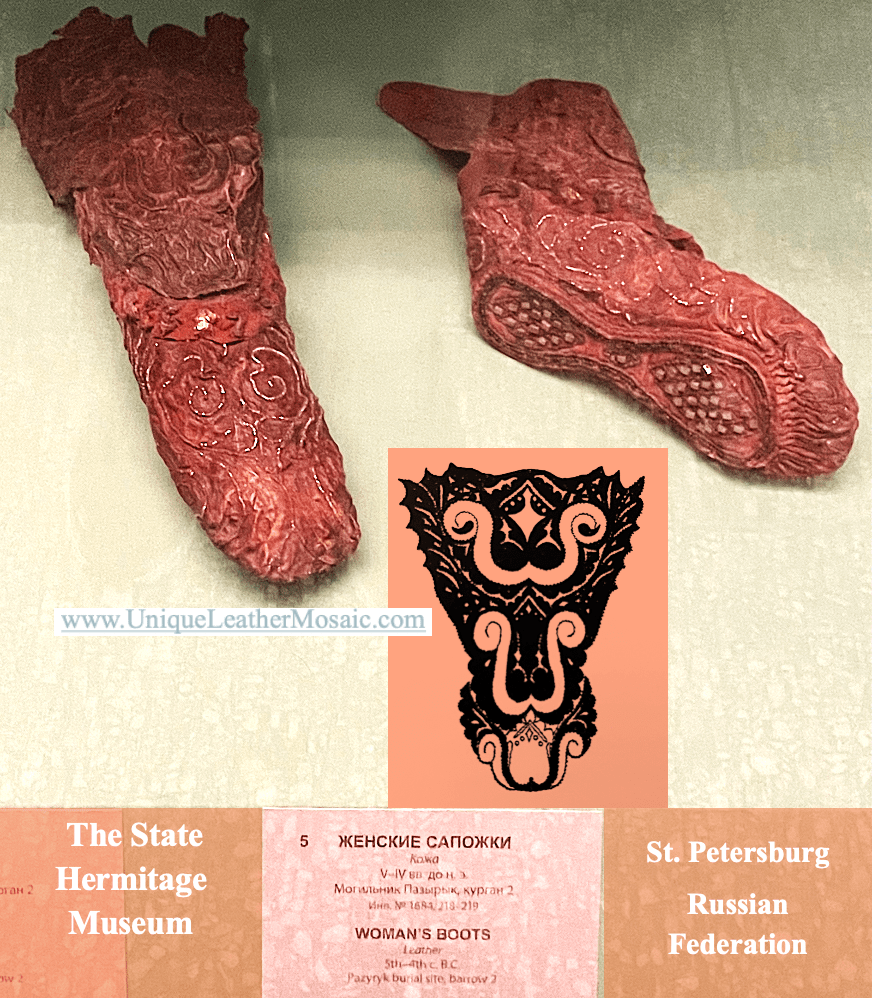
When your dream comes true and you, finally, can “touch” (…well…stay in front of ) the 2300 years old organic exhibit – the leather boots of a noble Altai woman -, a sensible connection with the past starts pulsating through your veins. You can actually feel the rhythms and visualise the reality of those times through the impressively intricate and symbolic decorative handwork captured on the boots. They have been waiting for so many years to be appreciated, interpreted.
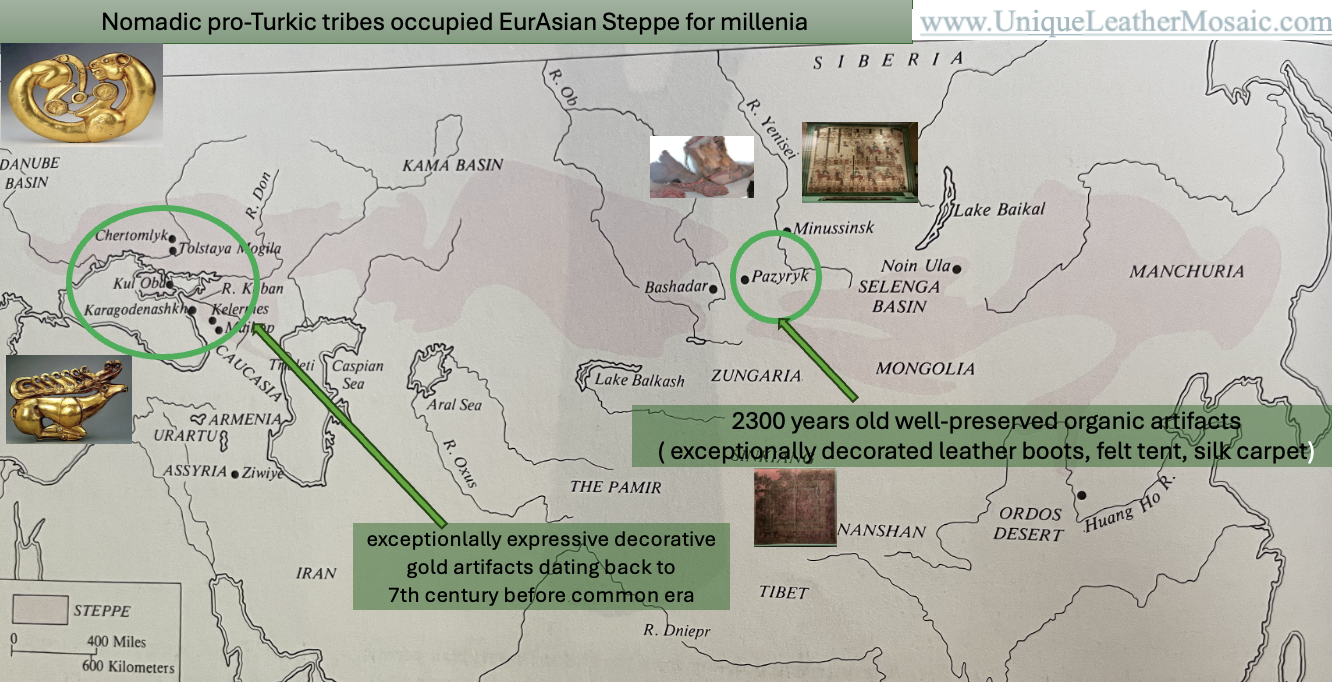
The worldview of early EurAsian steppe nomadic people of Turkic background (ancestors of Bulgar-Tatars) dwelled on a strong belief  in procreation and progression of life as well as promotion of marriage and healthy offsprings. This core belief was protected by Tengri and Umai – the spiritual deities of well-being, wellness, family unit and woman health.

In artistic interpretation, the Bulgars-Tatars have been illustrating the code of wellbeing in the form of a stylised progression from the ground towards the sky. The creative way of showcasing this code was mastered in shchiteqler – a unique artistic form of Tatar people. A traditionally decorated shchiteq composition has four parts that corresponds to stages of human life: birth, growth, blossom, and afterlife. Each part is depicted through specific stylised symbolic elements that tell a story of the boot’s creator or owner. 

Emotional attachement

Human emotions present themselves regardless of time, distance, matter, subject. The strength of an emotion, though, depends mainly on internal depth of connections between self and an emotion “evoker”. For me, an acute yearning of a mother, whose children are reaching maturity and starting their independent life, is as prominent as a jaw-dropping surprise of incidental discovery of a pair of boots that carry heritage of myriads of networks that have been tying and uniting the world for centuries. 

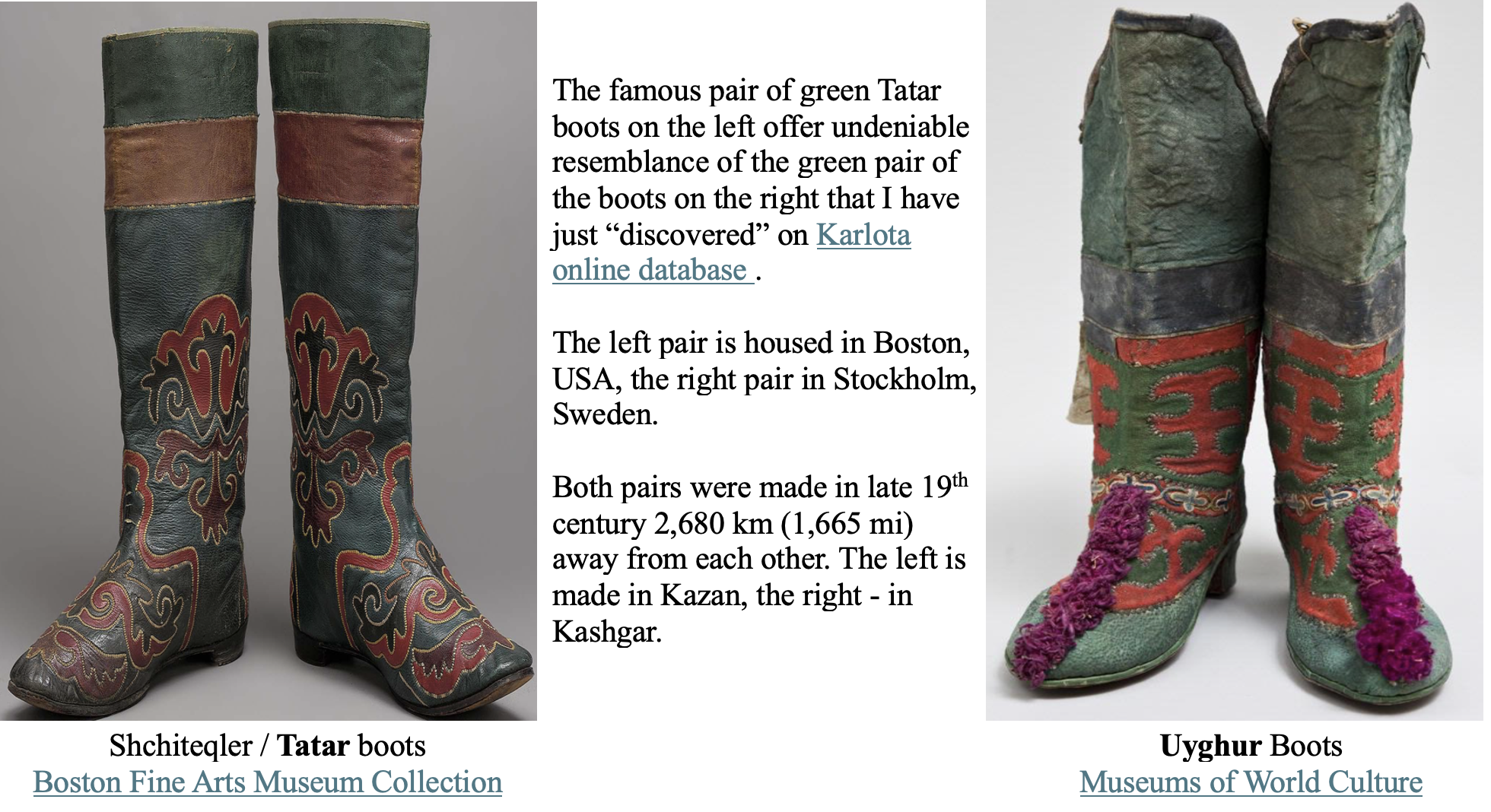
Despite of geographical distance, both pairs share similarities that tie them to one origin – the EurAsian nomadic people (Saka/Scythians) who were impressively skillful leathercrafters. The Volga Tatars of then-Russian Empire mastered the decorated leather footwear craft to the levels unprecedented – the Tatar leather mosaic technique is unique in nature. The Uyghurs of then-Turkestan utilized the knowledge of boot composition and stitching shared between the skillful Tatars and Turkic people (trading routs had been buzzing, people had been mingling for ages). But, as one can notice in the pair from Kashgar, the Uyghurs ventured in different direction when putting creativity in decorating their boots. I.e., the Uyghurs placed colored fabric cutouts on top of the leather, put embroidered elements around shin and embellished the top with the bright pompons. All those elements are common features of the leather footwear created by the people dwelling over 6,991 km (4,344 mi) away, in the areas of Northern Africa (Morocco, Algeria, Egypt, etc.).

A desire to intricately decorate the wear that protects the foot is rooted in us (impressive designs found in Pazyryk burials date back to 4th century BCE) as deeply as emotional attachment to own children. Those two unite, connect, and tie us for centuries to come.