Exploring Labyrinth In Marrakesh

It is a fact that overwhelming reliance on technological advances is eroding our memory. So, finding engaging activities to hone cognitive abilities is a must! What can be more engaging for the brain than challenge of finding your way without GPS (global positioning system)? One of the best places to be lost and search for the way out without a map are the mazes of Marrakesh Old Medina.
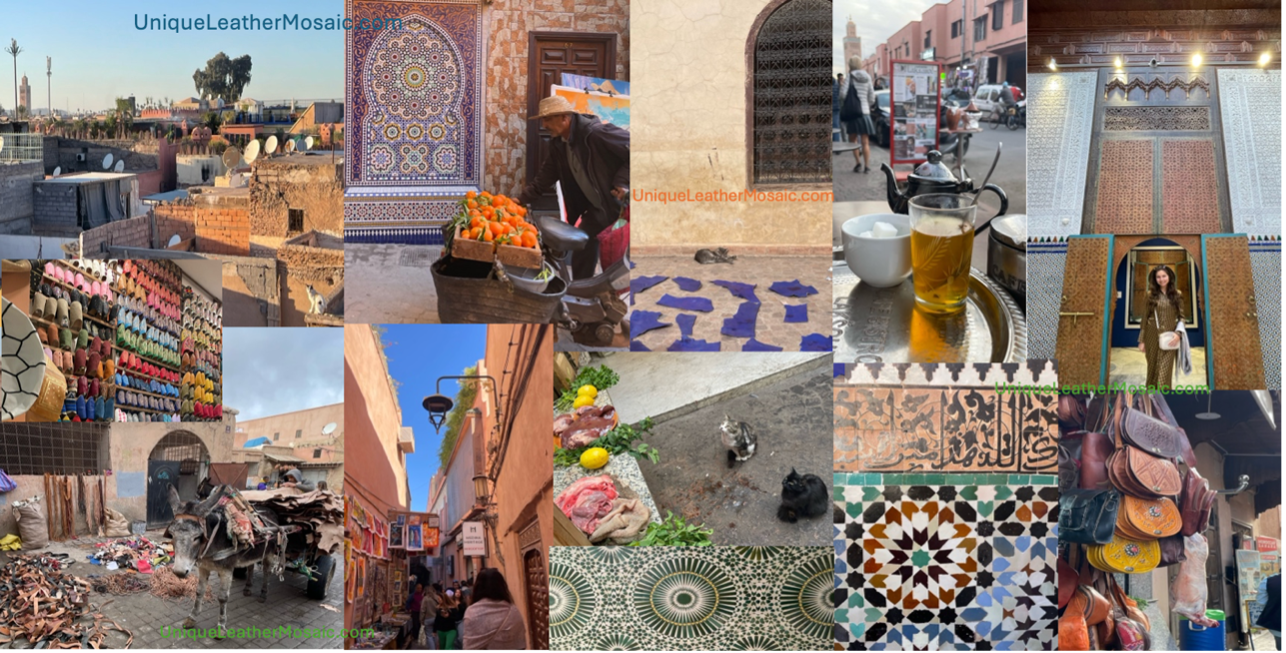
Rows of eye-catching, fragrant, colorful, locally sourced goods made of leather, fibers, brass, clay, straw. Endless flow of sellers, buyers, donkeys, cats, bikes. Mesmerizing geometry of shapes, blasts of vivid colors, clouds of fragrant aromas of simmered-for-hours dishes, soothing sounds of call for prayers and chatting in Amazigh, Arabic, French. Moroccan labyrinth of souks captivates and educates. Our goal of “not to be lost” were successful the more we practiced it. Although, the other goal, fueled by our passion to leather craft, was not so much.  We were on a mission to observe and document the decorative leather stitching technology that looks like “Kazan” stitch that has been utilized and mastered for centuries in Tatarstan. It is roughly 5000 km of air distance between Tatarstan and Morocco, but those are the places where, up to this day, this distinct manual decorative stitch is being actively used despite of pressing lures of mechanized world. 

In Marrakesh, we explored myriads of tiny workshops that had leather merchants and crafters working the magic of creating and attuning to the leather goods (Ottoman poufs, Berber bags, babouches), but every time we wondered about the leather decorators (stitchers and embroiders), there were silence, suspense, mystery around it. We were told that all decorative stitching happens in the female cooperatives in the Atlas Mountains.

When we asked to arrange for the compensated educational tour, various excuses were offered with subtle intention of pretense. We left Marrakesh without being able to see the stitching in action, but we got excited to find the only workshop that sells Tbourida boots. The boots that are worn during famous annual festival of riding horses and firing riffles that has been a Moroccan tradition since Middle Ages.

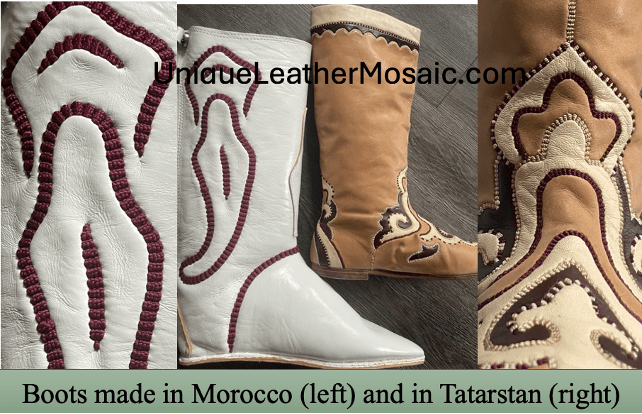
The decoration of these boots is made with the technology of leather mosaic that also the Tatar boots (shchiteqler) are made with. The decorative pattern cutouts and their attachment with distinct decorative stitch are similar, but shchiteqler are created with much more sophisticated technology of Tatar leather mosaic that is unique in its design complexity and intricacies of ornamental patterns and colors. 
The inquisitory nature of our short trip to impressive Morocco led us to having more questions than answers, specifically: How the exchange of leather crafting technologies happened in the time of Volga Bulgaria, Ulus Ulug, Kazan Khanate, Kazan Guberniya of Russian Empire (the earlier state names of current Tatarstan, the subject of Rossiyan Federation)? Is there any reason for the distinct manual decorative stitch to be deliberately guarded in Morocco? What do the Arabic words “sabra” and “sarma” referred in the souks mean? We might be digging for the answers to the first question for some time, but answers for the other two yielded some results thanks to…well… technological advances: internet. It seems that in a middleman economy of Morocco, creating an enticing enigma and baseless mysteries are the ways to keep the tourists coming. It turns out that:

An Arabic صبر  “sabra/sabr” (meaning “patience”) is referred to the cactus and the thread that is used to decorate the leather goods. It is widely believed that the thread is made from cactus, but is it really?: Here is an investigative story on searching the puzzling “sabra” silk.

An Arabic سارما “sarma” (from Ottoman Turkish صرمه  meaning “golden or silver thread, wire; wrapping”) is a term for the stitch that we have been looking for: It is performed similarly to the “Kazan” stitch. This compassionate FB page LarahCollection introduces the artisans of the Altai Mountains and their craftsmanship without the “burden” of the middleman. Sarma stitching is described as “a special embroidery work on leather that consists on sewing two pieces of leather together with special knots in the junction. All this work is done on the back of the leather”.

The page offers a video of the stitching that is performed almost in the same manner as “Kazan” stitch with a little difference. Can you engage your brain to identify this little difference by comparing the process of creating the Tatar “kazan” stitch and the Moroccan “sarma” stitch?
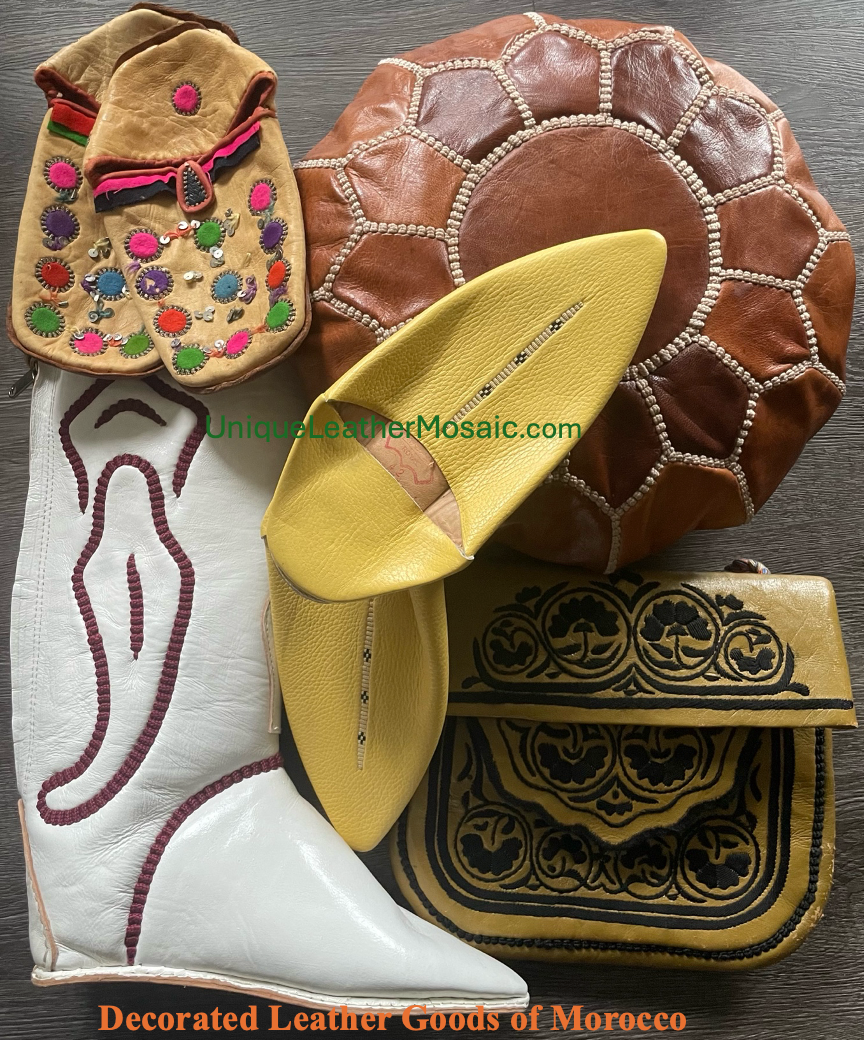
Decorated Leather Goods of Tatarstan and Morocco

Compare the Boots!

Comparing yourself with others is, generally, considered non-productive since each person is different, exceptional in their own way. But if urge to compare is stronger than ever, change the subject: compare the boots (they wouldn’t mind…). The boots that are beautifully decorated and carry the wisdom and warmth of generations through ethnic designs and intensive crafting! The boots that excite with all the attention to the owner, when worn! Look at the boots created with several leather crafting technologies and, definitely, with the purpose to impress (and keep an evil eye away).

These boots are crafted with three technologies of applying the leather ornaments: inlay, overlay and mosaic. Inlay and overlay attach colorful leather elements using the machine. Leather mosaic attaches the simplistic decorative cutout pieces from the inside of the boot by hand-stitching. The Tatar leather mosaic is the most complex, intricate and manual labour-intesive. The boots created with the Tatar leather mosaic technology is called shchiteq (shchiteqler for plural) in the Tatar language, the language of the Tatar people, the people who have been mastering the Art of Tatar Leather Mosaic for centuries.

If you want to learn the art of Tatar Leather Mosaic, there are several online resources:

 QulEse and Bulgari offer master classes in Kazan, Tatarstan, Russian Federation.

If you are interested in custom-made shchiteqler, email to uniqueleathermosaic at gmail.com.

Discovering Tatar Boots in Bukhara

Bukhara (pronounced “Bohoro” by locals who speak Tajik, Uzbek and Russian) once was a powerful city-state on the Silk Road. These days,

Bukhara is Uzbekistan’s charming gem with impressive heritage. It excites with plentiful of:

Islamic historic buildings dating back to 12th century with the original and restored elaborate vegetative and geometric decorations; – medrasas that educated many academicians in Middle Ages; – wooden doors with intricate carvings; – hand-span silk and cotton fabrics with unique designs called abr (from Pesian ابر “cloud“) or  ikat (from Malay mengikat “to tie”) ; – impressively detailed hand-woven silk carpets; – hand embroidered suzani (from Farsi سوزن “suzan” meaning “needle”) that became a synonym of Uzbek artistry.  

What is hard to find in Bukhara are ethnic shoes.There is barely any visibility of traditional footwear of ethnic people populating modern Uzbekistan (the land of indigenous people -Uzbeks, Uyghurs, Tajiks, Turkmen, Kazakhs, Kyrgyz) on the streets, in the museums, in the stores. Locals, these days, give preference to mass produced rubber shoes. In bazars, a small number of vendors sell masi/maxsi (from Arabic  مَسْ “masH” meaning “to wipe”), sometimes called shchiteq (from Tatar “чителгән итек“). Those are soft leather socks (made of halal sheep skin; in Arabic countries, those are called “khuff or kuffain”) that are worn with outer shoes. They are indented to be kept on when entering the mosque for prayer: during ablution it is considered sufficient to wipe those over. Antique shops and ethnographic museums showcase a tiny number of traditional footwear: embroidered fabric boots, full length black leather masi/ shchiteq, hard leather bashmak.

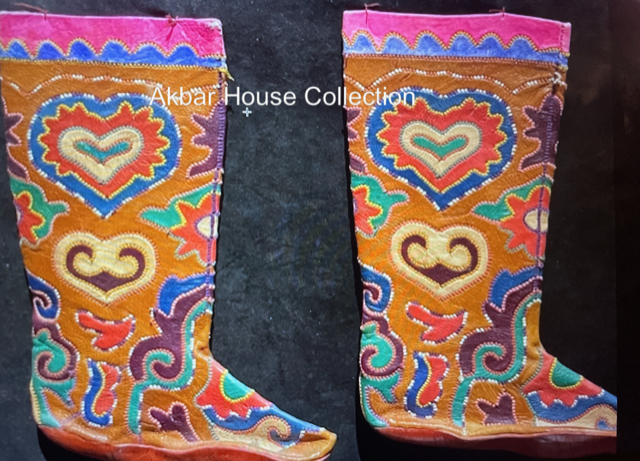
It was a treat to discover a pair of 19th century Tatar boots with ornamental patterns of various colors including vibrant pink (that is super rare) in Akbar House private collection! An antiques collector Akbar Aka mentioned that the boots are one-of-a-kind, not for sale, and that the “appliquéd” leather technique were developed by Volga Bulgars back in middles ages and that the boots like that are not being produced anymore.

We excited Akbar Aka with the fact that the craft is very well alive, that the boots, like his, are referred as Tatar or Kazan boots (shchitekler in Tatar, ichigi in Russian) and have been continuously crafted (although in much smaller quantities and with modernised looks) in Kazan, Tatarstan (the indigenous land of the Volga Bulgars). The ornamental technique of Tatar boots are often mistaken with a well-recognized techniques of appliqué (application of one piece/pattern on top of another) or embroidery. The unique Tatar boot technology (the ones that Akbar Aka owns, or the ones that are housed in Samarkand National Museum, or the ones that are mis-labeled/mis-identified in world museums, auction sites, mass online publications, etc.) aligns the colored leather patterns with twisted silk threads in intricate play of ornamental cutouts (like jigsaw puzzles). It is referred as Tatar Leather Mosaic or “Kayuly Kün”

Akbar House Collection features this ethnic outfit on its website. It is a masterful compilation of items, details, patterns, materials, attributes that many Turkic and Iranic people consider their own. The featured soft leather boots with elaborate ornamental patterns tell the story of ancient nomads of Eurasian steppes&mountains and of then-Volga-Bulgars-now-Volga-Tatars who embraced a leather medium to showcase exceptional craftiness, mastery, creativity and spirituality.

It Is Time For a Hat! One-of-a-kind Hat!

A recent encounter of a hat that is designed with Tatar Leather Mosaic technique excited the beginning of 2023! Wish this year is filled with new discoveries and learning opportunities!

A man on the photo (captured by V. Sucksdorff and Y. Blomstedt, now at Finnish Heritage Agency) looks like enjoying his warm hat or, maybe, the fact that he is married – the description mentions “wedding hat”. What can be more stunning than a groom with exceptionally decorated hat? It can easily beat a bride with exquisite Tatar boots…or can it?

The photo of a hard-working man resting on a grass in the village of Muujarvi of eastern Karelia’s (nowadays in Russian Federation) in the summer of 1894 pictures him wearing long boots and the hat.

The hat looks like the one that is commonly used by many ethnic groups populating the areas where cold is a daily normal (even during the summer months). The structure of this type of the hat has flaps that are intended to cover ears, chin, and neck. It is made of leather and fur to keep the head warm. In the description of the photo, the hat is referred as “turkislakki” or “karvaslakki” in Finnish. In Tatar (and several other Turkic languages) this type of hat is called “bürek/börek“or “kolakshchyn”. In Russian it is called “ushanka” or “treuh(ka)“. Interestingly, the words incorporate “ears” in both Tatar and Russian versions, emphasising the intentional design with ear coverings.

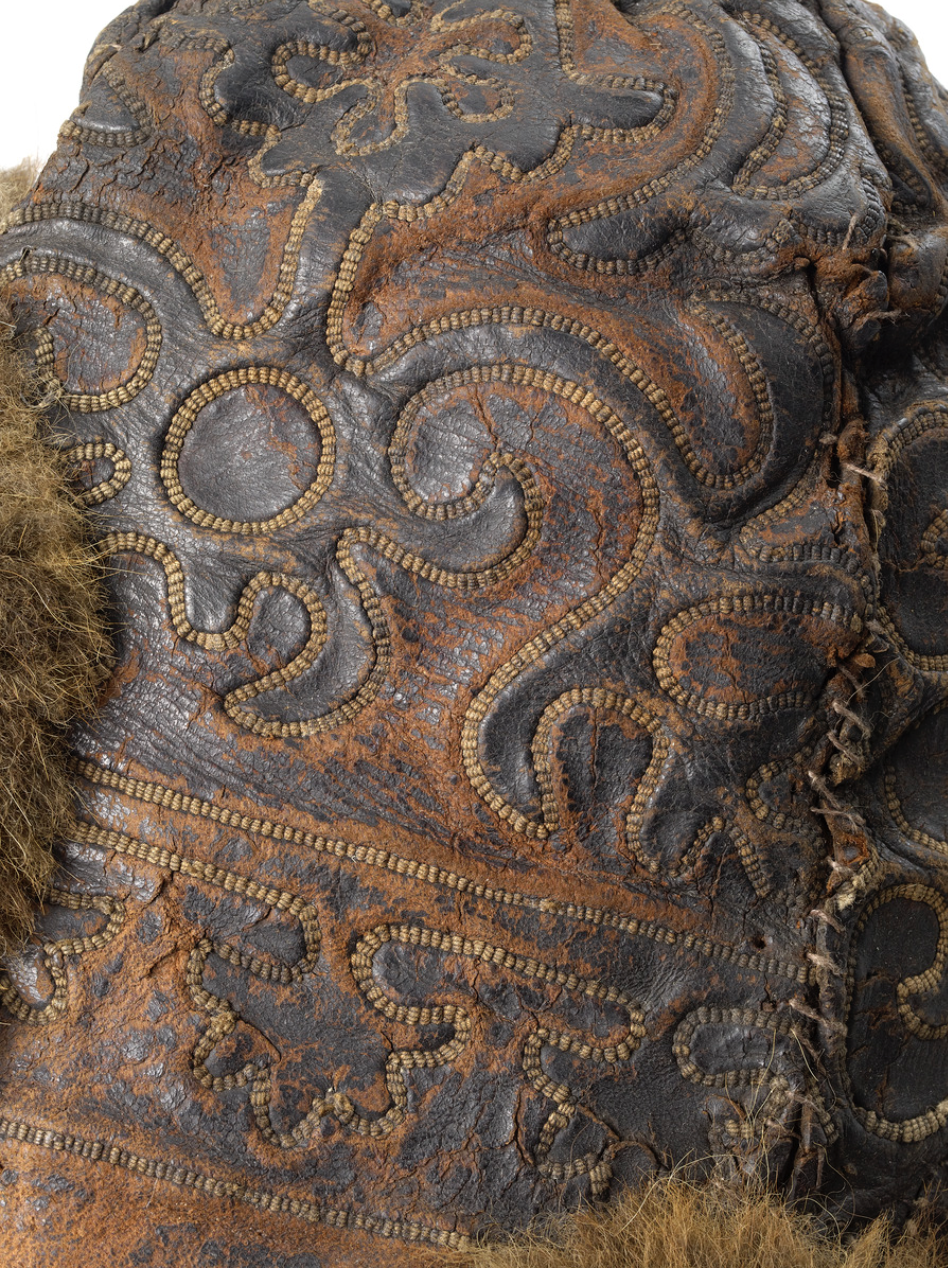
A closer look at the hat reveals so familiar Tatar ornamental patterned design attached from the inside by Kazan stitch. It is unknown how this unique “bürek” featuring exceptional decorations created with Tatar Leather Mosaic technique made it to the Scandinavian peninsula and where exactly it was crafted. The largest leather mosaic workshops had been historically located in Kazan area (over 1400 miles away from Muujarvi). Tatar people traditionally covered their heads with different types of hats made of fur, felt and cotton that are skilfully decorated with embroidery but barely with leather mosaic. The hat housed in the National Museum of Finland surprised us with the history and the potential of the Tatar Leather Mosaic.

A closer look to “burek” reveals Tatar ornamental patterns and Kazan stitch