Treasuring shchiteqler

A pair of intricately and skilfully decorated shchiteqler is good enough to feel and look exceptional! But when researching about uniquely decorated Tatar boots, the more the happier! 2025 has been a year of experiencing a great variety of shchiteqler: ~215 years old… ~3 months young…

Ledermuseum in Offenbach, Germany, owns allegedly the oldest pair in their archives; History and Ethnography Museum in Arsk, Tatarstan, Rossiyan Federation has the largest number of shchiteqler on display. These museums, that are located in two small European towns thousand miles away from each other, possess the treasure that unites them: tangible evidence of impressive leather craftsmanship of the Tatars. Both small towns of Arsk and Offenbach also share “gone” big fame of an epicenter of exceptional leather manufacturing: in late 18th-early 20th centuries both places were bustling with production and trade of quality processed skins and leather goods.

Deutsches Ledermuseum has an impressive collection of ~30 thousand leather artifacts, 12 of which are crafted with Kaiyly KünThis “extremely distinctive” technology identified as “Ledermosaik” in 1967 museum’s catalogue, as “Saffianleder mit Mosaiken, Mosaikarbeit” in 1980 catalogue, and“Lederinlegearbeit (leather inlay)” on the tags that are placed by actual items. On a windy fall day, a museum curator Leonie Wiegand revealed 7 pairs of tall boots, 1 pair of short boots, 2 pairs of boot shafts, 1 pair of shoes and 1 pouch that were acquired in 1939 from a collector Slg.Schmid of Vienna and have been preserved in excellent condition in the museum archives. One pair of the boot shafts are dated 1812 and noted as to be brought from Rossiyan Empire. Those are the oldest known (with exact date) shchiteqler but they look like have just been crafted! Each item in Deutsches Ledermusuem collection is an excellent representation of versatile assortment of products crafted with kaiyly kun technology in late 18-early 20th centuries. The design in each item does not repeat and speaks to incredible creativity of the Tatar individual and collective leather craftsmanship.

Out of 12 items, the only image that is permissible to be presented is the boot on the left that was photographed for the Deutsches Ledermuseum’s catalogue #6 published in 1980. (The copyright is: © Deutsches Ledermuseum, C. Perl-Appl. The caption reads: Boot, Kazan, Tatarstan, early 19th century). Crafted with Kaiyly Kün technology items are in the Deutsches Ledermusuem’s archives: They are neither displayed on the museum floors nor on the website. Hopefully one day, shchiteqler will be showcased digitally and/or physically for visitors to appreciate the craftsmanship of the Tatars.

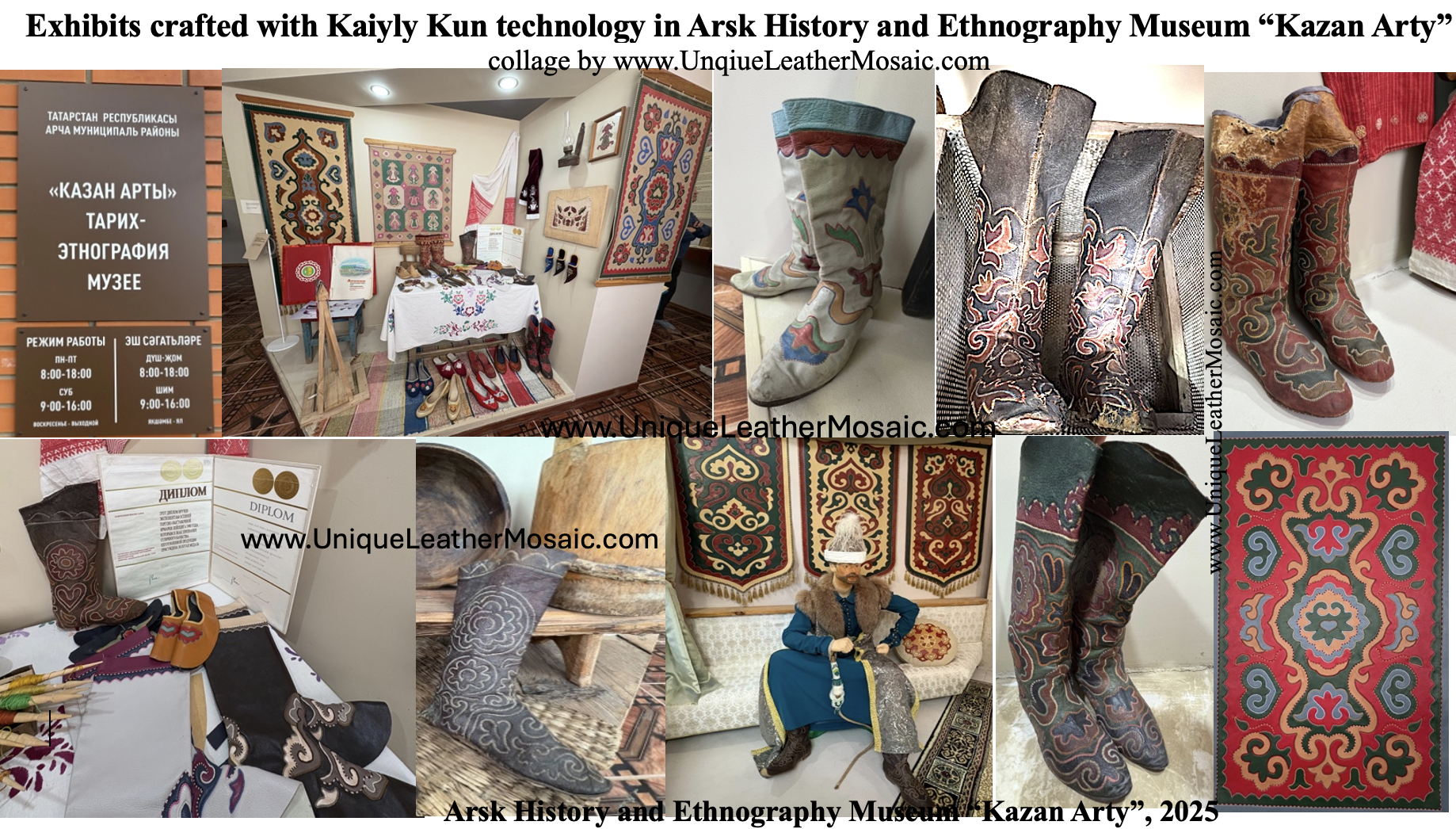
A collection of Arsk Historical and Ethnographic Museum brings unique Tatar leather craftsmanship to the perspectives that allow assessment of the Art of Kaiyly Kün through the centuries and into the current times. A large number (over 100 by a shy estimate) of Kaiyly Kün items are exhibited throughout two museum floors and are harmoniously weaved in permanent collection displaying rich history and ethnography of the town. The museum curators Gelyusya Khazieva, Alsu Murtazina, Irina Sinichkina, Regina Akhmatgalimova and others have put a lot of efforts in displaying leather items with distinctive Tatar decorations throughout the museum, allowing the visitors to engage and learn. The museum boasts of massive Kaiyly Kün collection because the Town of Arsk (Arshcha in Tatar language, ~30 miles north-east of Kazan) has been a cradle of Kaiyly Kün, the manual technology that has no analogy and has been mastered in this area for centuries. Arsk has been a backbone of Muslim thought and leather craftsmanship: Promotion of Islamic education and laborious manual artistry have been two prominent features of the Volga Bulgars-turned (Volga/ Idel-Ural)-Tatars for millennia

Leather processing and production of shchiteqler became profitable business in 19th-early 20th centuries because of increasing demand among European, American and internal aristocracy of intricate manually crafted work- the elaborately decorated handiwork practiced over millennia by people of various ethnic backgrounds of Eastern Europe, Western, Central Asia (referred as Tartars, Tatars, Muslims, Noghays, Turks, people of Turkistan, Asians, etc.). Up until late 1920ies, large quantities of traditional and customized shchiteqler had been manufactured by individuals and private enterprises in Arshcha (Arsk) and Kazan as well as workshopped far outside of these areas. After ~40 years of hiatus, production of shchiteqler (with simplified designs) continued in less quantities by Soviet state-owned Arsk Footwear factory from 1964 to 2006, the operation of which slowly dwindled in early 2000 due to inability survive novice market economy.

As of now, only a very small number of individual artisans continue producing shchiteqler and building on the legacy of ceased-to-exist Arsk factory. Company “Сахтиян / Sahtiyan” (from Persian ساختيا derived from ساخته “saht” meaning “fit/processed/made), is the only leather goods enterprise that carries reasonable inventory (in their one small shop in Kazan) of elaborately and uniquely designed shchiteqler but with the hides sourced from outside of Arshcha-Kazan. There is one functioning factory that processes leather these days in Kazan-Arshcha area: only cowhides and on a small scale. It is branded as “Сафьян (Safyan/ Saffianleder)”, another way of spelling of sahtiyan: this term carries the legacy of high quality soft colored fragrant leather (originally referred as Bulgari, later as Cordovan, Morocco, Russia) processed with exceptional original technology mastered by the Volga Bulgars, the ancestors of modern Tatars.

Although manually-crafted-with-Kaiyly-Kün shchiteqler are slowly re-gaining popularity, the amount of produced Tatar boots is not even 1% of allegedly estimated annual production of 3 million pairs during primetime. Our dream is that shchiteqler are back on the world stage, in demand so greatly that their supply exceeds the 19th century levels, and that young people are eager to learn, master and benefit from impressive and unique leather craftsmanship of the Tatars. 

Curious abut other leather art explorations and connections? Checkout our other postings/ publishings here or just keep scrolling down this page.
Connecting the Dots

“What is primary: a line or a circle?” I asked. “The dot” she answered with no hesitation.

 Fadhila Al Dhahouri of Global Center of Islamic Art, an impressive young visionary, made it very clear that the dot can undeniably evolve into both the line and the circle, and allow the infinite transformation into the beautiful, the harmonious, the inspiring. Fadhila and exceptionally talented Sandy Kurt empower the world for a “search for knowledge” through engagement of artistic potential within aesthetics of Islamic discourse. In which activation of creativity enables humanity and is connected with the higher power, Allah.

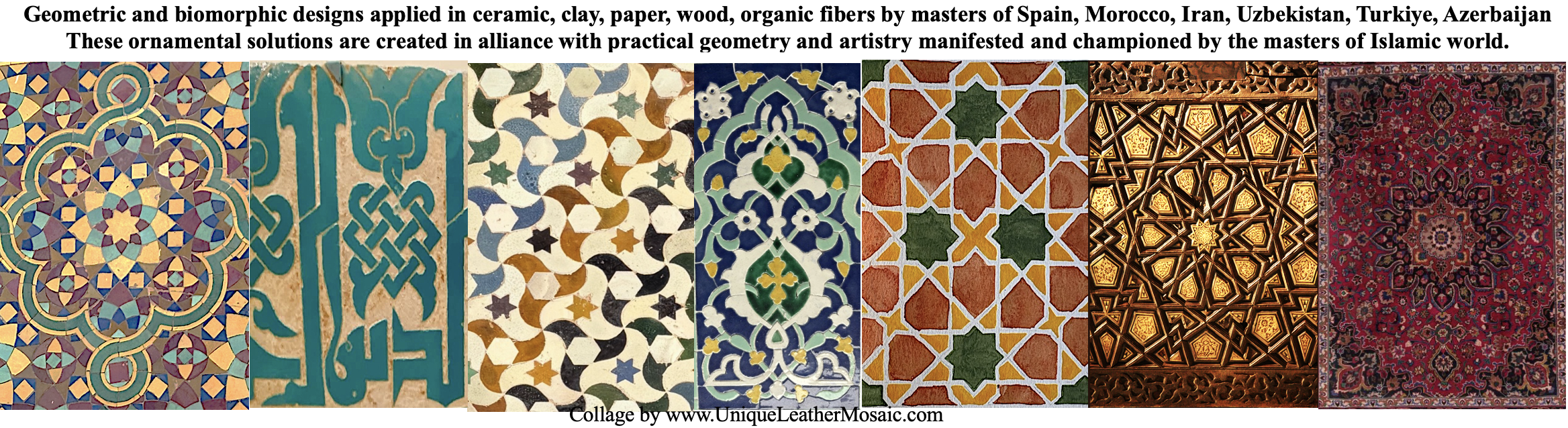
Specifically, the art of practical geometry is connecting individual’s humanity and internal energy through interplay of dots, lines, circles – visible or hidden. This unity is built on paramount importance of symmetry, balance, harmony, precision, order and the internal individual desire to seek for those. For centuries, guided by structure, spiritual energy and eternal potential of geometry, myriads of ornamental solutions have been mastered. They all offer deep engagement to the ones who create them and the ones who seek the learning. 

With knowledge that “geometry enlightens the intellect and sets one’s mind right” (Ibn Khaldun’s (1332-1406), we have been exploring the role of Islamic aesthetics and practical geometry in the ancient leather art of the (Volga) Tatars, the descendants of the Turkic nomads of EurAsia (Turkic Khaganates of 6-8th centuries) and the settled Volga Bulgars, whose indigenous lands are referred these days as Tatarstan Republic. Volga Bulgaria were the first northernmost civilization that in 922 officially accepted Islam under the mission of Ibn Fadlan, the envoy of Abbasid caliph al-Muqtadir. In 10-13th centuries, Volga Bulgaria had manifested itself as a powerful center for Islamic education, science, art and lifestyle.

The Volga Bulgars’ Islamic knowledge, esthetics and material culture had been transmitted through immense trading channels of those times, so-called Volga Trade route and Silk Road. People of Volga Bulgaria have continued being a backbone of Muslim networks despite of complex and endless military, political, religious, authoritarian, colonizing processes. The descendants of the Volga Bulgars are now called the Tatars. Representing the largest and the most spread-out ethnic minority in ~17 mln. sq. km. territory of Rossiyan Federation, the modern Tatars have been slowly recovering their collective memory loss of their own impressive Islamic history. The leather art of the modern (Volga) Tatars serves as a vessel that has protected the core from turbulent realities, the vessel that carries a powerful blend of Tengri’s connection with nature and Allah’s empowerment of humanity.

  • Two more worth sharing quotes:

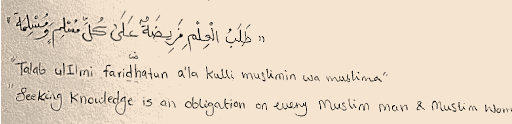
from Quran (hand-written and translated by Fadhila) on obligation of seeking the knowledge by both Muslim man and woman. This motto is worth following by any, fidel or infidel. The modern reality is increasingly and intentionally complex, and the survival in it is possible only with developed critical thinking.

from ibn al-Haytham’s (965-1040) “The Optics” (snapshotted from Windy Shaw’s book) on never-ending complexities of the world. Ibn Al-Haytham’s statement compliments the Quranic wisdom and emphasizes the constant search for the truth using the senses

Defining ageless, timeless, borderless

Longing for a pair of soft, hand-crafted shchiteqler is a no brainer. The Tatar boots’ undeniable appeal, unforgettable artistry and luxurious feel leave no one indifferent – little or old, ages or miles apart.

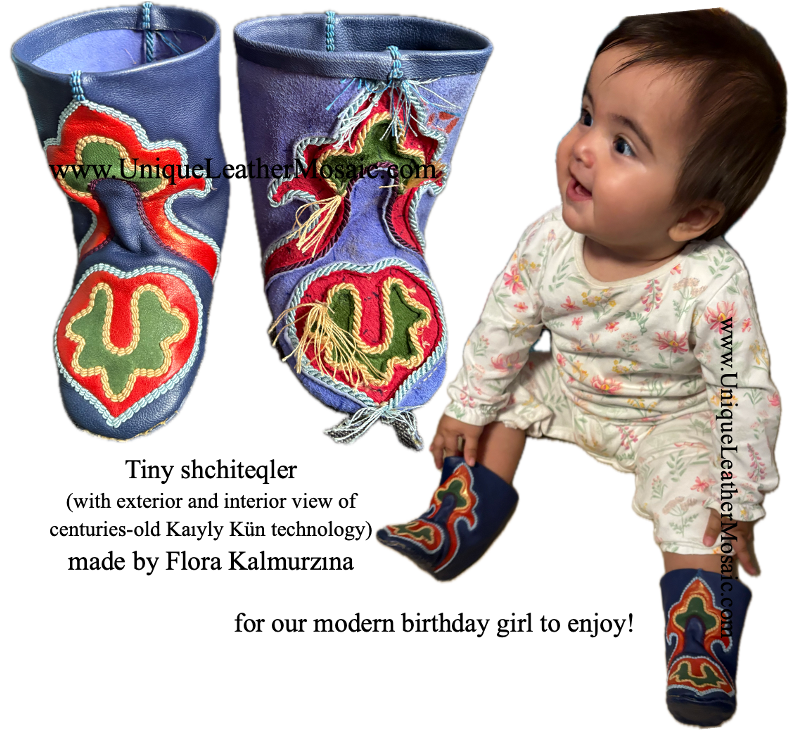
Our cutest model, Beekeh, who is celebrating her first anniversary this week, here in USA, thousand miles away from her birth country of Turkiye – is rocking the Tatar shchiteqler that she borrowed from a 50-year-old young-looking doll, whose Tatar ethnic outfit was lovingly crafted by 80-year-old Flora Kalmurzina in Kazan.

Flora hanum could not have imagined that her tiny shchiteqler (hand-stitched in 2012) would be adored by a little beauty in 2025, over five thousand miles away from Kazan, Tatarstan. A hundred years before and over one thousand miles apart in the city of Istanbul in 1912 while writing short story “Kezhul shchiteq”, the prominent Tatar genius Gayaz Iskhaki could not have fathomed that an iconic Tatar footwear craft would have survived the tumultuous beginning of the 21st century mostly due to humble efforts of amateurs like Flora Kalmurzina. 

Although Beekeh is not yet knowledgeable of exceptional value of shchiteqler made with the unique technology of kaiyly kün (aka Tatar leather mosaic), her excitement is comparable with little Ahmadulla’s anticipation described in Iskhaki’s story. It opens up with the boy waiting for his father bring him a coveted pair of shchiteqler, a symbol of status and wellness in early 20st century. Little boy has been dreaming about the boots made from the highest quality fragrant supple goat leather that had been processed with exceptional technology mastered by the Volga Bulgars (ancestors of the Tatars) over thousand years ago…

Linking time and space via material culture and emotional response allows experiencing past, present and future in one continuum. Exploratory connections encourage appreciation of history and respect to collective memory that are foundation for meaningful future!

Wondering if Ahmadulla got his dream shchiteqler? Gayaz Iskhaki’s “Kezhul shchiteq” short story is written in Tatar language, originally with Arabic script. It has been transliterated in Cyrilic and Latin. You can read a Latin version here, a Cyrillic version here. Audio recording is also available here. Google offers a good translation into English of the Cyrillic version but not the Latin. Want us to reveal you a twist in the plot? Message us in Instagram.

A Force of Transcending Inspirations

A contemporary writer Nadeem Aslam’s phrase “pull a thread here and you’ll find it’s attached to the rest of the world” has inspired us to explore and pay tribute to myriads of impactful global contributions spanning millennia to shape the staple of human clothing – ornamented footwear. We are pulling the thread that uniquely and distinctly binds all decorative elements of soft leather shchiteqler to discover a continuum of captivating artefacts of material culture in the forms of vessels, stone carvings, organic fragments, paintings, photos, texts, cinematography…

Tall protective footwear enters EurAsian nomadic people’s life during the times of domestication of a horse around 3500 BCE (before common era). The first depictions of people wearing foot coverings appear between 9th and 7th centuries BCE during the time of Assyrian rule (nowadays the territories of Iran, Iraq, Syria and Turkiye). A leather boot from Pazyryk burials (Altai mountains, nowadays in Kazakhstan, Mongolia) of 4th-3d centuries BCE is the earliest example of impressive leather craftsmanship and spiritual significance embedded in ornamentation.

Roughly one millennium forward, in ~7th century CE (common era), the Volga Bulgars carry on the spirit and skills of nomadic predecessors to, eventually, become well-known for their processing of soft colored fragrant leather (reffered as bulgari, saffian, later as morrocco, russian). In 14-16th century, the descendants of Volga Bulgars (nowadays referred as Kazan /Idel-Ural /Volga Tatars of Rossiyan Federation) master Qaiely Kün’ ( referred in English as Tatar Leather Mosaic) technology to create exceptionally-decorated saffian boots –shchiteqler- a desired-by-many footwear.

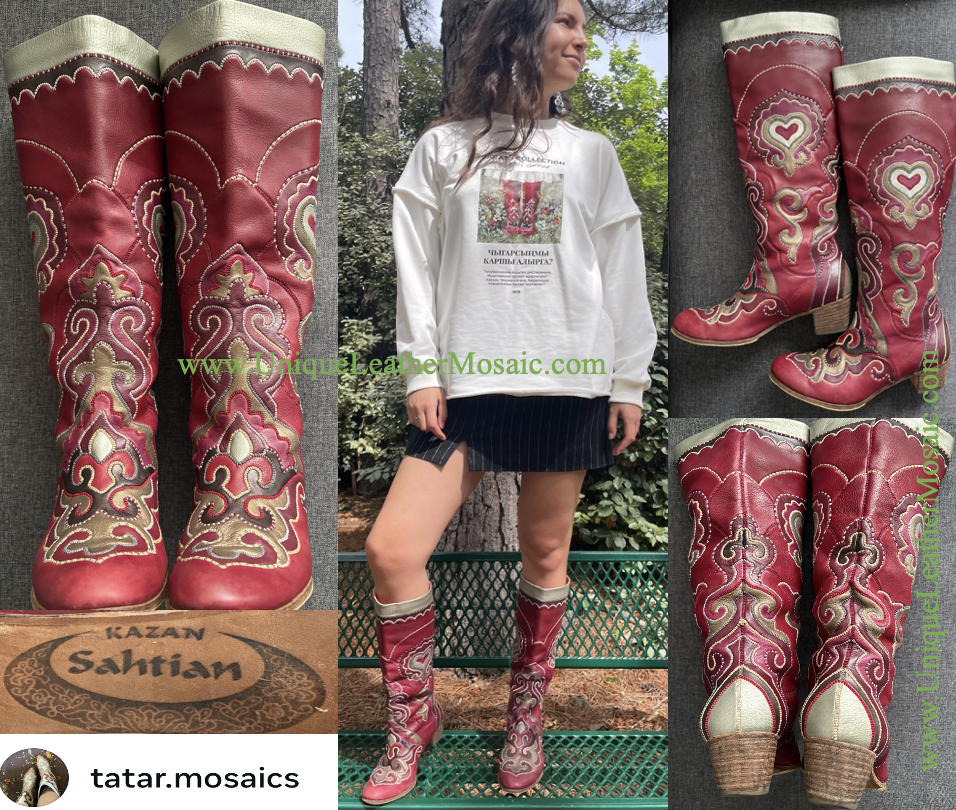
Some 500 years later, in 2025, a boundaries-and-times-transcending look of a modern Tatar girl by @tatar.mosaics incorporates saffian shchiteqler by Sahtian with a SABR sweater featuring a painted version of the boots by Guzel Khaib, and Aigel Salakh leather bag, designed with the same Qaiely Kün technology as shchiteqler, both utilizing a so-called “Kazan” zhoye (stitch) that is featured in a recent eponymous documentary by Mira Rahmat and Bai Khairullin. The look is a synergy of millennium-long human ingenuity, innovation and craftsmanship. It could not be possible without impactful contributions of many creative agents that feed from wisdom of previous generations and impact the future connections. 

There wouldn’t be a popular SABR Yaratu Collection sweater without all previous collaborations of human creativity. This sweater impressively empowers the modern wearers through signaling belonging or/and awe: it features two uniquely-Tatar cultural staples – shchiteqler and “mongly zhyr(soulful poem/song)  and offers a new, accessible way of “owning” a Tatar cultural icon. There wouldn’t be a talented Guzel Khaib’s famous painting without social virtual networks and the beloved Tatar song about a heart’s yearning for shared love “Shchygarsynmy Karshy Alyrga?Would you come to greet me?” (lyrics by Damir Garifullin, music by Valeriy Ahmetshin) originally performed in 1963 by legendary Tatar singer Ilham Shakirov. And so on…

We are grateful to all forces and links in the history that inspire creative spirit of modern artists. Reminded by Diana Darke’s “everything is a continuum – nothing just appears out of vacuum”, we promote a respectful and appreciative mindset: different, versatile, distinct people and cultures contribute and inspire the evolution of material heritage that is interconnected, and, thus, the most valuable!

Compare the Boots!

Comparing yourself with others is, generally, considered non-productive since each person is different, exceptional in their own way. But if urge to compare is stronger than ever, change the subject: compare the boots (they wouldn’t mind…). The boots that are beautifully decorated and carry the wisdom and warmth of generations through ethnic designs and intensive crafting! The boots that excite with all the attention to the owner, when worn! Look at the boots created with several leather crafting technologies and, definitely, with the purpose to impress (and keep an evil eye away).

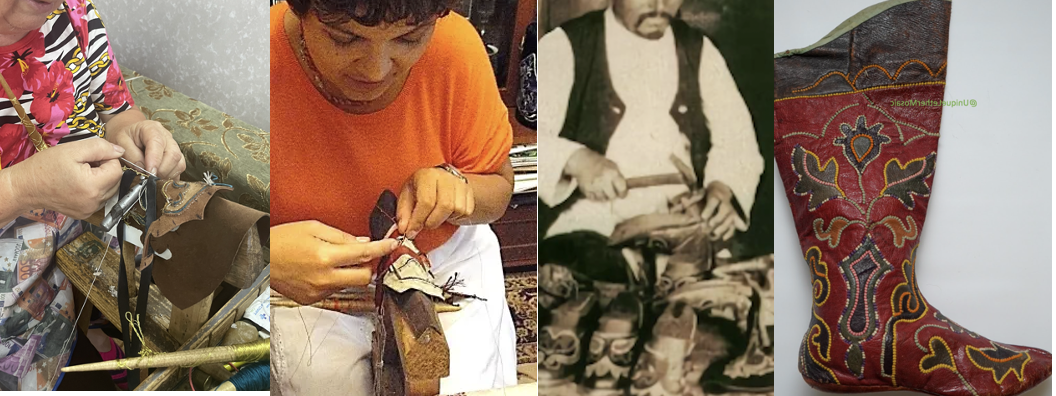
These boots are crafted with three technologies of applying the leather ornaments: inlay, overlay and mosaic. Inlay and overlay attach colorful leather elements using the machine. Leather mosaic attaches the simplistic decorative cutout pieces from the inside of the boot by hand-stitching. The Tatar leather mosaic is the most complex, intricate and manual labour-intesive. The boots created with the Tatar leather mosaic technology is called shchiteq (shchiteqler for plural) in the Tatar language, the language of the Tatar people, the people who have been mastering the Art of Tatar Leather Mosaic for centuries.

If you want to learn the art of Tatar Leather Mosaic, there are several online resources:

 QulEse and Bulgari offer master classes in Kazan, Tatarstan, Russian Federation.

If you are interested in custom-made shchiteqler, email to uniqueleathermosaic at gmail.com.

Praise the Hands!

Dr. Ramilya Saubanova’s exceptional handwork

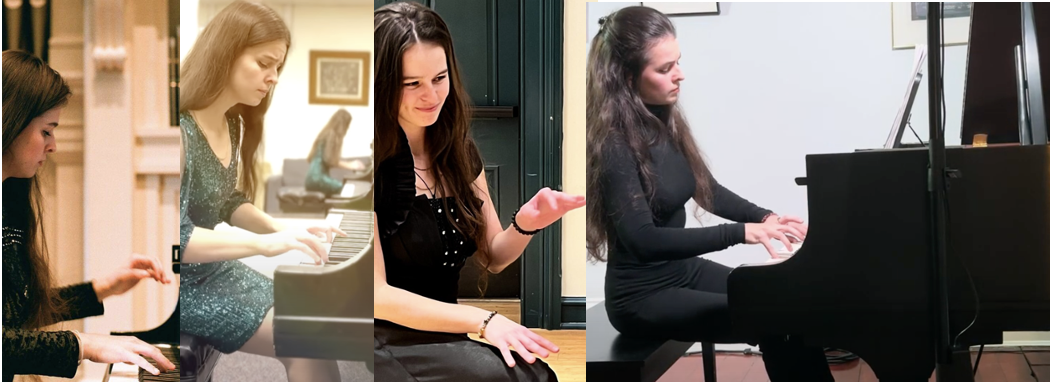
The magic of hands’ movements producing the music that melts the hearts and fills the souls with warmth is undeniable when Ramilya Saubanova performs the Tatar composer Rustem Yakhin’s Prelude. Ramilya’s skilled hands create a cloud of emotions, connections and memories that captures the listener to the core. The sounds of Ramilya’s interpretation of Tatar classics are simultaneously resilient and vulnerable thanks to the pianist’s deep understanding of Tatar rich heritage. Ramilya Saubanova’s introduction of Tatar composers to the American audience is of exceptional value: It delivers unique and vibrant compositions to the world stage to be appreciated. 

The trained hands of an artist are precious: capable of creating a masterpiece that touches a soul, evokes emotions, excites senses, empowers actions. Ramilya Saubanova’s capturing performances are lined up to indulge the senses in unforgettable ornamentation of Tatar music and mesmerizing handwork.

Ramilya’s talented work, for us, is like a pair of shchiteq – uniquely and intricately designed boot – crafted with patient and skilled hands that keep the centuries-long tradition of Tatar Leather Mosaic alive. 

Skilled and patient hands produce the shchiteqler – a Tatar unique heritage

It is crucially important for humanity to keep and appreciate intangible and material heritage of all people, because the culture of every ethnicity, even as small as the Tatars, contributes to vibrancy, diversity and well-being of a global society. 

Tatar Leather Mosaic at Raleigh International Festival

This year the introduction of Tatar culture and arts at the 28th annual International Festival in Raleigh, North Carolina has become inevitable because the theme was “Art, Crafts and Music”. The Tatars have so much to share and to be proud of! There are several unique art techniques that the Tatars developed, among which Tatar leather mosaic takes the special place. This year the festival was attended by over 25000 guests. Debutant of the festival -Tatar cultural exhibit – was warmly welcomed and heavily visited. Amazing volunteers from different cultural backgrounds (Tatar, American, Uzbek, Indian, Chinese…) helped to put together and run the booth.

Boot showcase

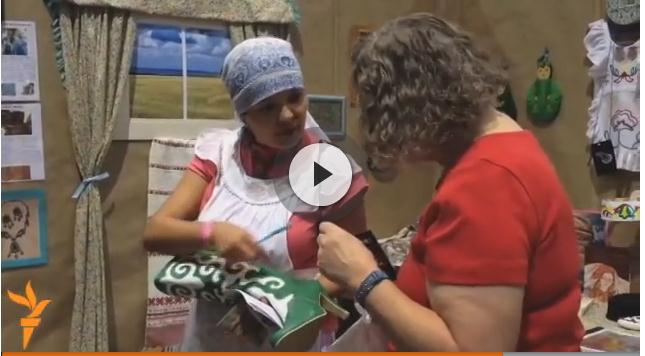
Explaining that the boot has been stitched by hand

Over 3 days we explained our guests who are the Tatars, where majority of them live, why Tatar culture is different from Russian, what are the arts and crafts that Tatars are accountable for. We showcased Tatar leather mosaic, embroidery, weaving, jewelry, book illustrations. We gave opportunity to listen to Tatar music, to repeat Tatar dance moves and to decorate paper boots; aprons and hats by very own Tatar ornamental patterns.  We observed such emotions as surprise, when guests learned about the ethnic group the majority have never heard before; the excitement, when the guests realized that they discovered something new and interesting; the amazement, when they saw how the leather mosaic is created… I, particularly, will never forget the big amazed eyes of a young girl when she realized that all the boots in the exhibits were made by hand.

I hope this first experience of showcasing Tatar arts and crafts to such broad American audience is a good start in changing stereotypical associations of Tatars with Mongols, warriors and peace breakers. I want Tatars to be well-known as peaceful, creative, innovative, sport-loving and caring people with culture and arts to be inspired and strived for.

I want to thank everyone who supported and encouraged me to organize and run the exhibit! I am, particularly, expressing my cheers to an exceptional American girl – Lily – whose incredible desire to learn and enjoy Tatar language, whose unimaginable inner power and strong and humble personality inspire me to diligently spread the word about the Tatars and their rich and mesmerizing culture.