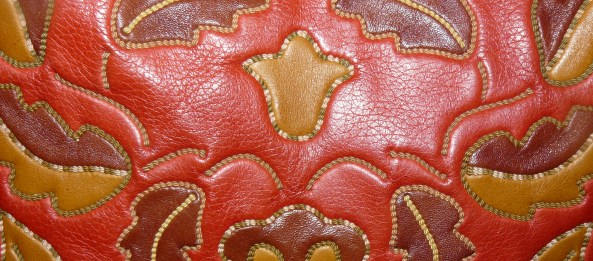
The Tatars have been proficient in jewelry, textile, embroidery and leather crafting for centuries. The Tatar decorative art carries traces of delicate and intricate combination of floral, vegetative, zoomorphic, geometrical elements that are influenced by traditions and beliefs of Saka (Scythians), Turkic nomads, Islamic artful interpretations of beauty. The art of leather mosaic is a unique artistic form mastered by the Volga Tatars: it stacks and aligns cutouts of ornamental soft colored leather patterns by cord-like decorative inward stitching. Variations of curvilinear lotus-, horn-, clouds–like stacked shapes create the baseline for the leather mosaic designs that are symbolic in nature.
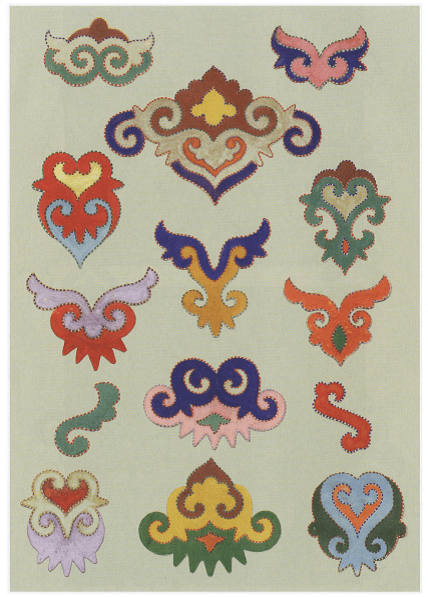
Above, one of many illustrations from the seminal work of Tatar professor Fuad Valeev,a trailblazer who, in 1974 (during repressive-to-minorities period of then-Soviet Union) authored a manuscript on the origins, unique features, plentitude and impact of the Tatar traditional ornamentation and decorative art on Russian and Eurasian cultures. The book “Tatar Folk Ornaments” is considered a staple for modern artists who preserve and promote the Tatar art. You can view the illustrations from the book on ornamika.com.

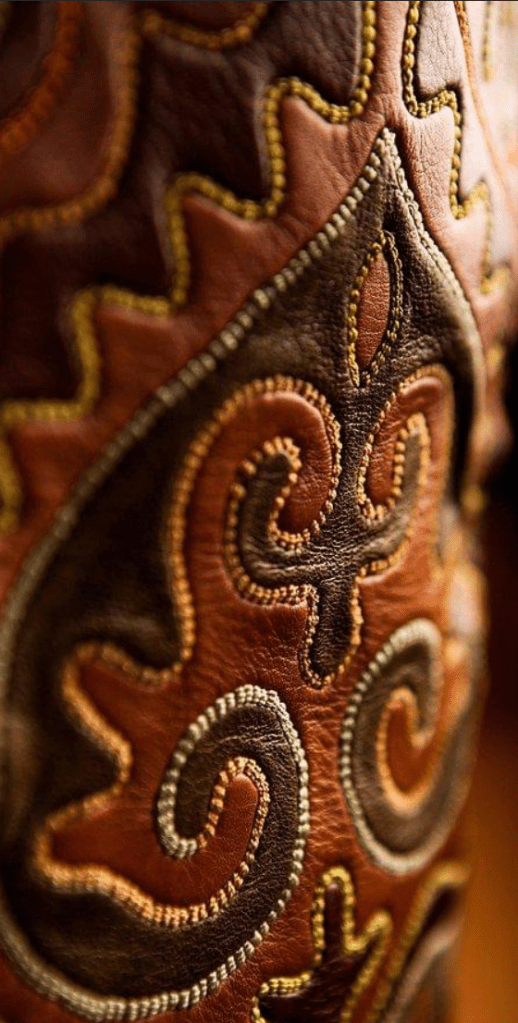
Stylised motifs of sprouts, leaves, palmettes, brunches, flowers, wings, antlers display an understanding of the world by ancient people. A durable surface of the footwear offers an excellent canvas to tell the story of human harmony that is closely connected with nature and spiritual power of Umay and Tengri. The Volga Tatars harnessed the potential of the leather medium to create a shchiteq – an exceptional combination of the artistic and the functional, where each element is stacked in the meaningful designs that are open for interpretation but the key symbolic features are universal: tree of life, cornucopia, fertility, value of family, respect to mother and higher power.
In artistic interpretation, the Bulgars-Tatars have been illustrating the code of wellbeing in the form of a stylised progression from the ground towards the sky. The creative way of showcasing this code was mastered in shchiteqler – a unique artistic form of Tatar people. A traditionally decorated shchiteq composition has four parts that corresponds to stages of human life: birth, growth, blossom, and afterlife. Each part is depicted through specific stylised symbolic elements that tell a story of the boot’s creator or owner.


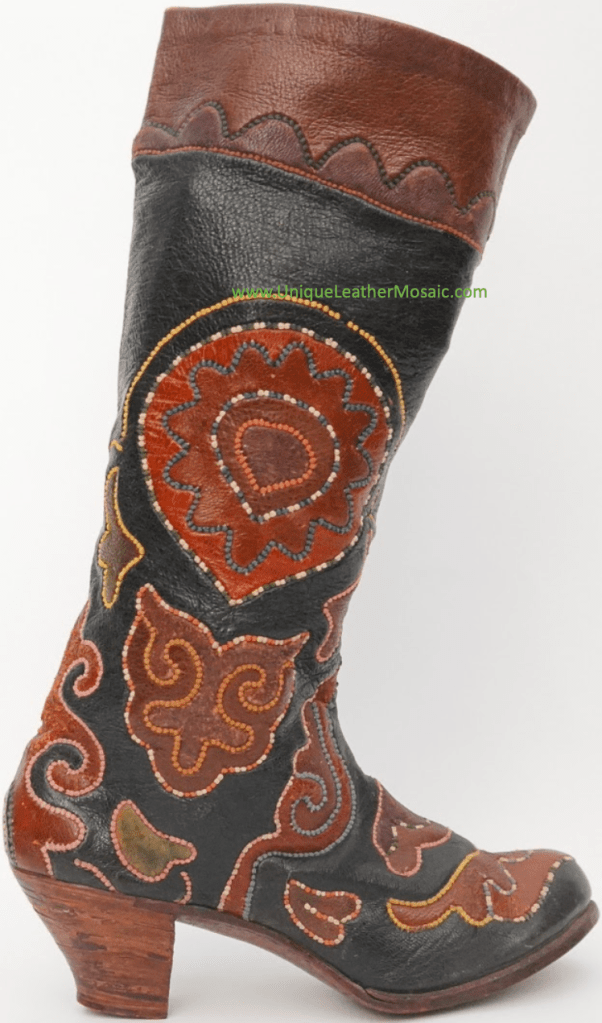


A skilfully hand-decorated shchiteq (Tatar boot) is a direct descendent of exceptionally crafted footwear of the Saka (Scythians) people who roamed the Eurasian steppes and hills in 3-5th centuries BCE. An omnipresent lotus (tulip) motif had inspired ancient crafters to create masterpieces with impressive interplay of sewn-on and embroidered elements. The Volga Tatar people had mastered the craft of creating expressive footwear by uniquely combining leather, ornamentation and stitching to deliver the uniquely skilful designs with unprecedented technology.


 Unique Leather Mosaic of the Tatars
Pingback: Unique Leather Mosaic
Pingback: Kazan is TripAdvisor’s Destinations on the Rise | Unique Leather Mosaic
Pingback: It is time for a hat! One-of-a-kind hat! | Unique Leather Mosaic