Inaugurating Turkic Languages Day!

The day of December 15th has recently been proclaimed by UNESCO (United Nations Educational, Scientific and Cultural Organization) as a World Turkic Language Family Day. In 2025, we are celebrating it for the first time!

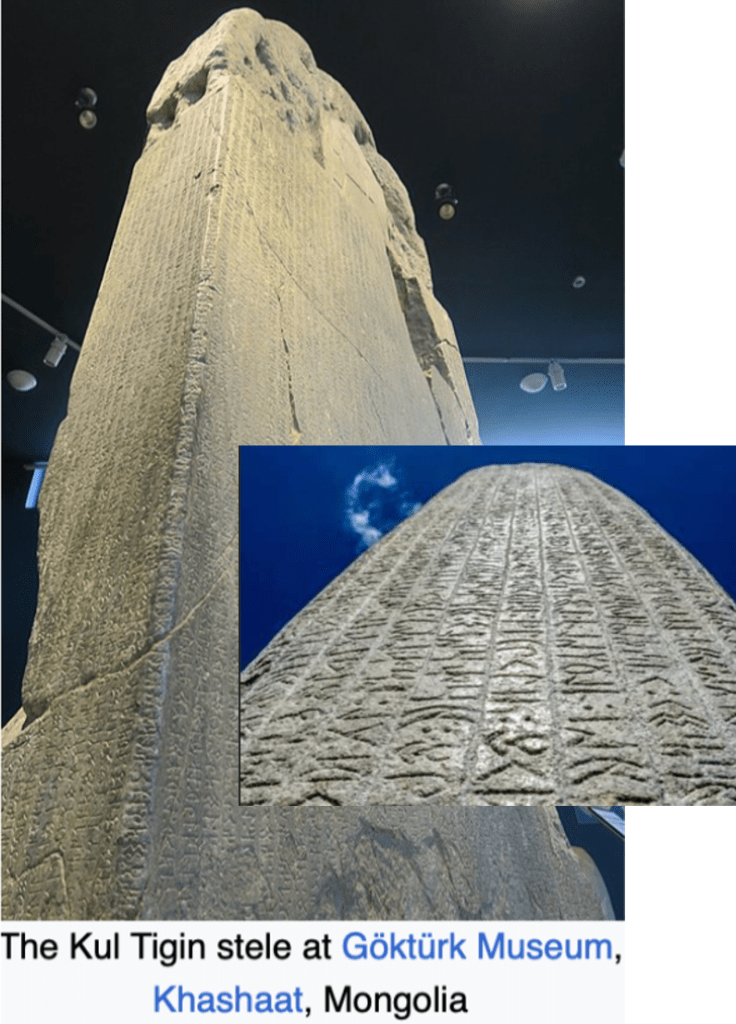
On this day in 1893 a linguist and turkologist Vilhelm Thomsen (1842-1927) made a very anticipated announcement that the text of the Orkhon Inscriptions (discovered in 1889 during the expedition of Nikolai Yadrintsev (1842-1894)) was deciphered (translation here). The 1300 years old inscriptions, also referred as Kul Tigin (684-731)  steles and Bilge Qaghan (683-734) inscriptions, found in Orkhon valley of modern Mongolia, are the oldest known written records of the Turkic language.
Out of ~8 billion people worldwide, roughly 200 million are speaking Turkic languages, ~7 millions of whom are the Tatar language speakers/ carriers, active and passive. Although the usage of the Tatar language is diminishing due to the prevalence of various lingua franca in the areas of modern habitats, there is a great interest in learning and preserving the Tatar language these days, simply because it connects to the roots (incredibly rich oral, written, material heritage) and to the other Turkic people.
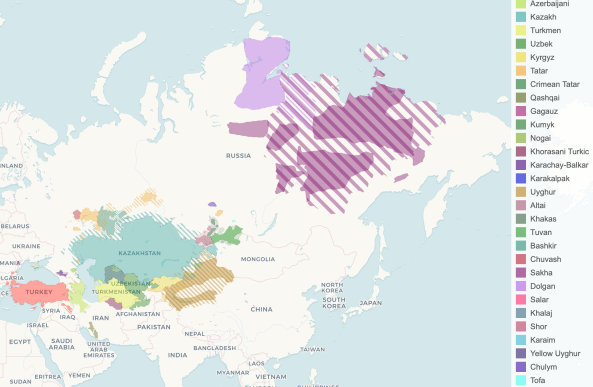
Turkic languages are characterized by the vowel harmony and agglutinative nature of grammatical relations between the words. According to the lexicostatistical matrix of Turkic languages and the article in Journal of Language Evolution, the Tatar language exhibits more than 50% of basic lexical similarities with most of the Turkic languages including Azerbaijani, Bashkir, Gagauz, Kazakh, Karakalpaq, Karachi, Khakas, KirimTatar, Turkish, Turkmen, Tuvan, Uyghur, Uzbek. To have an idea how closely they sound, just give a listen to Bulat Shaymi’s short song where he sings in 12 Turkic languages!

For several millennia, in the vast territories of central EuroAsia, impressive networks have been connecting, non-stop, the flow of goods, skills, thoughts through the well-established trading routes (Volga Route powered by the Volga Bulgars, ancestors of the modern Tatars, and Silk Road) that had been managed by various influential forces, including nomadic Saka/ Scythian EmpireTurkic KaganatesMongol Empire evolved into several Turkicized khanates later become referred as Turkistan (Turan by Persian sources, TransoxaniaCentral Asia by western sources) -the ethnonym represents a conglomerate of many Turkic-speaking states/“-stan”s-, Rossiyan Empire through 1917. 

Although Tatarstan is not a part of Turkestan geographically, the linguistic, customary and historic baseline of the Tatars (originally, Volga Bulgars) of the Volga-Ural area of modern Rossiyan Federation is linked to all Turkic people. The intelligible wide-spread Turkic languages have eased up the channels to carry on business, policies, thoughts, innovations, and the Tatars were instrumental in promoting successful collaborations and opportunities for the Turkic languages-speaking world and its neighbours creating so-called Tatar Empire, a term coined by Danielle Ross in her book.

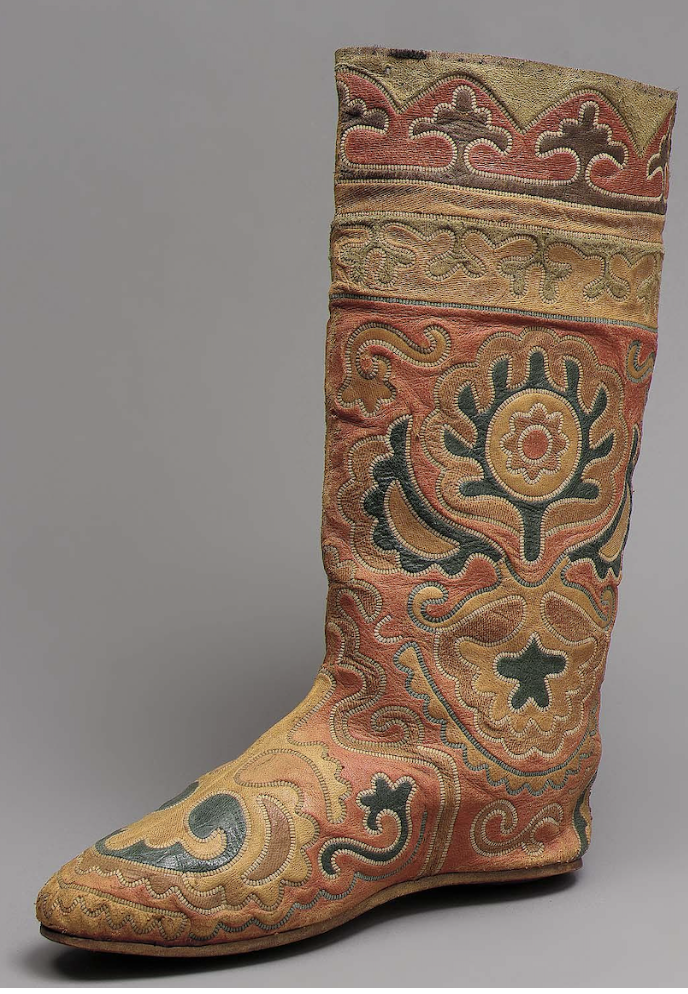
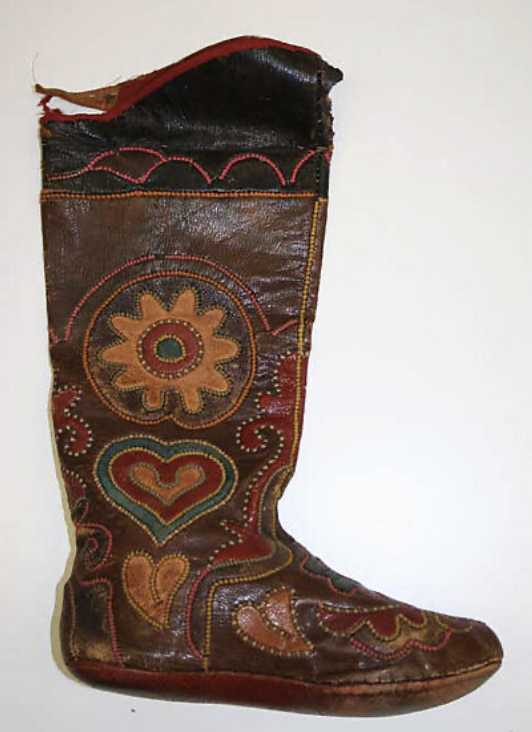
Material cultures of the Turkic people have many common features that speak to the unified sources of inspirations and beliefs (a subject for a separate post), the distribution of which showcases the collaborative nature of the networks. The simple fact that shchiteqlerboots uniquely decorated with Kaiyly Kün technology mastered by the Volga Tatarsexhibited in collections of many museums worldwide and labeled as originated from various Turkic-speaking places (such as Asia, China, Crimea, East & West Turkestan, Europe, Georgia, Indonesia, Hungary, Kazakhstan, Kyrgyzstan, Mongolia, Tajikistan, Tatarstan, Russia, Ukraine, Uzbekistan) speaks volumes.

The above Images of shchiteqler are courtesy of online collections (linked further) of PennMuseum of University of Pennsylvania, USA, Museum of Ethnography of Hungary, Museum of Fine Arts in Boston, USA, Metropolitan Museum of Art, USA, Ethnography Museum of Sweden, British Museum of Great Britain.

The due credit and appreciation are not always given to the skilful developers of the unique art in those museum collections: Successful Tatar leather artisans and entrepreneurs had not only manufactured uniquely decorated footwear in its “birthplace” Kazan-Arshcha area of Tatarstan to sell globally, but also had travelled far to trade and open workshops in Central Asia/Turkestan, Caucasus, Eastern Europe, cities of Rossiyan Empire. They shared their exceptionally-processed leather technology inherited from the Volga Bulgars (referred as bulgari/ safiyan/ sahtiyan/ yuft’) and unique decorated footwear making skills, they trained apprentices throughout European and Asian continent for centuries up until early 20ies century.

Let’s celebrate, promote and practice the

Arts of Native “Skilled Tongues” and “Skilled Hands” everyday

Celebrating the Beauty!

We are celebrating women today!

And everyday!

Female power is embedded in beauty of the world around and within!

What can be more expressive of female beauty than art and poetry!

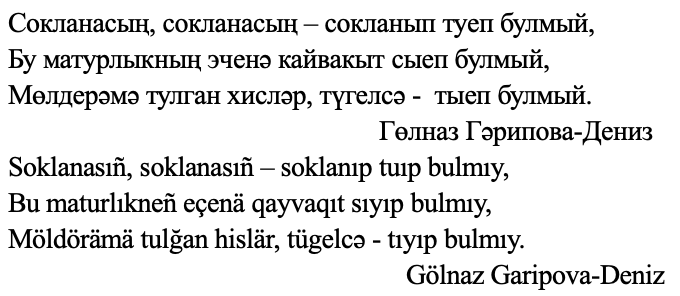
This Tatar leather-textile-text-art-insipred collage features a beautiful exerpt from Gөlnaz Deniz poetry. It enlightens us of impossibility to be tired of beauty (maturlıkneñ eçenä qayvaqıt sıyıp bulmıy),its encompassing presence (soklanıp tuıp bulmıy. “Soklanu” loosely equates “to be in awe” in English).

The way Gөlnaz describes the feeling, when beauty and love are intentangled and make you fly, (Möldörämä tulğan hislär, tügelсә – tıyıp bulmıy) is untranslatable! It is worth to learn the endangered Tatar language just to feel the Tatar expressive poems that help connect us to ourselves and the world!

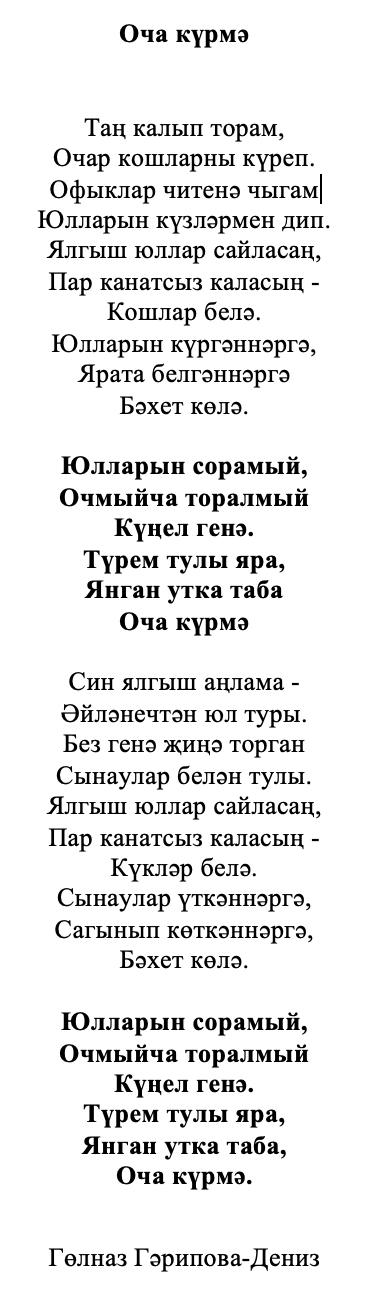
Here is one more treat from Gөlnaz Garipova-Deniz, poet, Tatar literature expert, educator. This poem is very lyrical. Here is how it is performed by Tatar singer Guzel Urazova. Interested in the meaning of the lyrics? Reach out to AlimaAcademy to signup for the Tatar Poetry course.

Emotional attachement

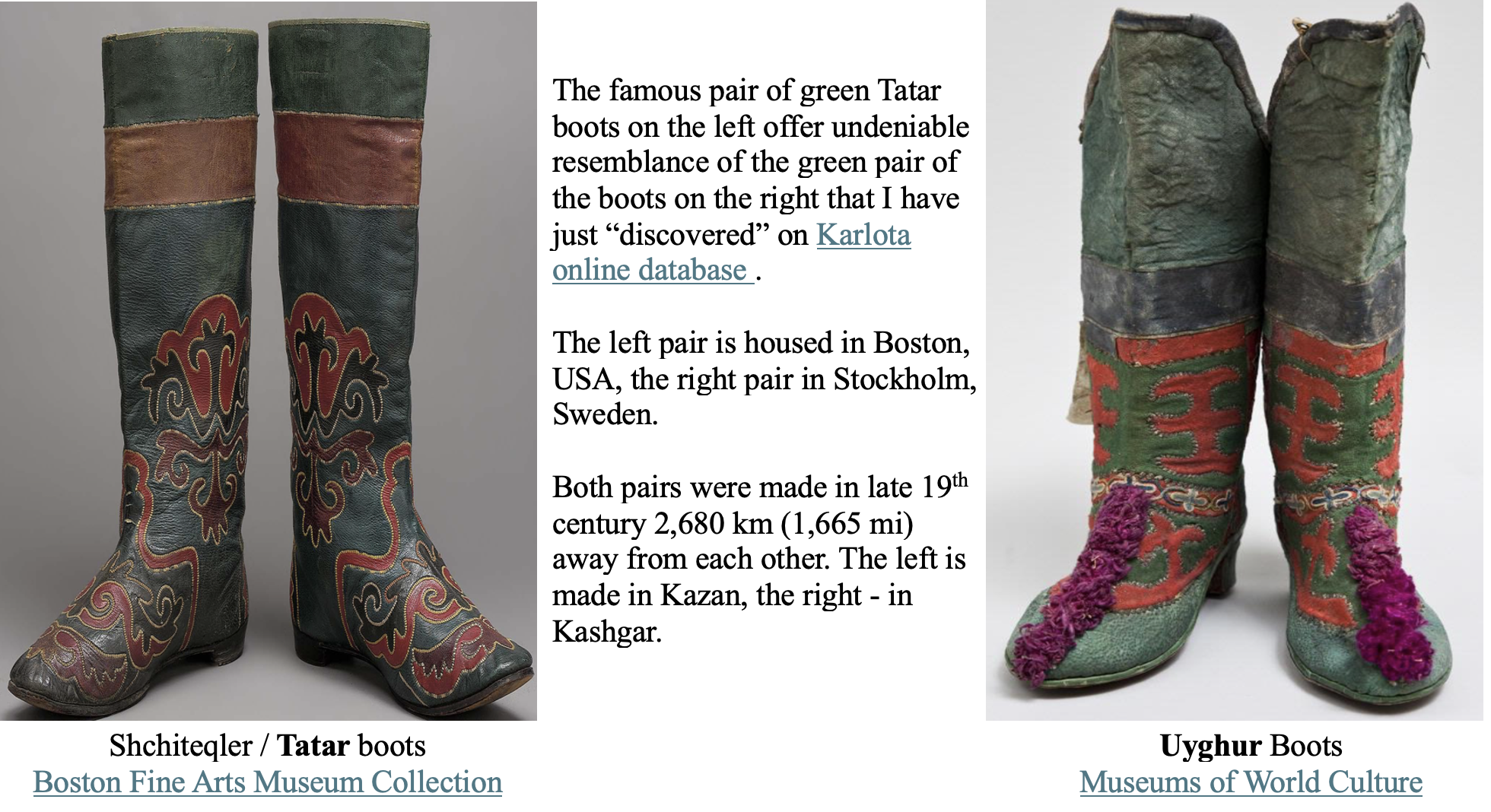
Human emotions present themselves regardless of time, distance, matter, subject. The strength of an emotion, though, depends mainly on internal depth of connections between self and an emotion “evoker”. For me, an acute yearning of a mother, whose children are reaching maturity and starting their independent life, is as prominent as a jaw-dropping surprise of incidental discovery of a pair of boots that carry heritage of myriads of networks that have been tying and uniting the world for centuries. 

Despite of geographical distance, both pairs share similarities that tie them to one origin – the EurAsian nomadic people (Saka/Scythians) who were impressively skillful leathercrafters. The Volga Tatars of then-Russian Empire mastered the decorated leather footwear craft to the levels unprecedented – the Tatar leather mosaic technique is unique in nature. The Uyghurs of then-Turkestan utilized the knowledge of boot composition and stitching shared between the skillful Tatars and Turkic people (trading routs had been buzzing, people had been mingling for ages). But, as one can notice in the pair from Kashgar, the Uyghurs ventured in different direction when putting creativity in decorating their boots. I.e., the Uyghurs placed colored fabric cutouts on top of the leather, put embroidered elements around shin and embellished the top with the bright pompons. All those elements are common features of the leather footwear created by the people dwelling over 6,991 km (4,344 mi) away, in the areas of Northern Africa (Morocco, Algeria, Egypt, etc.).

A desire to intricately decorate the wear that protects the foot is rooted in us (impressive designs found in Pazyryk burials date back to 4th century BCE) as deeply as emotional attachment to own children. Those two unite, connect, and tie us for centuries to come.

Discovering Tatar Boots in Bukhara

Bukhara (pronounced “Bohoro” by locals who speak Tajik, Uzbek and Russian) once was a powerful city-state on the Silk Road. These days,

Bukhara is Uzbekistan’s charming gem with impressive heritage. It excites with plentiful of:

Islamic historic buildings dating back to 12th century with the original and restored elaborate vegetative and geometric decorations; – medrasas that educated many academicians in Middle Ages; – wooden doors with intricate carvings; – hand-span silk and cotton fabrics with unique designs called abr (from Pesian ابر “cloud“) or  ikat (from Malay mengikat “to tie”) ; – impressively detailed hand-woven silk carpets; – hand embroidered suzani (from Farsi سوزن “suzan” meaning “needle”) that became a synonym of Uzbek artistry.  

What is hard to find in Bukhara are ethnic shoes.There is barely any visibility of traditional footwear of ethnic people populating modern Uzbekistan (the land of indigenous people -Uzbeks, Uyghurs, Tajiks, Turkmen, Kazakhs, Kyrgyz) on the streets, in the museums, in the stores. Locals, these days, give preference to mass produced rubber shoes. In bazars, a small number of vendors sell masi/maxsi (from Arabic  مَسْ “masH” meaning “to wipe”), sometimes called shchiteq (from Tatar “чителгән итек“). Those are soft leather socks (made of halal sheep skin; in Arabic countries, those are called “khuff or kuffain”) that are worn with outer shoes. They are indented to be kept on when entering the mosque for prayer: during ablution it is considered sufficient to wipe those over. Antique shops and ethnographic museums showcase a tiny number of traditional footwear: embroidered fabric boots, full length black leather masi/ shchiteq, hard leather bashmak.

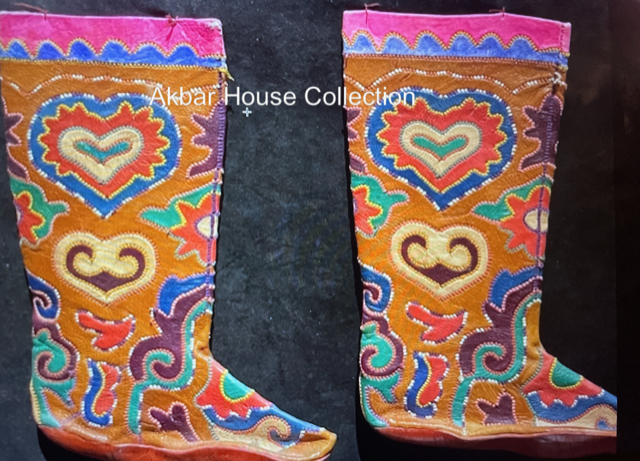
It was a treat to discover a pair of 19th century Tatar boots with ornamental patterns of various colors including vibrant pink (that is super rare) in Akbar House private collection! An antiques collector Akbar Aka mentioned that the boots are one-of-a-kind, not for sale, and that the “appliquéd” leather technique were developed by Volga Bulgars back in middles ages and that the boots like that are not being produced anymore.

We excited Akbar Aka with the fact that the craft is very well alive, that the boots, like his, are referred as Tatar or Kazan boots (shchitekler in Tatar, ichigi in Russian) and have been continuously crafted (although in much smaller quantities and with modernised looks) in Kazan, Tatarstan (the indigenous land of the Volga Bulgars). The ornamental technique of Tatar boots are often mistaken with a well-recognized techniques of appliqué (application of one piece/pattern on top of another) or embroidery. The unique Tatar boot technology (the ones that Akbar Aka owns, or the ones that are housed in Samarkand National Museum, or the ones that are mis-labeled/mis-identified in world museums, auction sites, mass online publications, etc.) aligns the colored leather patterns with twisted silk threads in intricate play of ornamental cutouts (like jigsaw puzzles). It is referred as Tatar Leather Mosaic or “Kayuly Kün”

Akbar House Collection features this ethnic outfit on its website. It is a masterful compilation of items, details, patterns, materials, attributes that many Turkic and Iranic people consider their own. The featured soft leather boots with elaborate ornamental patterns tell the story of ancient nomads of Eurasian steppes&mountains and of then-Volga-Bulgars-now-Volga-Tatars who embraced a leather medium to showcase exceptional craftiness, mastery, creativity and spirituality.

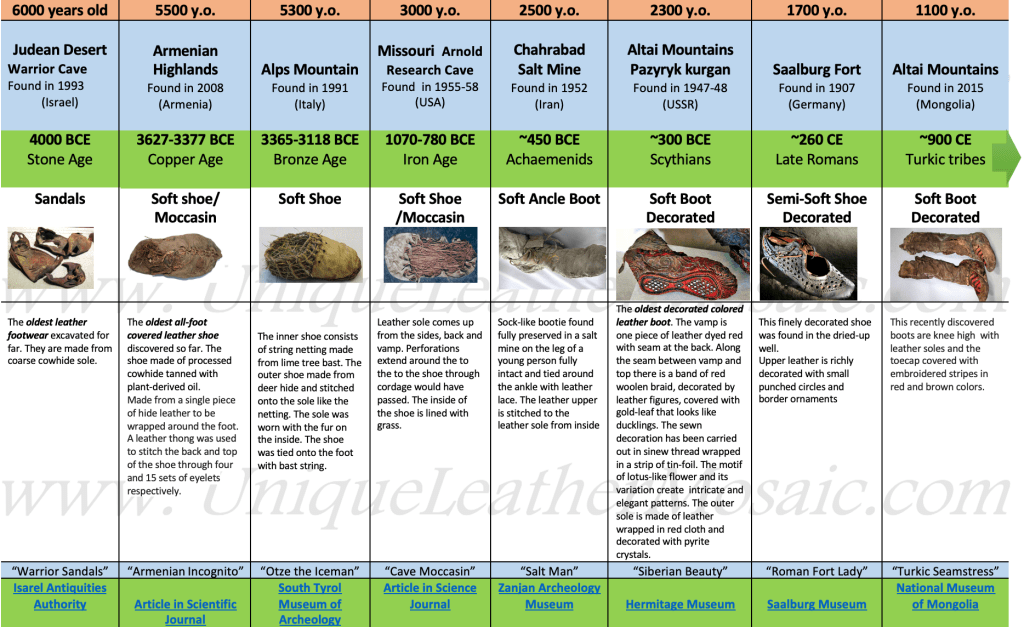
How Old Is the Oldest Leather Shoe?

The oldest (found so far) leather sandals were worn 6000 years ago! They were discovered in Cave of Warrior in Judean Desert in 1993.

The oldest all-foot covered leather soft shoe was found in the cave of Armenian Highlands in 2008.

The exceptional discovery was made by Soviet archeologists in 1947 in Pazyryk kurgans of Altai Mountains (south of modern city of Novosibirsk in Russian Federation), when the oldest ornamented leather boots were excavated from the burrows of Scythian nomadic tribes that had been waiting to be found for over 2300 years. All three recovered boots are decorated with intricate patterns and ornaments that bore sacred meaning for the owner.

The Tatar boots tradition is keeping the spirit and the leather craftsmanship of the nomadic heritage.

“Warrior Sandals”“Armenian Incognito”“Otze the Iceman”“Cave Moccasin”“Salt Man”“Siberian Beauty”“Roman Fort Lady”“Turkic Seamstress”
Isarel Antiquities Authority Article in Scientific JournalSouth Tyrol Museum of ArcheologyArticle in Science JournalZanjan Archeology Museum Hermitage Museum Saalburg MuseumNational Museum of Mongolia

Exceptional boot is called shchiteq

When you google “boot”, tons of images of different boots come up: fancy, classy, ugly, modern, in all shapes and colors. But the boots that are created using unique leather mosaic technique do not… It can be because the boots, that this website is dedicated to, belong to a different category that embodies a unique collaboration of footwear and art.

New Sah boots

shchiteqler made by Sahtian

This exceptional footwear category is shchiteq (kauly run shchigelgen iteq – full version). The word shchiteq (“shch” is pronounced as in Chicago or  “c” in “appreciate“) comes from the Tatar language word читек (with pronunciation as “щитэк”, Russified versions of “ичиг”, “ичитыг” are also in use) is an abbreviation of чигелгән итек (shchigelgen iteq). It literally means a “decorated/ embroidered boot”.

A shchiteq is made from soft colored leather and ornamented with the Tatar-inspired cutout designs that are  stitched together by hands from the inside”. The technique is unique and sophisticated that no other ethnic people but the Tatars have mastered it over the centuries. Shchitekler (“ler” is for plural form in Tatar language) are popular in Tatarstan, Russia, and highly treasured by their owners because one can “conquer the world” in them. The word читек is googalabe. But shchiteq is not yet…  It will be wonderful if the association of boot with shchiteq becomes recognizable, so acknowledgement and due credits are offered to the Tatar people who had originated and mastered the unique craft of Tatar Leather Mosaic and has been working hard for centuries to keep it alive.made by Sahtian


Kazan

Leather mosaic by Sahtian

Come to get a taste of Tatar Culture and Art  as well as  to celebrate many other cultures at the International Festival in Raleigh, NC, on October 4 – 6, 2013.

This is the first year the Tatar Culture is presented in this annual festive celebration of ethnicities and their vibrant cultures. This year’s theme is “Arts, Crafts and Music” – and the Tatars have so much to offer and share.

Please stop by to see beautiful exhibits and samples of Tatar leather mosaic, embroidery, weaving, jewelry, decorations, illustrations and more. You will have a chance to realize why technique of leather mosaic is so unique and why Tatar decorative art  is so exceptional and beautiful! You will also have a chance to try yourself as a designer of Tatar costume: Boots, hats and aprons are waiting for you to be decorated with Tatar ethnic ornaments and patterns.