Treasuring shchiteqler

A pair of intricately and skilfully decorated shchiteqler is good enough to feel and look exceptional! But when researching about uniquely decorated Tatar boots, the more the happier! 2025 has been a year of experiencing a great variety of shchiteqler: ~215 years old… ~3 months young…

Ledermuseum in Offenbach, Germany, owns allegedly the oldest pair in their archives; History and Ethnography Museum in Arsk, Tatarstan, Rossiyan Federation has the largest number of shchiteqler on display. These museums, that are located in two small European towns thousand miles away from each other, possess the treasure that unites them: tangible evidence of impressive leather craftsmanship of the Tatars. Both small towns of Arsk and Offenbach also share “gone” big fame of an epicenter of exceptional leather manufacturing: in late 18th-early 20th centuries both places were bustling with production and trade of quality processed skins and leather goods.

Deutsches Ledermuseum has an impressive collection of ~30 thousand leather artifacts, 12 of which are crafted with Kaiyly KünThis “extremely distinctive” technology identified as “Ledermosaik” in 1967 museum’s catalogue, as “Saffianleder mit Mosaiken, Mosaikarbeit” in 1980 catalogue, and“Lederinlegearbeit (leather inlay)” on the tags that are placed by actual items. On a windy fall day, a museum curator Leonie Wiegand revealed 7 pairs of tall boots, 1 pair of short boots, 2 pairs of boot shafts, 1 pair of shoes and 1 pouch that were acquired in 1939 from a collector Slg.Schmid of Vienna and have been preserved in excellent condition in the museum archives. One pair of the boot shafts are dated 1812 and noted as to be brought from Rossiyan Empire. Those are the oldest known (with exact date) shchiteqler but they look like have just been crafted! Each item in Deutsches Ledermusuem collection is an excellent representation of versatile assortment of products crafted with kaiyly kun technology in late 18-early 20th centuries. The design in each item does not repeat and speaks to incredible creativity of the Tatar individual and collective leather craftsmanship.

Out of 12 items, the only image that is permissible to be presented is the boot on the left that was photographed for the Deutsches Ledermuseum’s catalogue #6 published in 1980. (The copyright is: © Deutsches Ledermuseum, C. Perl-Appl. The caption reads: Boot, Kazan, Tatarstan, early 19th century). Crafted with Kaiyly Kün technology items are in the Deutsches Ledermusuem’s archives: They are neither displayed on the museum floors nor on the website. Hopefully one day, shchiteqler will be showcased digitally and/or physically for visitors to appreciate the craftsmanship of the Tatars.

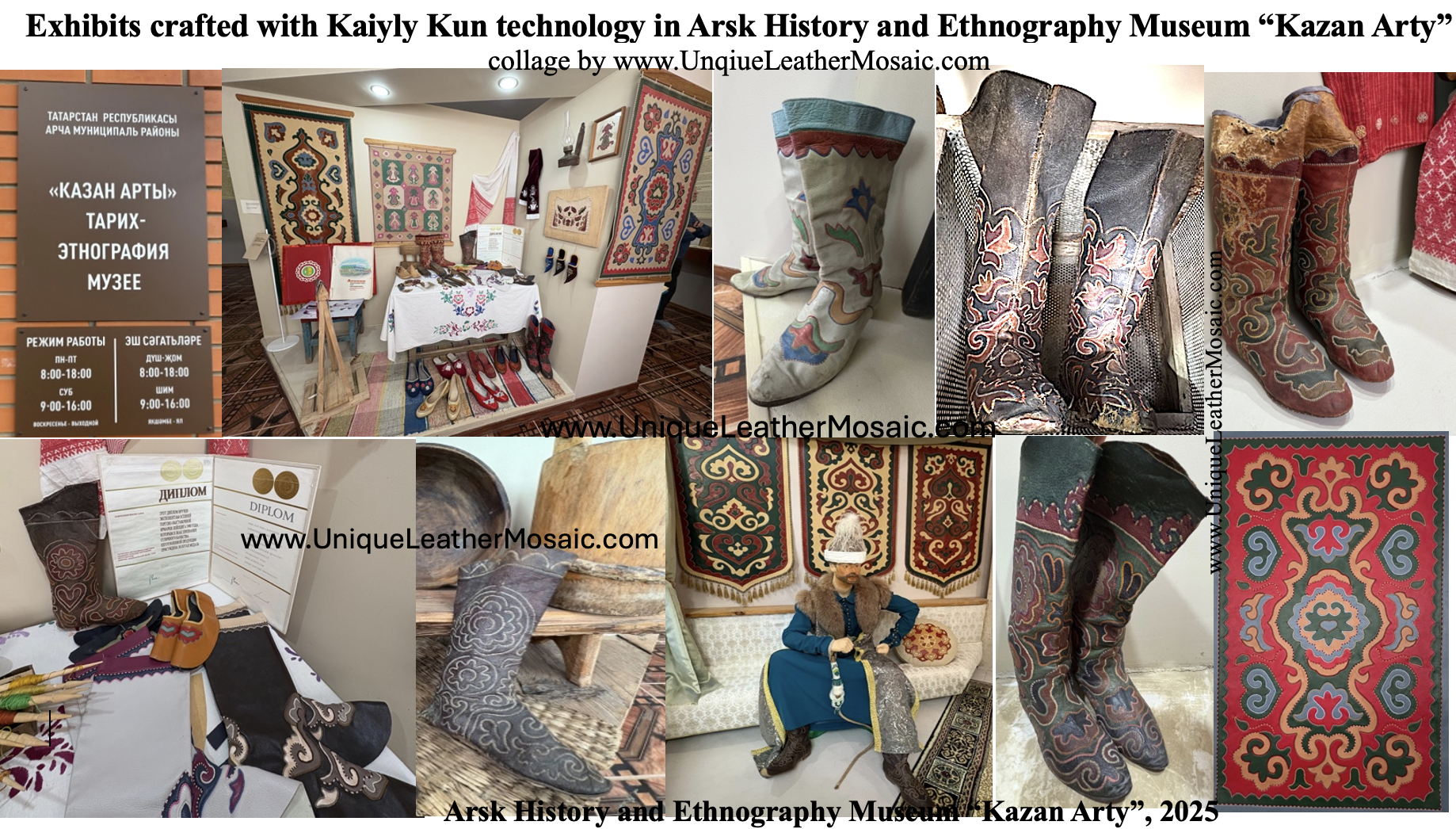
A collection of Arsk Historical and Ethnographic Museum brings unique Tatar leather craftsmanship to the perspectives that allow assessment of the Art of Kaiyly Kün through the centuries and into the current times. A large number (over 100 by a shy estimate) of Kaiyly Kün items are exhibited throughout two museum floors and are harmoniously weaved in permanent collection displaying rich history and ethnography of the town. The museum curators Gelyusya Khazieva, Alsu Murtazina, Irina Sinichkina, Regina Akhmatgalimova and others have put a lot of efforts in displaying leather items with distinctive Tatar decorations throughout the museum, allowing the visitors to engage and learn. The museum boasts of massive Kaiyly Kün collection because the Town of Arsk (Arshcha in Tatar language, ~30 miles north-east of Kazan) has been a cradle of Kaiyly Kün, the manual technology that has no analogy and has been mastered in this area for centuries. Arsk has been a backbone of Muslim thought and leather craftsmanship: Promotion of Islamic education and laborious manual artistry have been two prominent features of the Volga Bulgars-turned (Volga/ Idel-Ural)-Tatars for millennia

Leather processing and production of shchiteqler became profitable business in 19th-early 20th centuries because of increasing demand among European, American and internal aristocracy of intricate manually crafted work- the elaborately decorated handiwork practiced over millennia by people of various ethnic backgrounds of Eastern Europe, Western, Central Asia (referred as Tartars, Tatars, Muslims, Noghays, Turks, people of Turkistan, Asians, etc.). Up until late 1920ies, large quantities of traditional and customized shchiteqler had been manufactured by individuals and private enterprises in Arshcha (Arsk) and Kazan as well as workshopped far outside of these areas. After ~40 years of hiatus, production of shchiteqler (with simplified designs) continued in less quantities by Soviet state-owned Arsk Footwear factory from 1964 to 2006, the operation of which slowly dwindled in early 2000 due to inability survive novice market economy.

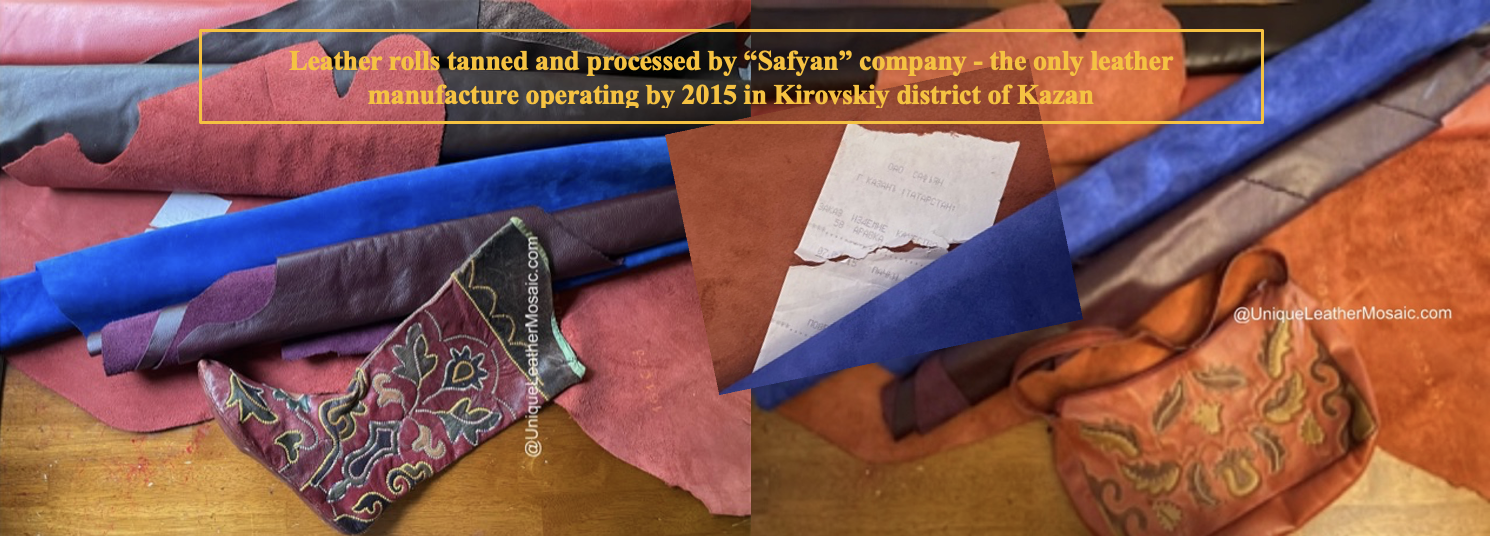
As of now, only a very small number of individual artisans continue producing shchiteqler and building on the legacy of ceased-to-exist Arsk factory. Company “Сахтиян / Sahtiyan” (from Persian ساختيا derived from ساخته “saht” meaning “fit/processed/made), is the only leather goods enterprise that carries reasonable inventory (in their one small shop in Kazan) of elaborately and uniquely designed shchiteqler but with the hides sourced from outside of Arshcha-Kazan. There is one functioning factory that processes leather these days in Kazan-Arshcha area: only cowhides and on a small scale. It is branded as “Сафьян (Safyan/ Saffianleder)”, another way of spelling of sahtiyan: this term carries the legacy of high quality soft colored fragrant leather (originally referred as Bulgari, later as Cordovan, Morocco, Russia) processed with exceptional original technology mastered by the Volga Bulgars, the ancestors of modern Tatars.

Although manually-crafted-with-Kaiyly-Kün shchiteqler are slowly re-gaining popularity, the amount of produced Tatar boots is not even 1% of allegedly estimated annual production of 3 million pairs during primetime. Our dream is that shchiteqler are back on the world stage, in demand so greatly that their supply exceeds the 19th century levels, and that young people are eager to learn, master and benefit from impressive and unique leather craftsmanship of the Tatars. 

Curious abut other leather art explorations and connections? Checkout our other postings/ publishings here or just keep scrolling down this page.

Defining ageless, timeless, borderless

Longing for a pair of soft, hand-crafted shchiteqler is a no brainer. The Tatar boots’ undeniable appeal, unforgettable artistry and luxurious feel leave no one indifferent – little or old, ages or miles apart.

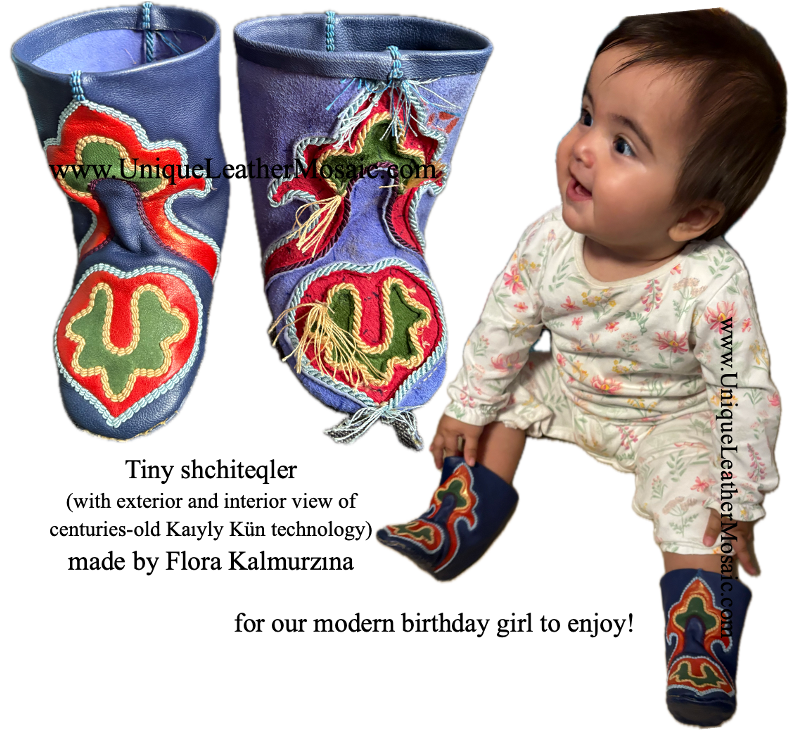
Our cutest model, Beekeh, who is celebrating her first anniversary this week, here in USA, thousand miles away from her birth country of Turkiye – is rocking the Tatar shchiteqler that she borrowed from a 50-year-old young-looking doll, whose Tatar ethnic outfit was lovingly crafted by 80-year-old Flora Kalmurzina in Kazan.

Flora hanum could not have imagined that her tiny shchiteqler (hand-stitched in 2012) would be adored by a little beauty in 2025, over five thousand miles away from Kazan, Tatarstan. A hundred years before and over one thousand miles apart in the city of Istanbul in 1912 while writing short story “Kezhul shchiteq”, the prominent Tatar genius Gayaz Iskhaki could not have fathomed that an iconic Tatar footwear craft would have survived the tumultuous beginning of the 21st century mostly due to humble efforts of amateurs like Flora Kalmurzina. 

Although Beekeh is not yet knowledgeable of exceptional value of shchiteqler made with the unique technology of kaiyly kün (aka Tatar leather mosaic), her excitement is comparable with little Ahmadulla’s anticipation described in Iskhaki’s story. It opens up with the boy waiting for his father bring him a coveted pair of shchiteqler, a symbol of status and wellness in early 20st century. Little boy has been dreaming about the boots made from the highest quality fragrant supple goat leather that had been processed with exceptional technology mastered by the Volga Bulgars (ancestors of the Tatars) over thousand years ago…

Linking time and space via material culture and emotional response allows experiencing past, present and future in one continuum. Exploratory connections encourage appreciation of history and respect to collective memory that are foundation for meaningful future!

Wondering if Ahmadulla got his dream shchiteqler? Gayaz Iskhaki’s “Kezhul shchiteq” short story is written in Tatar language, originally with Arabic script. It has been transliterated in Cyrilic and Latin. You can read a Latin version here, a Cyrillic version here. Audio recording is also available here. Google offers a good translation into English of the Cyrillic version but not the Latin. Want us to reveal you a twist in the plot? Message us in Instagram.

Memory, Spirit and Legacy

Tатарчаны монда укый аласыз / Tatar version here

The memorial plaque dedicated to “Serp i Molot” plant and its legendary contributors was placed these days on the last remaining wall of the once-powerful plant. Located in historic Bishbalta (Tatarstan) for over 150 years (1851-2015), the plant supplied heavy machinery, conveyor belts and various tools to support livelihood of Russian Empire, of the USSR, Tatarstan, Russian Federation. 

Putting the plaque up is an idea of Garafutdin Minegaziz uly Khisamutdinov, a labor veteran who dedicated over 20 years of his career to the plant. Starting as a locksmith at the age of 17, Garafutdin contributed his skills, excelled, and moved up the ladder to make the plant a success. The collapse of the Soviet Union turned the progressive industrial complex as well as the whole livelihood setup of the USSR upside down.

Many state ventures could not survive the turmoil and, thus, seized to exist.  “Serp i Molot” plant’s fate was not an exception. Although the change opened new opportunities for Garafutdin, his heart has been aching for such a powerful establishment with long history to come to an end on his watch. The plaque commemorates the plant’s existence and its contribution to the history of the city. It also pays a tribute to Garafutdin’s youth that was dedicated to “Serp i Molot” full-heartedly! 

Garafutdin’s partner and supporter of over 50 years, a mathematician by training and a teacher by trade, Zaituna Gafi kyzy Khisamutdinova took the pressure of caring for the household and three children while Garafutdin served in the leadership positions in the plant and the local district government.

Nowadays, the smile and the spirit, the most persistent attributes of Garafutdin and Zaituna, keep them energized to share and preserve the Tatar heritage and the history of Bishbalta.

A bitter story of “Serp i Molot” plant is not the only one. In one of the used-to-be-industrial-heavy districts of Kazan, Kirovskiy, from mid- 19th to late 20th century, there were many large manufacturing and industrial plants supplying various goods to the vast country. Most of them ended their operations in early 21st century including the ones that were dedicated to leather production using tanning and dressing technologies developed in Volga Bulgaria (predecessor of Kazan Khanate and Tatarstan). At the verge of 19th and 20th centuries, the leather manufacturing was the second (after fabric weaving) high-volume-high-profit business in Kazan (“Tatar Industrialist”, S. Belov, 2017, p.5-6). By mid-20th century, only two leather processing and leather goods manufacturing plants operated in Kirovskiy district of Kazan city. Nowadays, the one that produces leather goods ranks 165th out of ~400 in Russian Federation, the leather-processing plant is mostly out of business. 

The legacy of famous high quality soft aromatic leather mastered in Volga Bulgaria that once were pride and fame of the Volga Bulgars (now referred as (Volga) Tatars) has been slowly vanishing in history. The leather tanned using the exceptional technology developed by the Volga Bulgars had been referred as bulgari in Middle Ages in Asia, Europe and America (“The Patterned Leather of Kazan”, L. Sattarova, 2004, p. 7-23). The word “bulgari” had been utilized as an umbrella term for the two types of leather: 1) “juft/yut (either from Persian جفت meaning “pair” or from Bulgarian «ӳт» meaning “leather”), and 2) “safyan/ sahtiyan” (from Persian ساختيا derived from ساخته “saht” meaning “fit/processed/made). Those terms, originally and primarily, had been referred to goat (safyan) and sheep (yut) hides tanned with sumac and willow bark, colored by plants-derived dyes and oiled by birch tar. In 18th – early 20th centuries, soft leather with distinctive aroma (acquired during the tanning and oiling with birch tar) that was manufactured using the technologies of the Volga Bulgars got referred as “Russia” leather in American and Western literature (“The Manufacture of Leather”, C.Davis, 1885, p.65-68).  

Leather processing is not a profitable business in Kazan anymore. The last leather manufacturing plant in Kirovsky district of Kazan (the successor of various pre-Soviet era profitable leather-tanning establishments of Azmetyev, Yunusovs, Apanayevs, etc.) has been operating on the smallest percentage of its capacity since the collapse of the Soviet Union. It was in-and-out-of-business for the last decade. The hope is on for the famous-aromatic-soft leather bulgari and the exceptionally-decorated-leather-sock-boots shchitekler to gain their momentum again, to be the staple of local economy, and to be a  celebration of (Volga Bulgar) Tatar legacy and handiwork.