Tатарчаны монда укый аласыз / Tatar version here
The memorial plaque dedicated to “Serp i Molot” plant and its legendary contributors was placed these days on the last remaining wall of the once-powerful plant. Located in historic Bishbalta (Tatarstan) for over 150 years (1851-2015), the plant supplied heavy machinery, conveyor belts and various tools to support livelihood of Russian Empire, of the USSR, Tatarstan, Russian Federation.
Putting the plaque up is an idea of Garafutdin Minegaziz uly Khisamutdinov, a labor veteran who dedicated over 20 years of his career to the plant. Starting as a locksmith at the age of 17, Garafutdin contributed his skills, excelled, and moved up the ladder to make the plant a success. The collapse of the Soviet Union turned the progressive industrial complex as well as the whole livelihood setup of the USSR upside down.

Many state ventures could not survive the turmoil and, thus, seized to exist. “Serp i Molot” plant’s fate was not an exception. Although the change opened new opportunities for Garafutdin, his heart has been aching for such a powerful establishment with long history to come to an end on his watch. The plaque commemorates the plant’s existence and its contribution to the history of the city. It also pays a tribute to Garafutdin’s youth that was dedicated to “Serp i Molot” full-heartedly!

Garafutdin’s partner and supporter of over 50 years, a mathematician by training and a teacher by trade, Zaituna Gafi kyzy Khisamutdinova took the pressure of caring for the household and three children while Garafutdin served in the leadership positions in the plant and the local district government.
Nowadays, the smile and the spirit, the most persistent attributes of Garafutdin and Zaituna, keep them energized to share and preserve the Tatar heritage and the history of Bishbalta.
A bitter story of “Serp i Molot” plant is not the only one. In one of the used-to-be-industrial-heavy districts of Kazan, Kirovskiy, from mid- 19th to late 20th century, there were many large manufacturing and industrial plants supplying various goods to the vast country. Most of them ended their operations in early 21st century including the ones that were dedicated to leather production using tanning and dressing technologies developed in Volga Bulgaria (predecessor of Kazan Khanate and Tatarstan). At the verge of 19th and 20th centuries, the leather manufacturing was the second (after fabric weaving) high-volume-high-profit business in Kazan (“Tatar Industrialist”, S. Belov, 2017, p.5-6). By mid-20th century, only two leather processing and leather goods manufacturing plants operated in Kirovskiy district of Kazan city. Nowadays, the one that produces leather goods ranks 165th out of ~400 in Russian Federation, the leather-processing plant is mostly out of business.
The legacy of famous high quality soft aromatic leather mastered in Volga Bulgaria that once were pride and fame of the Volga Bulgars (now referred as (Volga) Tatars) has been slowly vanishing in history. The leather tanned using the exceptional technology developed by the Volga Bulgars had been referred as bulgari in Middle Ages in Asia, Europe and America (“The Patterned Leather of Kazan”, L. Sattarova, 2004, p. 7-23). The word “bulgari” had been utilized as an umbrella term for the two types of leather: 1) “juft/yut” (either from Persian جفت meaning “pair” or from Bulgarian «ӳт» meaning “leather”), and 2) “safyan/ sahtiyan” (from Persian ساختيا derived from ساخته “saht” meaning “fit/processed/made). Those terms, originally and primarily, had been referred to goat (safyan) and sheep (yut) hides tanned with sumac and willow bark, colored by plants-derived dyes and oiled by birch tar. In 18th – early 20th centuries, soft leather with distinctive aroma (acquired during the tanning and oiling with birch tar) that was manufactured using the technologies of the Volga Bulgars got referred as “Russia” leather in American and Western literature (“The Manufacture of Leather”, C.Davis, 1885, p.65-68).
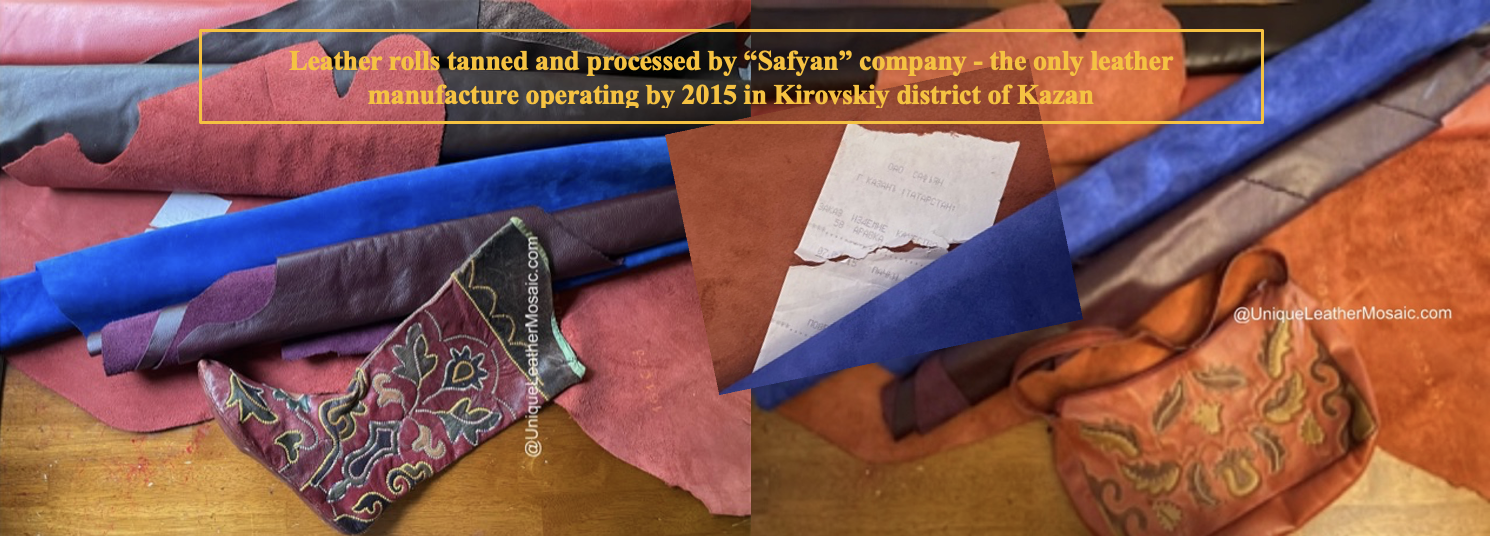
Leather processing is not a profitable business in Kazan anymore. The last leather manufacturing plant in Kirovsky district of Kazan (the successor of various pre-Soviet era profitable leather-tanning establishments of Azmetyev, Yunusovs, Apanayevs, etc.) has been operating on the smallest percentage of its capacity since the collapse of the Soviet Union. It was in-and-out-of-business for the last decade. The hope is on for the famous-aromatic-soft leather bulgari and the exceptionally-decorated-leather-sock-boots shchitekler to gain their momentum again, to be the staple of local economy, and to be a celebration of (Volga Bulgar) Tatar legacy and handiwork.


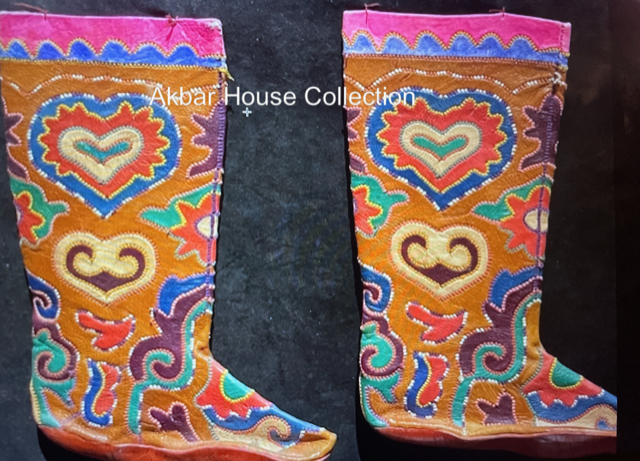

 Unique Leather Mosaic of the Tatars