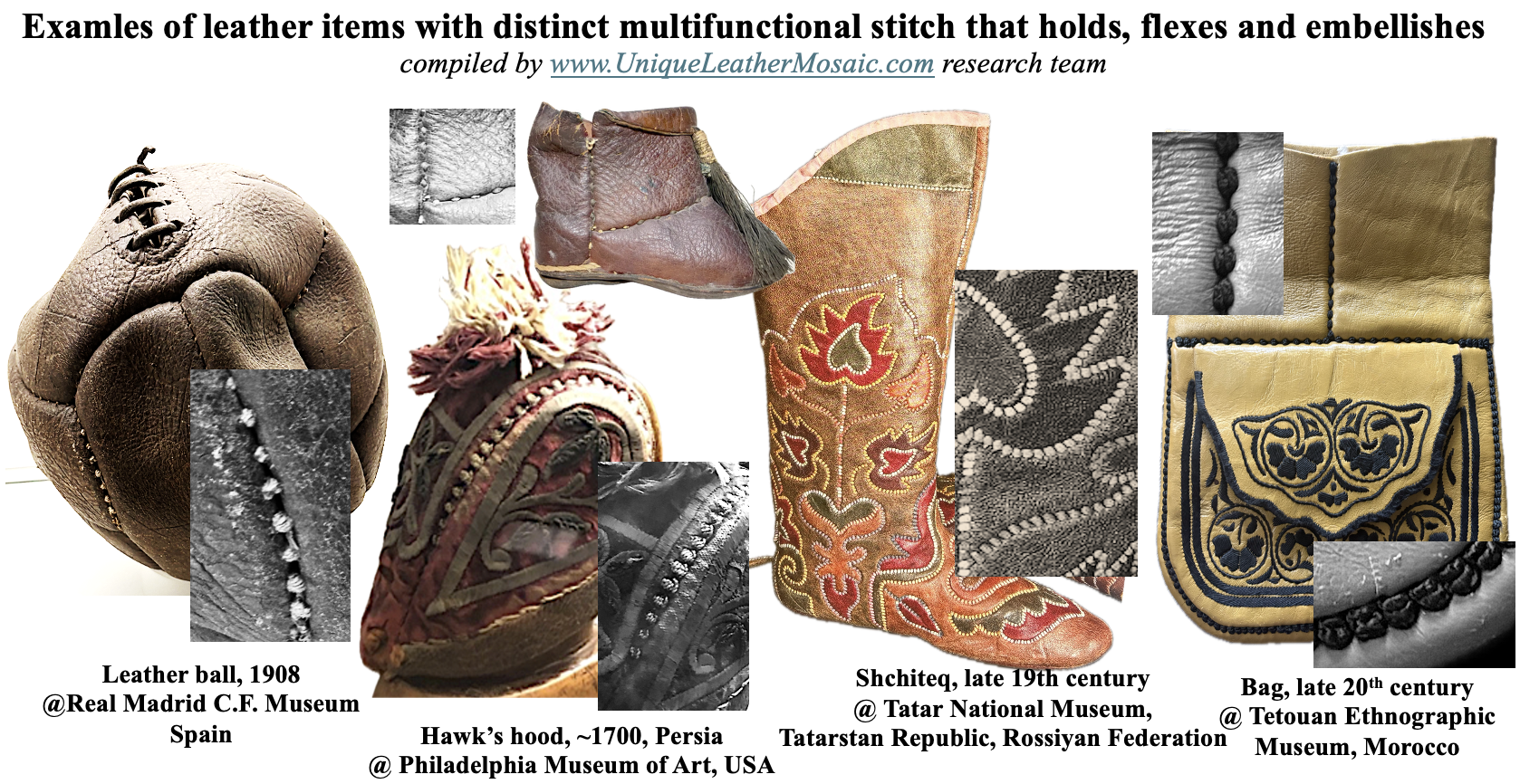
Among few types of manual leather panels stitching techniques, the one featured on the football of 1908 in Real Madrid Museum is performed the same way a so-called “Kazan” stitch on shchiteqler, the Tatar traditional footwear. This type of manual stitch has three goals: It simultaneously holds, flexes and embellishes. For centuries, if not millennia, this distinct stitch has been used to support the flexibility of leather shapes and to provide aesthetic appeal to the leather edges.
According to our years-long research of worldwide museum collections, auction sites and marketplaces, this distinct stitch has been mastered by Muslim leather crafters: they performed and spread it westward and eastward via various trading routs: all the way from medieval Spain to China. This type of inner stitching (that looks like embroidery, beadwork, cord-like to a layperson’s eye) was historically employed for leather-made footwear, headwear (e.g. falcon hoods), meal-ware (e.g. drinking vessels), animal gear (e.g., saddles), furnishing (e.g., “ottomans”), carriers (e.g., bags) and curvy objects (e.g., balls). Though an original term for this stitch may have differed in various locations, we believe it was widely referred as “sarma”, a word that stems from an ancient Turkic root “sar/sır” meaning “to wrap”.
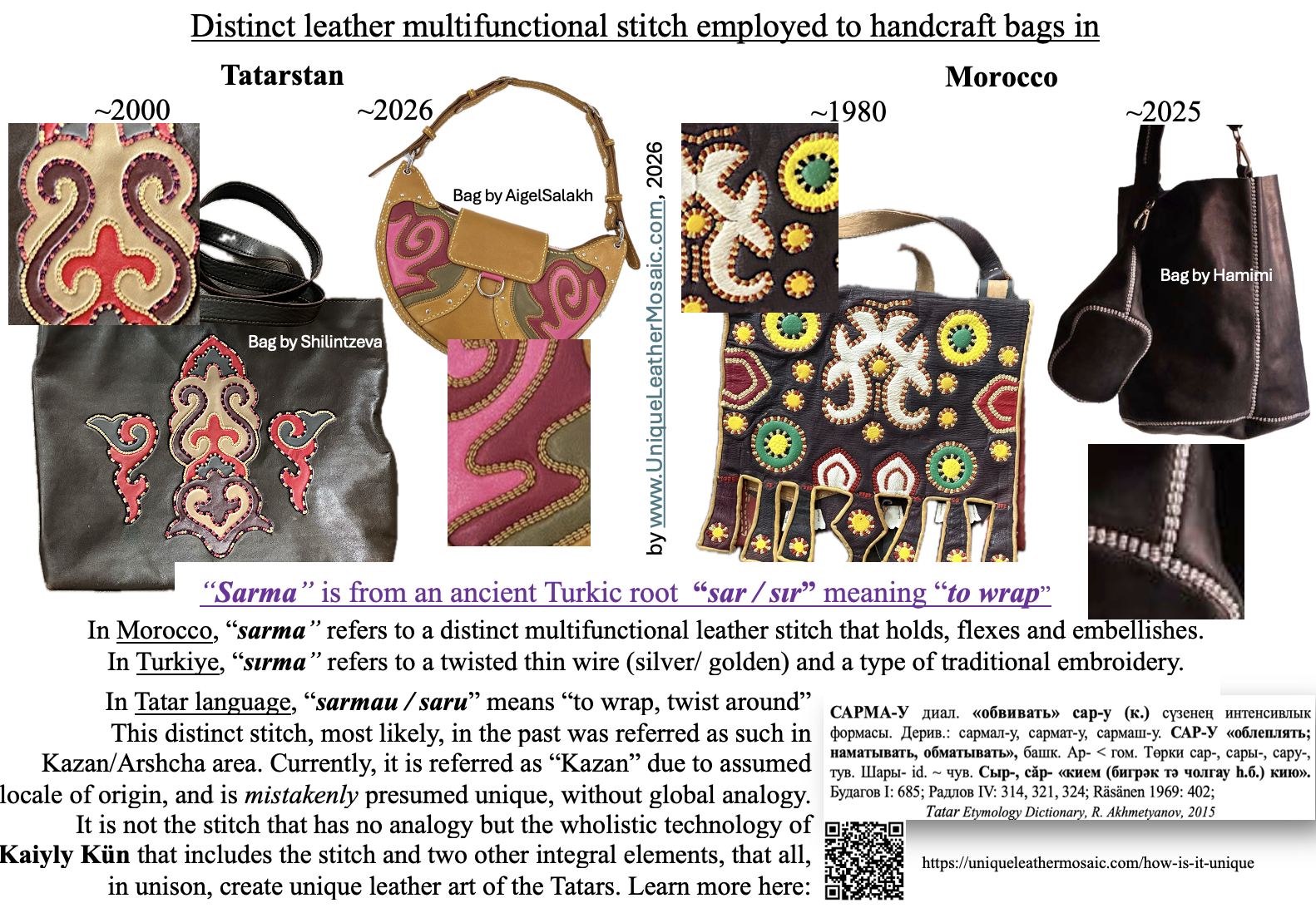
Nowadays, it is referred this way (sarma) in Morocco, the one of the only two locales where the distinct ancient stitch is still being successfully executed, by hands. The second location is Tatarstan Republic of Rossiyan Federation, specifically Kazan-Arshcha area. The original Tatar term for the stitch is lost/unknown and is currently being referred as “Kazan Zhouy” which, most likely, was originally referred as “сар(ма)у/ sar(ma)u”, a Tatar word from the same Turkic root that etymologically corresponds to the essence of the stitch. The essence of this impressively durable, flexible and decorative inner stitch is in several loops of decorative thread wrapped around a carrying waxed thread that adheres one leather piece to another. The technology of performing sarma stitching in Morocco slightly differs from how it is executed in Tatarstan. Check out these variations:
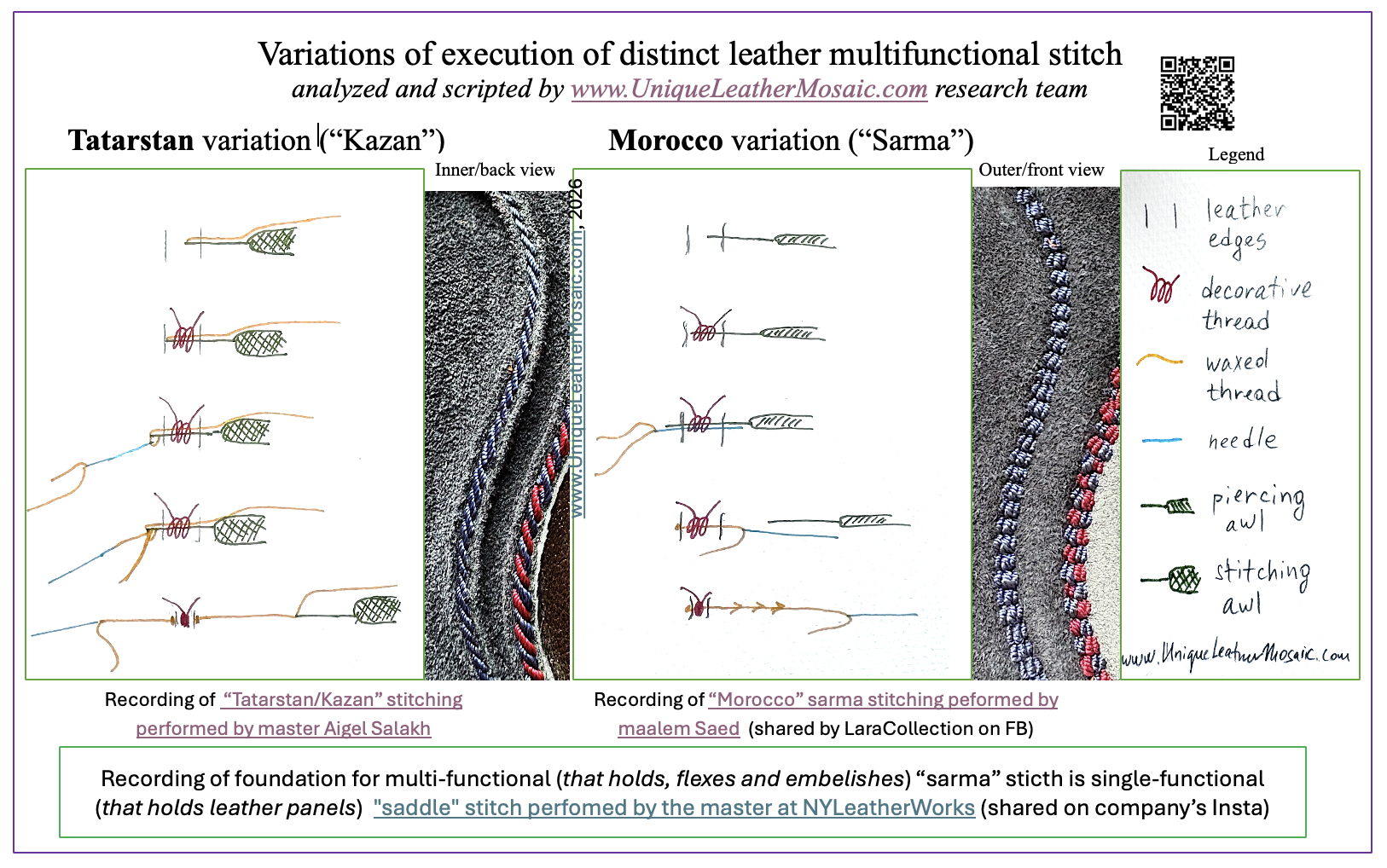
Recordings of the stitch executions: 1) Tatarstan/Kazan” stitching performed by usta Sabira apa; 2) Morocco” sarma stitching performed by maalem Saed also here 3) Foundation for the multi-functional (that holds, flexes and embellishes) “sarma” stitch is a single-functional (that holds leather panels) “saddle” stitch.
Can you identify the differences in the stitch execution? Isn’t it curious that people in faraway places (Tatarstan is ~ 3000 mi/ 5000 km away from Morocco) are still actively utilising the same ancient manual distinct leather stitching technique, but with variations in execution? Do you have an idea why? (please share if you do at Tatar.Mosaics) Would you agree that leather work created in Tatarstan is more ornamentally elaborate and intricate?The leather items from Tatarstan are more aesthetically prominent because of creative collaboration of leather color, complex stacked patterns and the distinct stitching that are all integral elements of unique traditional art of the Tatars, Kaiyly Kün.

