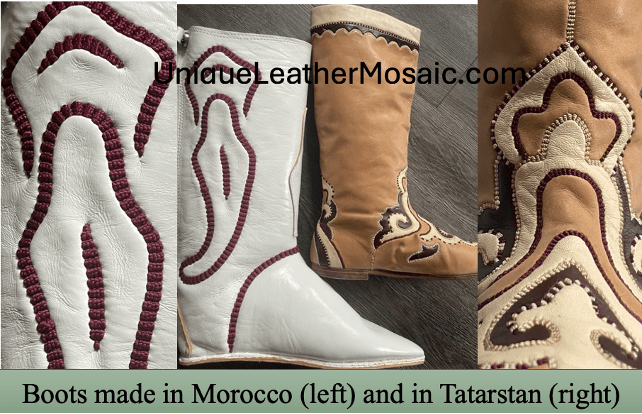
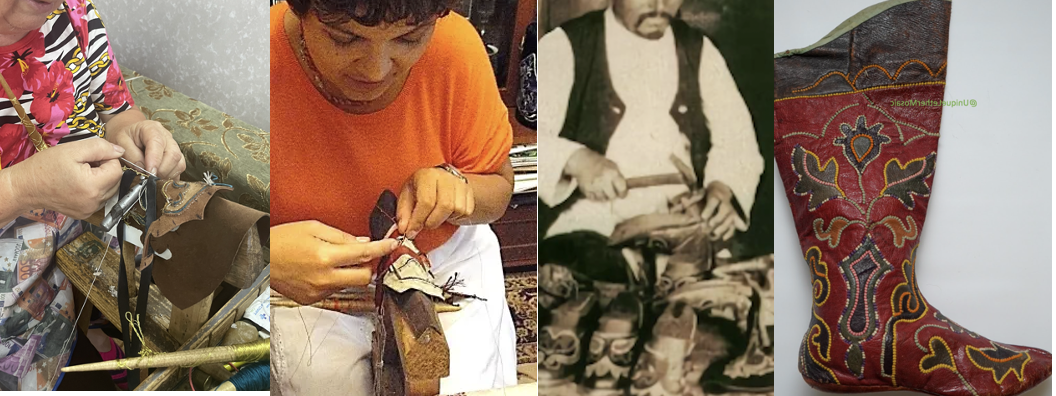
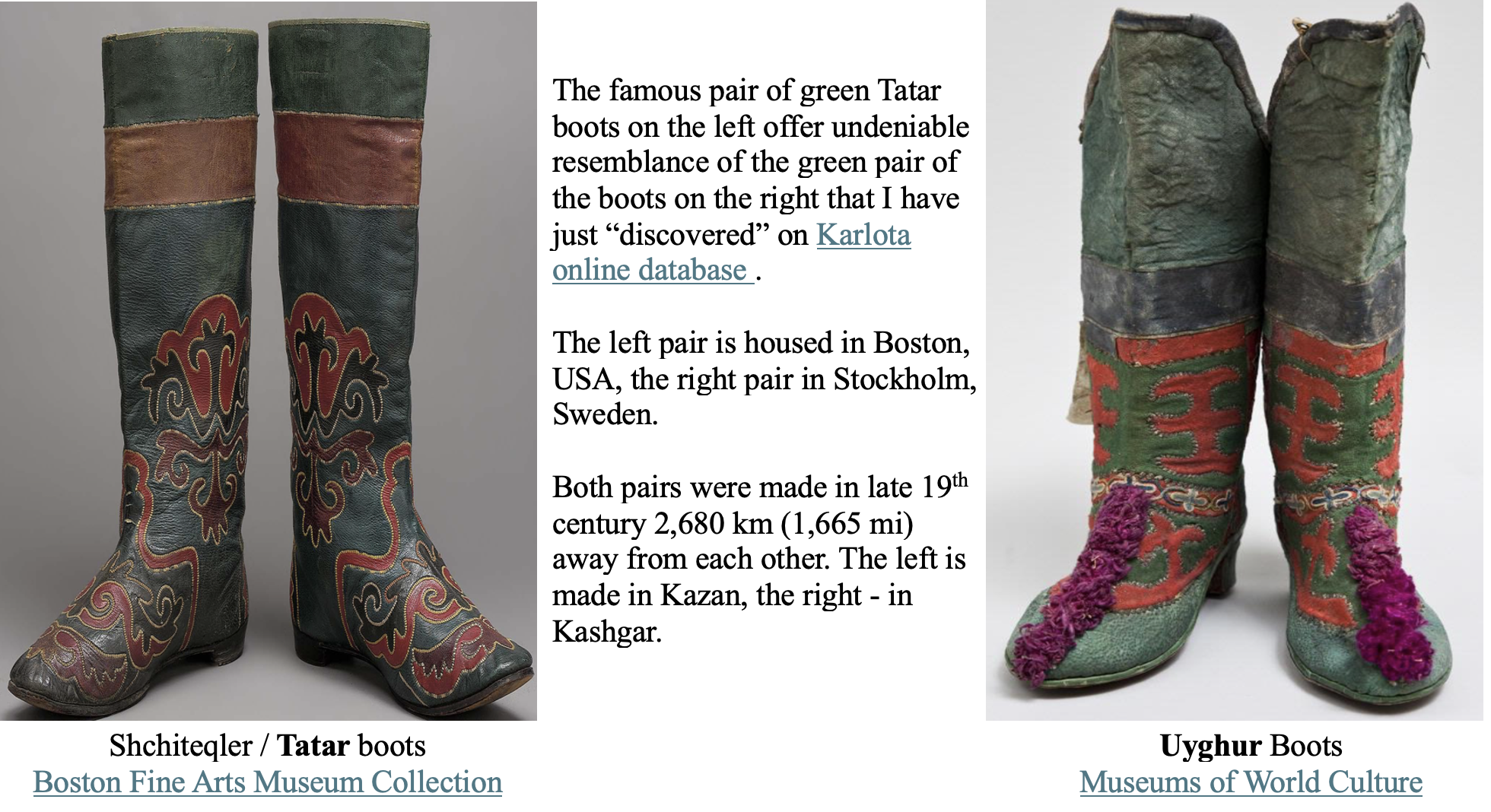
Human emotions present themselves regardless of time, distance, matter, subject. The strength of an emotion, though, depends mainly on internal depth of connections between self and an emotion “evoker”. For me, an acute yearning of a mother, whose children are reaching maturity and starting their independent life, is as prominent as a jaw-dropping surprise of incidental discovery of a pair of boots that carry heritage of myriads of networks that have been tying and uniting the world for centuries.
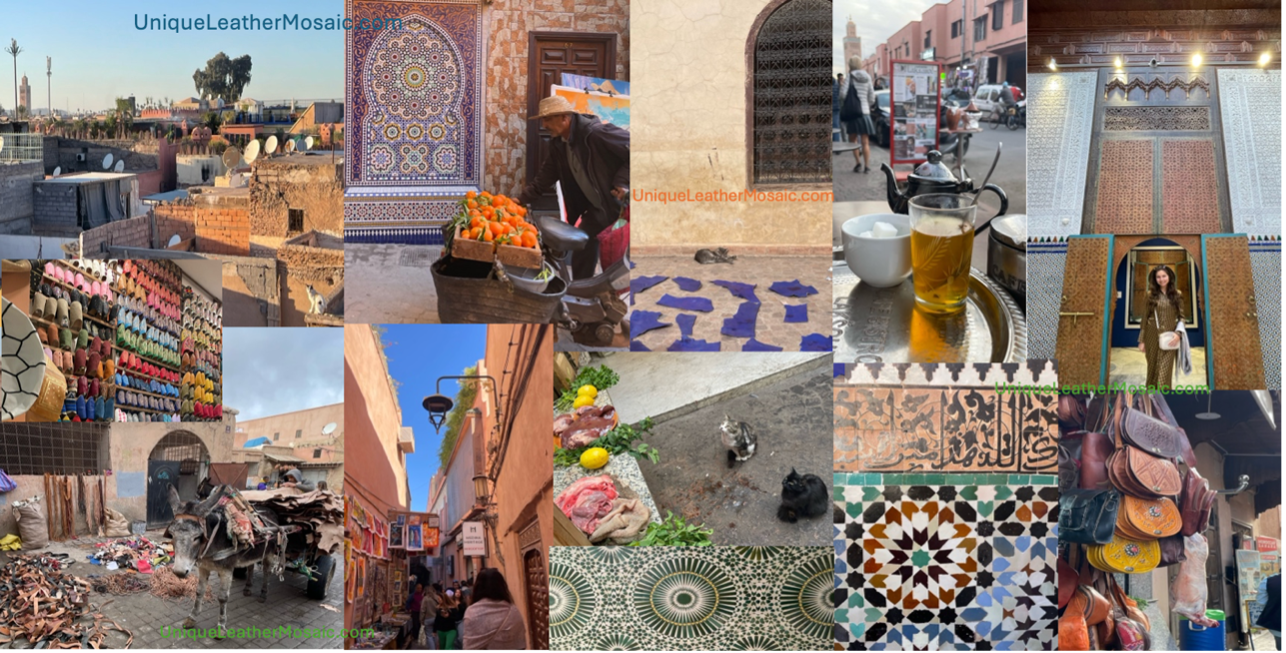
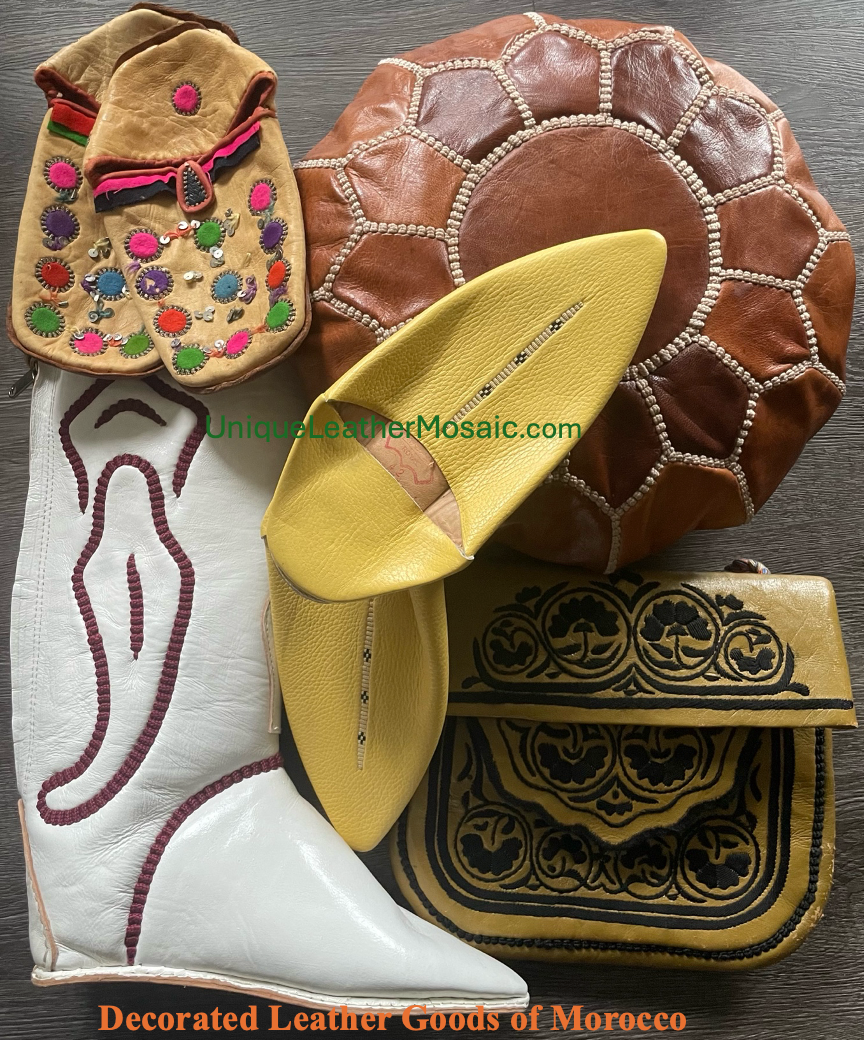
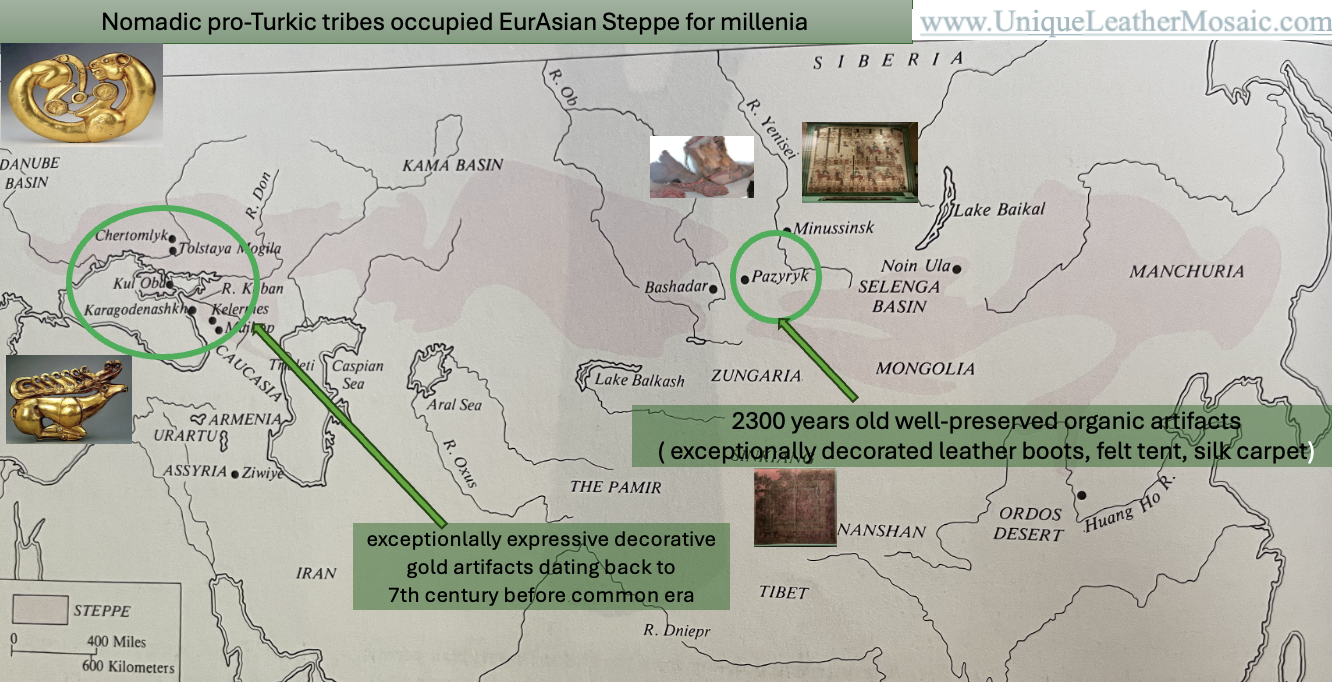
Despite of geographical distance, both pairs share similarities that tie them to one origin – the EurAsian nomadic people (Saka/Scythians) who were impressively skillful leathercrafters. The Volga Tatars of then-Russian Empire mastered the decorated leather footwear craft to the levels unprecedented – the Tatar leather mosaic technique is unique in nature. The Uyghurs of then-Turkestan utilized the knowledge of boot composition and stitching shared between the skillful Tatars and Turkic people (trading routs had been buzzing, people had been mingling for ages). But, as one can notice in the pair from Kashgar, the Uyghurs ventured in different direction when putting creativity in decorating their boots. I.e., the Uyghurs placed colored fabric cutouts on top of the leather, put embroidered elements around shin and embellished the top with the bright pompons. All those elements are common features of the leather footwear created by the people dwelling over 6,991 km (4,344 mi) away, in the areas of Northern Africa (Morocco, Algeria, Egypt, etc.).
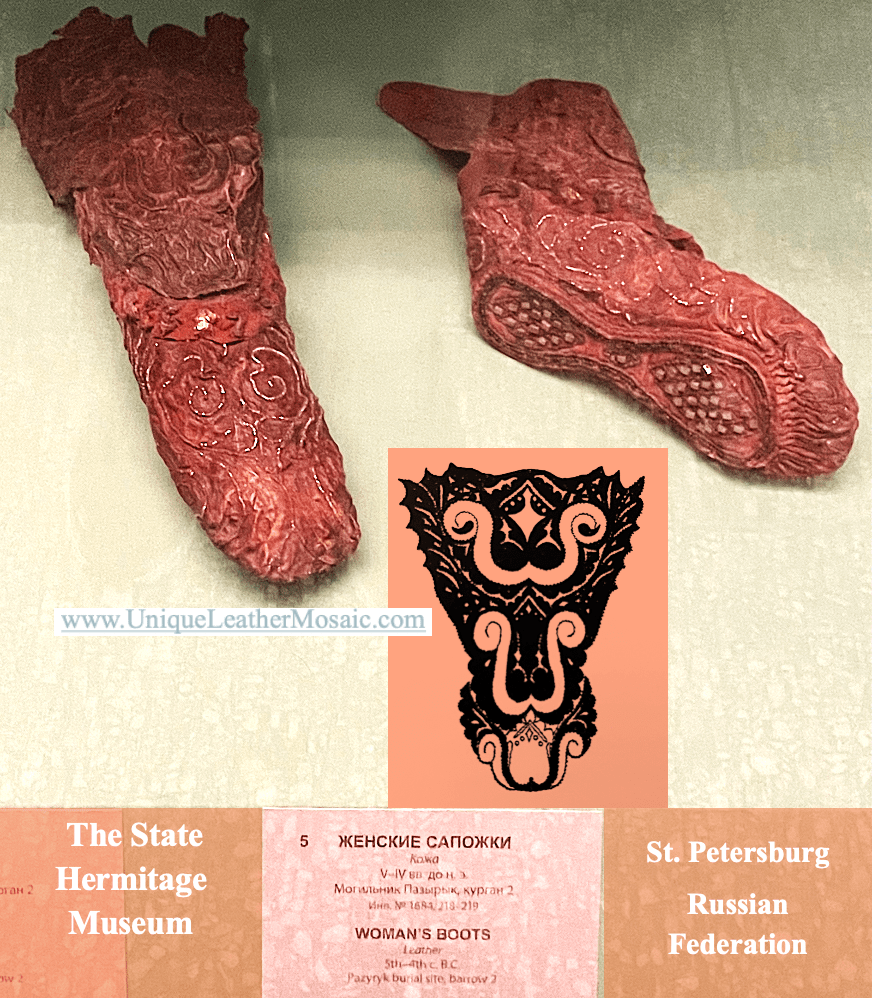
A desire to intricately decorate the wear that protects the foot is rooted in us (impressive designs found in Pazyryk burials date back to 4th century BCE) as deeply as emotional attachment to own children. Those two unite, connect, and tie us for centuries to come.
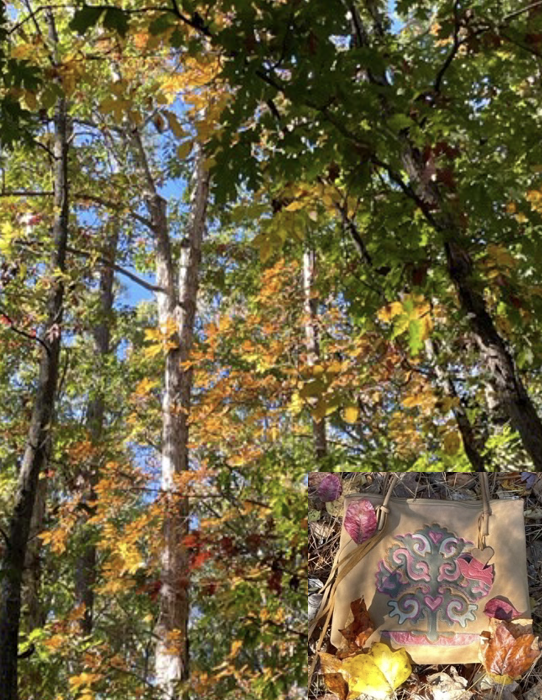
Autumn is an exceptional time of the year: variety of colors graciously capture the universe, fuel creativity and energize the spirit. The multicolored trees, especially, are attractive. They vividly remind a “Tree of Life”- a fundamental archetype that is part of many cultural and religious symbolic visions of the life cycle and the life meaning.
In the Tatar decorative art, the “Tree of Life” is interpreted with the language of vegetative and floral ornamental elements. A tree turns into a blooming stem that carries positive energy and hopes for a healthy life. A classic composition of shchitek (Tatar boot) conceptualizes a human life cycle as a progression from a seed to a bud to a blooming flower.
Skilful designs and hand-stitching are filled with positive intentions and wishes for a wearer to live through all stages of life well, and, at the end, to peacefully reach the world of Tengri for eternity. The world of Tengri (a higher power of endless Sky) is, generally, depicted in a different leather color and with a curvy line of distinctive stitching. Unnamed masters, for centuries, have kept and shared this illustrative code of wellbeing through exceptional craftsmanship of the Tatar boots.
A perfect collaboration of nature and art. Nailya Kumysnokova’s inspirational bag in leather mosaic technique with personal interpretation of a tree as a powerful symbol of life. Meaningful and beautiful.
Recently, we have been challenged with finding answers to questions: How to preserve a native language of minority culture of the stateless nation? The language that loses its speakers rapidly and, thus, making the oral, written, and artistic heritage unavailable for future generations? How to excite young generation to keep the ARTS OF mother LANGUAGE and the native HANDCRAFT alive and vibrant?
The Tatar language is among the many endangered languages that face existential challenges. The small Tatar diaspora of North America is trying to preserve the language by exciting the Tatar youth to learn, utilize and be proud of it. The Tatar Youth Scholarship has been created to generate interest in young American Tatars with any level of Tatar language proficiency to create projects that would engage the native tongue and educate the applicants and the community about the Tatar heritage.
If you wonder why it is essential to keep ancestral languages in use, then read the article by Brian McDermott, where he talks about Language Healers and the value of a heritage language as the most critical marker of the health of a community.
The memorial plaque dedicated to “Serp i Molot” plant and its legendary contributors was placed these days on the last remaining wall of the once-powerful plant. Located in historic Bishbalta (Tatarstan) for over 150 years (1851-2015), the plant supplied heavy machinery, conveyor belts and various tools to support livelihood of Russian Empire, of the USSR, Tatarstan, Russian Federation.
Putting the plaque up is an idea of Garafutdin Minegaziz uly Khisamutdinov, a labor veteran who dedicated over 20 years of his career to the plant. Starting as a locksmith at the age of 17, Garafutdin contributed his skills, excelled, and moved up the ladder to make the plant a success. The collapse of the Soviet Union turned the progressive industrial complex as well as the whole livelihood setup of the USSR upside down.
Many state ventures could not survive the turmoil and, thus, seized to exist. “Serp i Molot” plant’s fate was not an exception. Although the change opened new opportunities for Garafutdin, his heart has been aching for such a powerful establishment with long history to come to an end on his watch. The plaque commemorates the plant’s existence and its contribution to the history of the city. It also pays a tribute to Garafutdin’s youth that was dedicated to “Serp i Molot” full-heartedly!
Garafutdin’s partner and supporter of over 50 years, a mathematician by training and a teacher by trade, Zaituna Gafi kyzy Khisamutdinova took the pressure of caring for the household and three children while Garafutdin served in the leadership positions in the plant and the local district government.
Nowadays, the smile and the spirit, the most persistent attributes of Garafutdin and Zaituna, keep them energized to share and preserve the Tatar heritage and the history of Bishbalta.
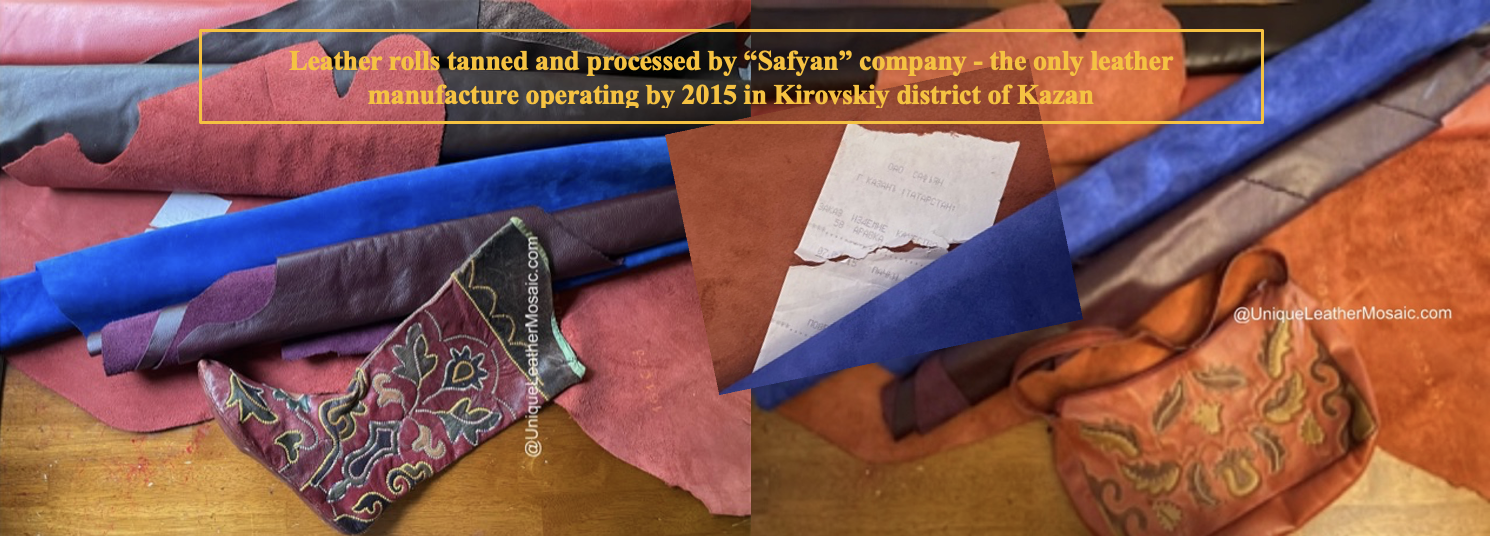
A bitter story of “Serp i Molot” plant is not the only one. In one of the used-to-be-industrial-heavy districts of Kazan, Kirovskiy, from mid- 19th to late 20th century, there were many large manufacturing and industrial plants supplying various goods to the vast country. Most of them ended their operations in early 21st century including the ones that were dedicated to leather production using tanning and dressing technologies developed in Volga Bulgaria (predecessor of Kazan Khanate and Tatarstan). At the verge of 19th and 20th centuries, the leather manufacturing was the second (after fabric weaving) high-volume-high-profit business in Kazan (“Tatar Industrialist”, S. Belov, 2017, p.5-6). By mid-20th century, only two leather processing and leather goods manufacturing plants operated in Kirovskiy district of Kazan city. Nowadays, the one that produces leather goods ranks 165th out of ~400 in Russian Federation, the leather-processing plant is mostly out of business.
The legacy of famous high quality soft aromatic leather mastered in Volga Bulgaria that once were pride and fame of the Volga Bulgars (now referred as (Volga) Tatars) has been slowly vanishing in history. The leather tanned using the exceptional technology developed by the Volga Bulgars had been referred as bulgari in Middle Ages in Asia, Europe and America (“The Patterned Leather of Kazan”, L. Sattarova, 2004, p. 7-23). The word “bulgari” had been utilized as an umbrella term for the two types of leather: 1) “juft/yut” (either from Persian جفت meaning “pair” or from Bulgarian «ӳт» meaning “leather”), and 2) “safyan/ sahtiyan” (from Persian ساختيا derived from ساخته “saht” meaning “fit/processed/made). Those terms, originally and primarily, had been referred to goat (safyan) and sheep (yut) hides tanned with sumac and willow bark, colored by plants-derived dyes and oiled by birch tar. In 18th – early 20th centuries, soft leather with distinctive aroma (acquired during the tanning and oiling with birch tar) that was manufactured using the technologies of the Volga Bulgars got referred as “Russia” leather in American and Western literature (“The Manufacture of Leather”, C.Davis, 1885, p.65-68).
Leather processing is not a profitable business in Kazan anymore. The last leather manufacturing plant in Kirovsky district of Kazan (the successor of various pre-Soviet era profitable leather-tanning establishments of Azmetyev, Yunusovs, Apanayevs, etc.) has been operating on the smallest percentage of its capacity since the collapse of the Soviet Union. It was in-and-out-of-business for the last decade. The hope is on for the famous-aromatic-soft leatherbulgariand the exceptionally-decorated-leather-sock-boots shchiteklertogain their momentum again, to be the staple of local economy, and to be a celebration of (Volga Bulgar) Tatar legacy and handiwork.
Bukhara (pronounced “Bohoro” by locals who speak Tajik, Uzbek and Russian) once was a powerful city-state on the Silk Road. These days,
Bukhara is Uzbekistan’s charming gem with impressive heritage. It excites with plentifulof:
– Islamic historic buildings dating back to 12th century with the original and restored elaborate vegetative and geometric decorations; – medrasas that educated many academicians in Middle Ages; – wooden doors with intricate carvings; – hand-span silk and cotton fabrics with unique designs called abr (from Pesian ابر “cloud“) or ikat (from Malay mengikat “to tie”) ; – impressively detailed hand-woven silk carpets; – hand embroidered suzani (from Farsi سوزن “suzan” meaning “needle”) that became a synonym of Uzbek artistry.
What is hard to find in Bukhara are ethnic shoes.There is barely any visibility of traditional footwear of ethnic people populating modern Uzbekistan (the land of indigenous people -Uzbeks, Uyghurs, Tajiks, Turkmen, Kazakhs, Kyrgyz) on the streets, in the museums, in the stores. Locals, these days, give preference to mass produced rubber shoes. In bazars, a small number of vendors sell masi/maxsi (from Arabic مَسْ “masH” meaning “to wipe”), sometimes called shchiteq (from Tatar “чителгән итек“). Those are soft leather socks (made of halal sheep skin; in Arabic countries, those are called “khuff or kuffain”) that are worn with outer shoes. They are indented to be kept on when entering the mosque for prayer: during ablution it is considered sufficient to wipe those over. Antique shops and ethnographic museums showcase a tiny number of traditional footwear: embroidered fabric boots, full length black leather masi/ shchiteq, hard leather bashmak.
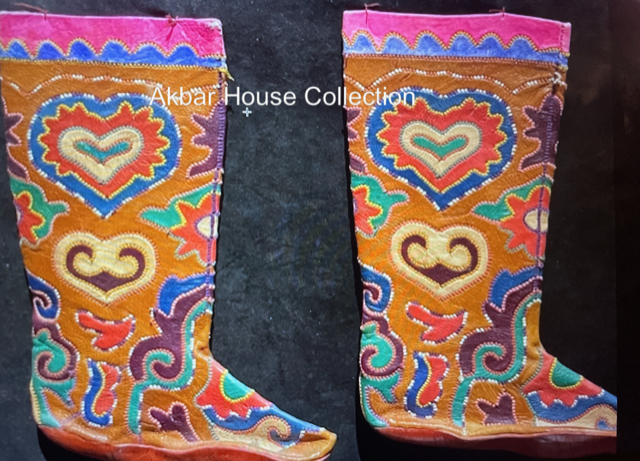
It was a treat to discover a pair of 19th century Tatar boots with ornamental patterns of various colors including vibrant pink (that is super rare) in Akbar House private collection! An antiques collector Akbar Aka mentioned that the boots are one-of-a-kind, not for sale, and that the “appliquéd” leather technique were developed by Volga Bulgars back in middles ages and that the boots like that are not being produced anymore.
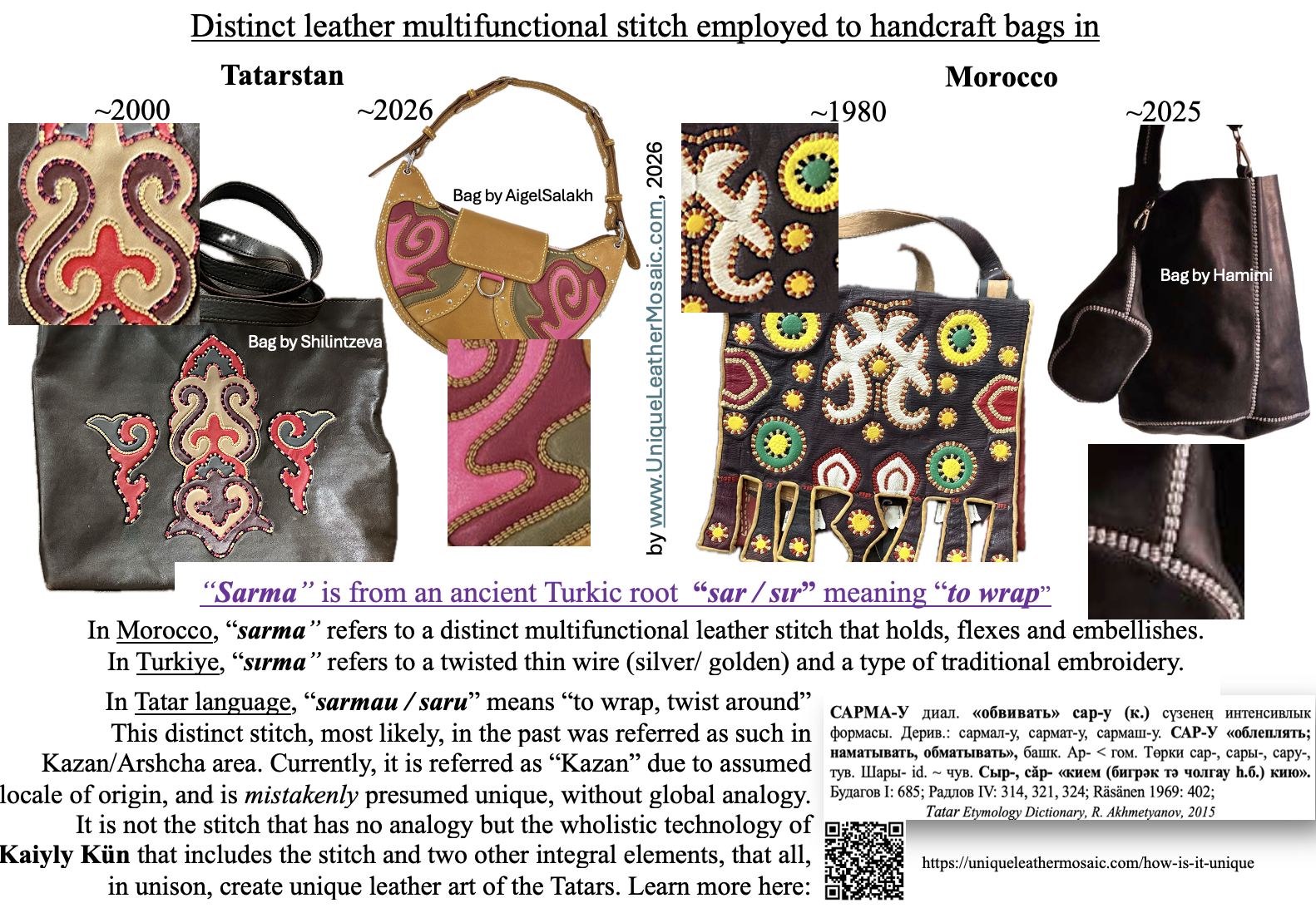
We excited Akbar Aka with the fact that the craft is very well alive, that the boots, like his, are referred as Tatar or Kazan boots (shchitekler in Tatar, ichigi in Russian) and have been continuously crafted (although in much smaller quantities and with modernised looks) in Kazan, Tatarstan (the indigenous land of the Volga Bulgars). The ornamental technique of Tatar boots are often mistaken with a well-recognized techniques of appliqué (application of one piece/pattern on top of another) or embroidery. The unique Tatar boot technology (the ones that Akbar Aka owns, or the ones that are housed in Samarkand National Museum, or the ones that are mis-labeled/mis-identified in world museums, auction sites, mass online publications, etc.) aligns the colored leather patterns with twisted silk threads in intricate play of ornamental cutouts (like jigsaw puzzles). It is referred as Tatar Leather Mosaic or “Kayuly Kün”.
Akbar House Collection features this ethnic outfit on its website. It is a masterful compilation of items, details, patterns, materials, attributes that many Turkic and Iranic people consider their own. The featured soft leather boots with elaborate ornamental patterns tell the story of ancient nomads of Eurasian steppes&mountains and of then-Volga-Bulgars-now-Volga-Tatars who embraced a leather medium to showcase exceptional craftiness, mastery, creativity and spirituality.
There are folk-arts, which intricate designs and impeccable craftsmanship incorporate the wisdom and ethnical legacy of many generations.
There are artists, whose immense depth and capturing creativity engage, empower, and energize anyone who interacts with them or with their masterpieces.
And…..there is Nailya Koumysnikova who uniquely incorporates all these parameters!
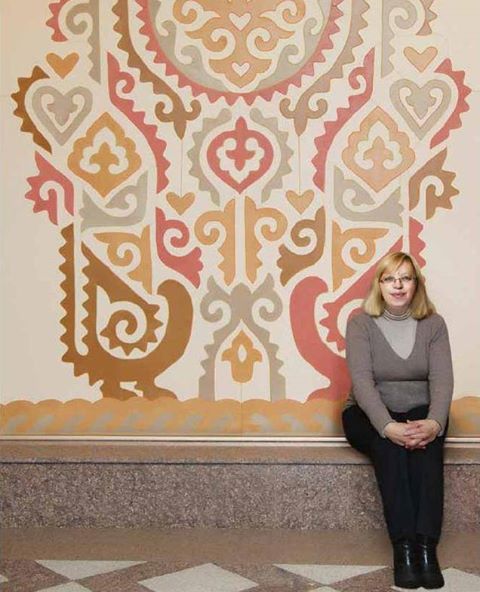
Nailya Koumysnikova has been on a mission to revive and reimagine the Tatar Leather Mosaic Art (Kayuly Kün Sangate) for many years. Discovering centuries old leather mosaic technique in 1990ies and deciding to revive and recreate a pair of the Tatar boots for her mother (a famous Tatar actress Asiya Khairullina) turned into passion that permeates through everything Nailya apa creates and who she is.
On April 26, 2023, Nailya Koumysnikova was awarded the Tukay Premiya – a prestigious in Tatarstan acknowledgement of a life-long dedication and contribution to the people, culture and legacy of Tatarstan. We are celebrating with Nailya apa thousands of miles away! We are so thankful for her wisdom, craftsmanship, creativity and humility. We are looking forward for many more years of productive artistry! Let Umai – the goddess of ancient Volga Bulgars – brings joy, wellbeing, and health for years to come!
Important notes:
We call Nailya Koumysnikova as Nailya apa, which is a respectful way to address to older than oneself lady in Tatar culture as well as to indicate a respectful connection and great appreciation.
Premiya has been established 65 years ago and is considered the highest recognition for contribution to Tatar culture. It is awarded annually on 26th of April – the birthday of Gabdulla Tukay, a classic Tatar poet and activist who promoted the Tatar language and is a staple of Tatar identity.
Goddess Umai in the form of the bird is one of the favourite images in the artworks created by Nailya apa. For us, Nailya Koumysnikova is theGoddess Umaiwho personally and through her art brings peace, harmony and wellbeing!
If you want to be connected with Nailya Koumysnikova and custom order exceptional masterpiece, let us know.
Pair of Tatar Boots and a bag designed by Nailya Koumyskikova
A heritage language along with an ancestral handicraft are the most critical markers of the health of the community and versatility of the world! Those are, unfortunately, the ones that are being jeopardised in the modern world due to globalisation, assimilation, and industrialisation.
Within last 11 years the number of Tatar language speakers residing on their indigenous territories (modern Russian Federation) has decreased by 24%. It is over one million speakers less compared to 2010.
The picture is more dramatic with myriad of other minority languages according to the 2021 census that surveyed residents of Russian Federation. For example, among the ones populating the Volga-Ural region, the most endangered – the Mordvin language – lost 45% of the speakers. Although keeping the knowledge of regional and global lingua franca is important, it is critical to work together to protect all mother tongues, so caring, humane and vibrant community is a possibility.
If your mother tongue happens to be a lingua franca, then pick a language that is loosing speakers! Here is an exciting opportunity to start learning one of them – the Tatar! Take 8 weeks Tatar Language and Culture exploration course. It will be taught this summer (May 30-July 14, 2023) at Arizona State Universityand online. Take a dive to learn a new minority language: https://melikian.asu.edu/cli/tatar!
If you are interested to learn why it is essential to keep ancestral languages in use, consider reading the article by Brian McDermott, where he talks about Language Healers and the value of a heritage language as the most critical marker of the health of a community.
If you want to be inspired by the example, listen and support Carolina Cicha – a Poland’s singer and composer who uses the language of music to overcome existential crises and historical prejudice towards minority groups in Europe, particularly Lipka Tatars and Karaims.
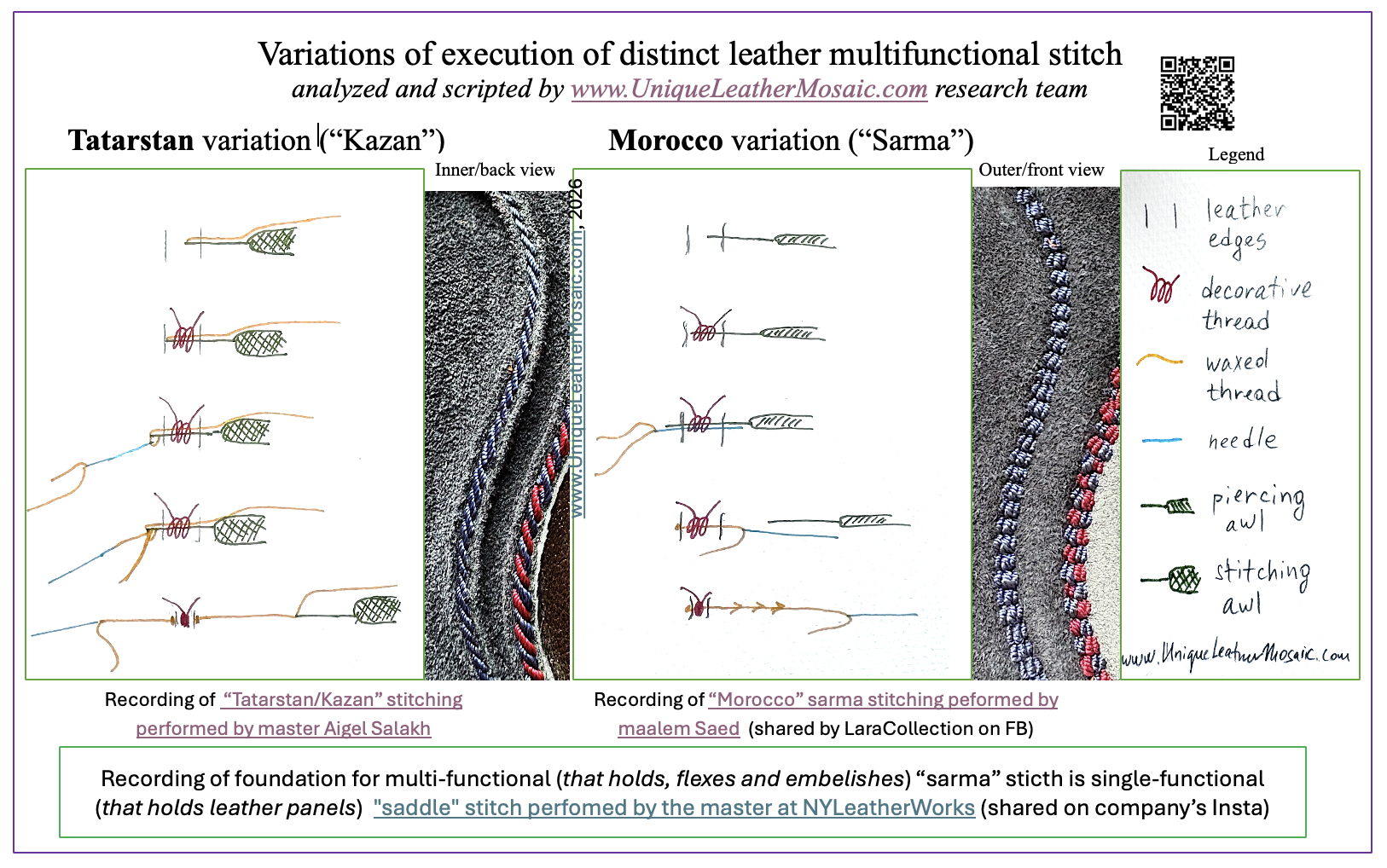
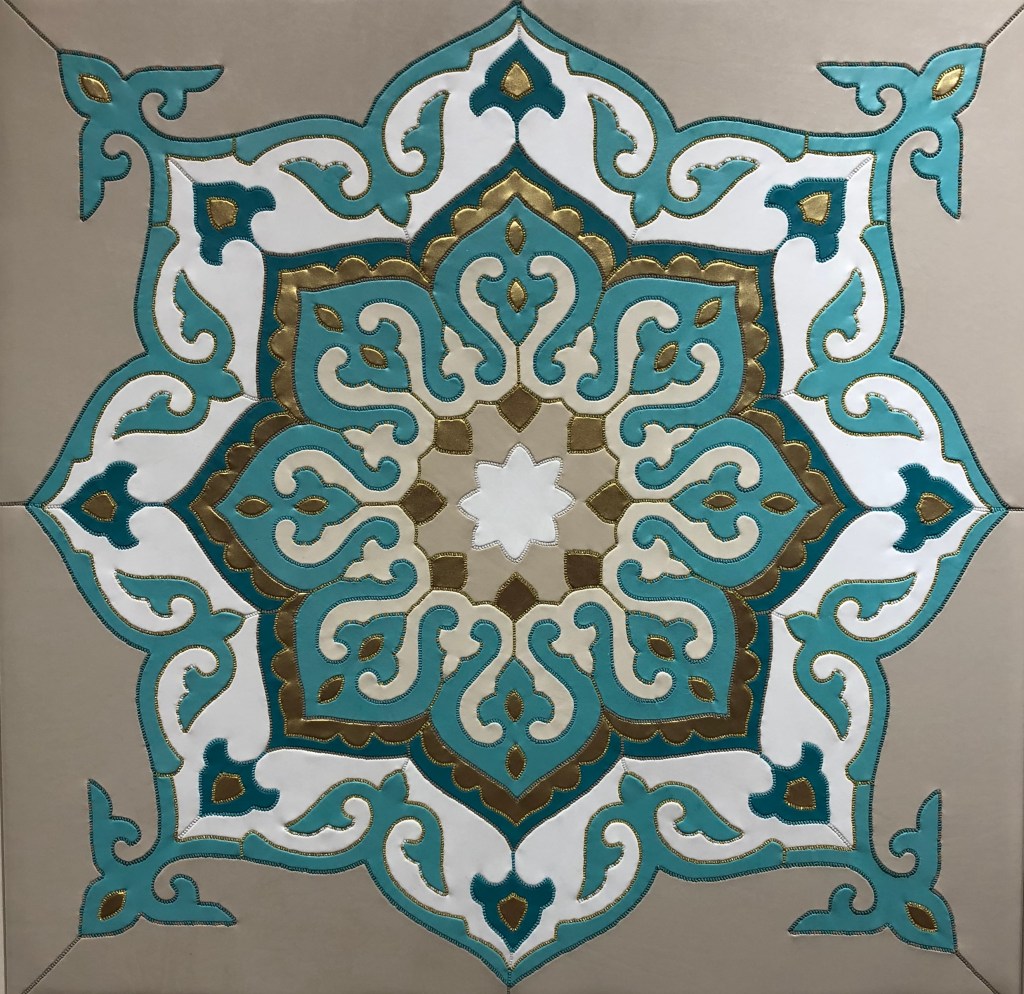
If you are not into languages, learn a handicaft. Here is a suggestion: learn Tatar Leather Mosaic or “kayuly kün” ! The Tatar leather mosaic is a unique and impressive alliance of the softest colorful leather cut into ethnic patterns and skilfully stitched together by hands. The pieces are aligned and attached to each other from the inside with theKazan stitch that looks like embroidery from the outside. To get inspired, just have a look at the bright leather flower design above that is stitched with vibrant silk threads and created by the prominent master of Tatar Leather Mosaic Nailya Koumysnikova who has contributed immensely to restoration, education and promotion of the unique ancient art.
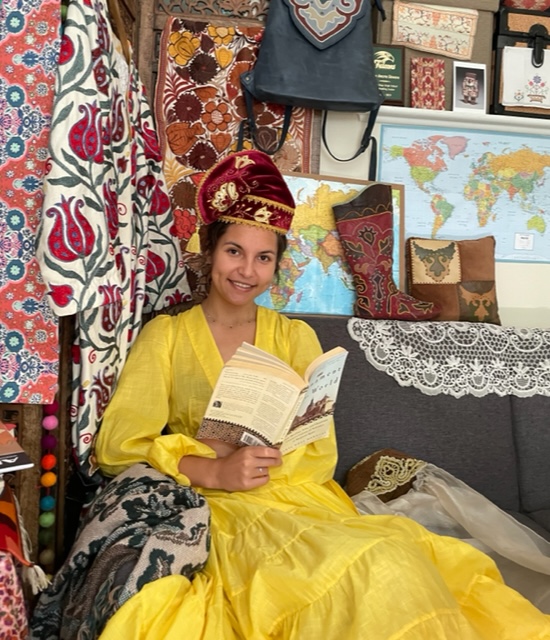
A recent encounter of a hat that is designed with Tatar Leather Mosaic technique excited the beginning of 2023! Wish this year is filled with new discoveries and learning opportunities!
A man on the photo (captured by V. Sucksdorff and Y. Blomstedt, now at Finnish Heritage Agency) looks like enjoying his warm hat or, maybe, the fact that he is married – the description mentions “wedding hat”. What can be more stunning than a groom with exceptionally decorated hat? It can easily beat a bride with exquisite Tatar boots…or can it?
The photo of a hard-working man resting on a grass in the village of Muujarvi of eastern Karelia’s (nowadays in Russian Federation) in the summer of 1894 pictures him wearing long boots and the hat.
The hat looks like the one that is commonly used by many ethnic groups populating the areas where cold is a daily normal (even during the summer months). The structure of this type of the hat has flaps that are intended to cover ears, chin, and neck. It is made of leather and fur to keep the head warm. In the description of the photo, the hat is referred as “turkislakki” or “karvaslakki” in Finnish. In Tatar (and several other Turkic languages) this type of hat is called “bürek/börek“or “kolakshchyn”. In Russian it is called “ushanka” or “treuh(ka)“. Interestingly, the words incorporate “ears” in both Tatar and Russian versions, emphasising the intentional design with ear coverings.
A closer look at the hat reveals so familiar Tatar ornamental patterned design attached from the inside by Kazan stitch. It is unknown how this unique “bürek” featuring exceptional decorations created with Tatar Leather Mosaic technique made it to the Scandinavian peninsula and where exactly it was crafted. The largest leather mosaic workshops had been historically located in Kazan area (over 1400 miles away from Muujarvi). Tatar people traditionally covered their heads with different types of hats made of fur, felt and cotton that are skilfully decorated with embroidery but barely with leather mosaic. The hat housed in the National Museum of Finland surprised us with the history and the potential of the Tatar Leather Mosaic.
A closer look to “burek” reveals Tatar ornamental patterns and Kazan stitch
As it turns out snow is the best canvas to display the splendour of Tatar boots (shchiteqler)! But to embrace the beauty and comfortability of shchiteqler during wet or snowy weather, one would need another piece of footwear – qalushlar. Those are the rubber low overshoes that would protect gentle leather and intricate ornaments from dirt and water.
At the beginning of the 21st century, Crocs are contemporary alternative to qalushlar that care for my beautiful schiteqler!
The hope is that sooner then the beginning of 22d century the overshoes become made of ecologically-friendly materials: not from synthetic rubber of traditional qalushlar and plastic of Crocs (both are derivatives of crude oil), but of natural and renewable materials like dandelion: the special one that is abundant in Eurasian steppes where decorated boots began their charm. Kudos to Continental for engineering the innovative tires from plant kok-saghyz – a modest and powerful dandelion that is native to Central Asia (Kazakhstan, Kyrgyzstan, Uzbekistan). It is translated from Kazakh language (and also Tatar) as “root gum” and it’s impressive qualities were discovered by USSR/Soviet scientists in 1932.
Another footwear that Tatar people would put on to protect soft Tatar boots are either bashmaqlar or shchuweqler like the ones pictured below (middle) in the sketches by Tatar prominent sculptor and painter Baqi Urmance. Those sketches (started in 1970) were meant to serve as a decorative background for the Soviet-ideolozied museum of Tatar prominent poet Gabdulla Tukay in Kazan. They ended up not being displayed in the museum but they made it on this website! Urmance’s work masterfully depicts the dynamics of Tukay’s Kiseqbash poem (written in 1908) as well as skilfully showcases the busy life and Islam-dictated fashion of Tatars of early 20th century in the Tatar biste (neighbourhoods) of Kazan.
Sketches by Baqi Urmance
If Baqi Urmace is the staple of Tatar visual arts, Gabdulla Tukay is the staple of Tatar literary arts, then not mentioning one more Tatar staple of musical art Salikh Saidashev would not be fair. Salikh Saidashev is one of the creators of Tatar music that was aligned with Soviet Union’s atheistic (absence of religion) ideology and aesthetics. Here is the glimpse of Saidashev’ & T.Gizzat’s musical “Merchant” (created in 1930ies) that vividly displays the new interpretation and stylezed reality of Tatar life – where religious Islamic practices were forced to be removed but the spirit of cheer and resilient community persist.
Like everybody else, I have many wishes to come true in the new year! But, first, I want to recognize and thank the last year for things that came my way, particularly, this mind-blowing encounter on the internet. A hand-painted cold-cast porcelain miniature of a Tatar boot (shchiteck) designed by Raine Willlitts back in 2002 that had been patiently waiting to be found by me! What a discovery! This is a miniature replica of right boot that was worn by Caroline Ogden-Jones Peter. Caroline and her husband Armistead Peter traveled the world and claimed New York, Paris, Washington DC (Tudor place) as their homes.
Just by looking at the Caroline’s portrait that hangs in the Tudor place (painted by her husband in 1925), one can say that she was a fashionista. She, most likely, had been visiting fashionable salons and fairs around the world to keep up with the trends. Paris World Fair in 1925 (International Exhibition of Modern Decorative Arts and Industrial Arts) was, probably, the place where she spotted unique Tatar boots that were featured in the USSR’s pavilion that impressed visitors with it’s futuristic designs and elaborate presentation of folk art of many diverse ethnicities of young Union of Soviet Socialistic Republics.
This exhibition in Paris of 1925 (world fairs once used to be grandiose events to showcase the country’s capabilities and potential) was the great opportunity for the newly established USSR (1922-1991) to display its uniqueness not only from the political stand (as socialistic endeavour with equality as the highest value). It vowed the visitors with exceptional, not-seen-before-by-Westerners plentitude of versatile decorative folk arts of multiple indigenous people. It signalled that the strengths of USSR is in it’s diverse ethnic backgrounds and skilled hands that were inherited from myriads of past ruling empires including Ottoman and Russian.
“Les Bottes brodées-“itchegui” des Tartares de Kazan” (embroidered boots “ichigi’/”schiteck” made by Kazan (Volga) Tatars) were among the ones mentioned and boasted about in the official brochure. Tatar leather mosaic – the technique the “Tartares” boots were decorated in – is truly exceptional utilitarian art that captured the eyes of not only Caroline Peter but many others. Tatar boots were sought-after items that accessorised the looks of fashionistas of early 20th century.
Unfortunately, unfavourable progression in the USSR’s leadership attitudes towards ethnic minorities led to stagnation of indigenous people’s cultures, languages and folk arts including Tatar Leather Mosaic. My wish for the new year and years to come is that Tatar boots are back to production heights of the early 20th century (millions per year) and are desired by many.
Illustration of Tatar boots of 1925 Paris World Exhibition’s catalogue