Inaugurating Turkic Languages Day!

The day of December 15th has recently been proclaimed by UNESCO (United Nations Educational, Scientific and Cultural Organization) as a World Turkic Language Family Day. In 2025, we are celebrating it for the first time!

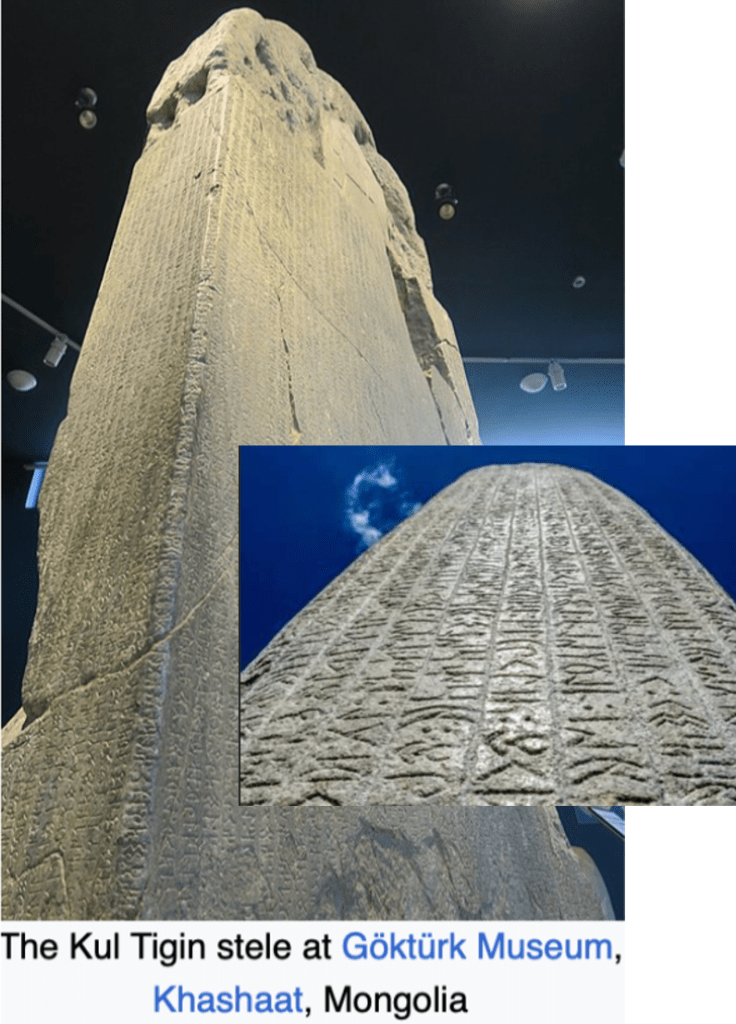
On this day in 1893 a linguist and turkologist Vilhelm Thomsen (1842-1927) made a very anticipated announcement that the text of the Orkhon Inscriptions (discovered in 1889 during the expedition of Nikolai Yadrintsev (1842-1894)) was deciphered (translation here). The 1300 years old inscriptions, also referred as Kul Tigin (684-731)  steles and Bilge Qaghan (683-734) inscriptions, found in Orkhon valley of modern Mongolia, are the oldest known written records of the Turkic language.
Out of ~8 billion people worldwide, roughly 200 million are speaking Turkic languages, ~7 millions of whom are the Tatar language speakers/ carriers, active and passive. Although the usage of the Tatar language is diminishing due to the prevalence of various lingua franca in the areas of modern habitats, there is a great interest in learning and preserving the Tatar language these days, simply because it connects to the roots (incredibly rich oral, written, material heritage) and to the other Turkic people.
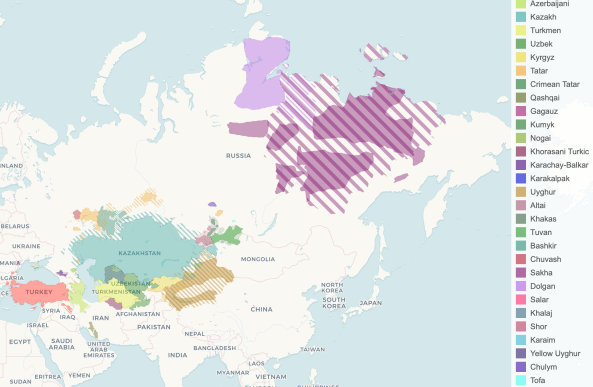
Turkic languages are characterized by the vowel harmony and agglutinative nature of grammatical relations between the words. According to the lexicostatistical matrix of Turkic languages and the article in Journal of Language Evolution, the Tatar language exhibits more than 50% of basic lexical similarities with most of the Turkic languages including Azerbaijani, Bashkir, Gagauz, Kazakh, Karakalpaq, Karachi, Khakas, KirimTatar, Turkish, Turkmen, Tuvan, Uyghur, Uzbek. To have an idea how closely they sound, just give a listen to Bulat Shaymi’s short song where he sings in 12 Turkic languages!

For several millennia, in the vast territories of central EuroAsia, impressive networks have been connecting, non-stop, the flow of goods, skills, thoughts through the well-established trading routes (Volga Route powered by the Volga Bulgars, ancestors of the modern Tatars, and Silk Road) that had been managed by various influential forces, including nomadic Saka/ Scythian EmpireTurkic KaganatesMongol Empire evolved into several Turkicized khanates later become referred as Turkistan (Turan by Persian sources, TransoxaniaCentral Asia by western sources) -the ethnonym represents a conglomerate of many Turkic-speaking states/“-stan”s-, Rossiyan Empire through 1917. 

Although Tatarstan is not a part of Turkestan geographically, the linguistic, customary and historic baseline of the Tatars (originally, Volga Bulgars) of the Volga-Ural area of modern Rossiyan Federation is linked to all Turkic people. The intelligible wide-spread Turkic languages have eased up the channels to carry on business, policies, thoughts, innovations, and the Tatars were instrumental in promoting successful collaborations and opportunities for the Turkic languages-speaking world and its neighbours creating so-called Tatar Empire, a term coined by Danielle Ross in her book.

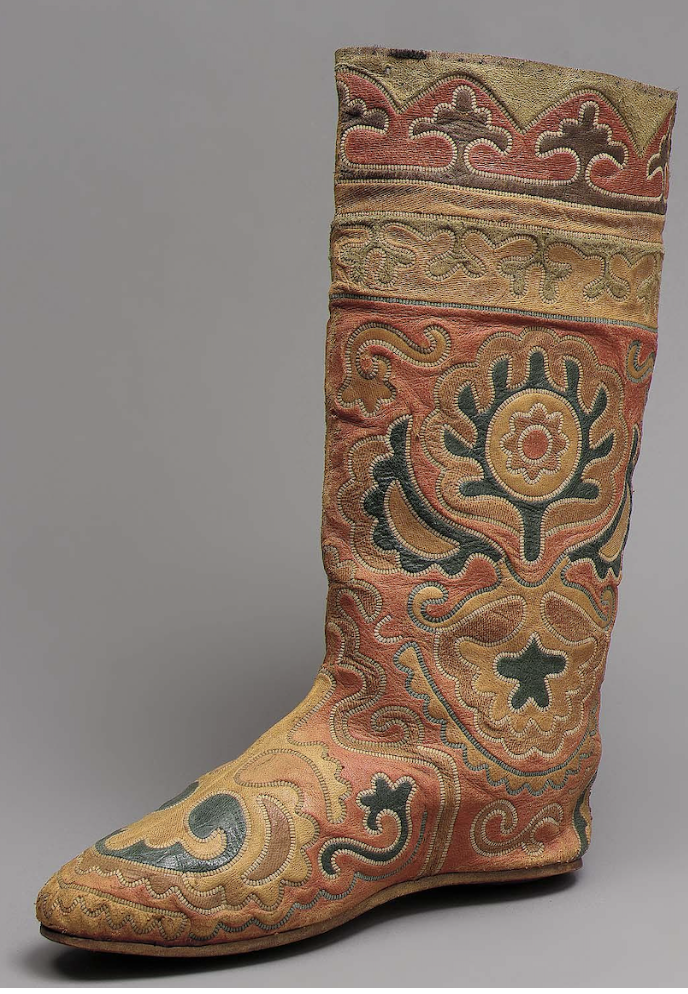
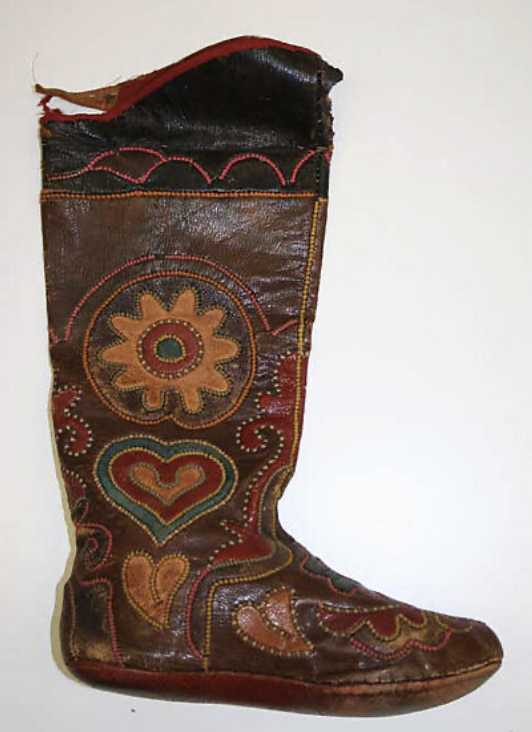
Material cultures of the Turkic people have many common features that speak to the unified sources of inspirations and beliefs (a subject for a separate post), the distribution of which showcases the collaborative nature of the networks. The simple fact that shchiteqlerboots uniquely decorated with Kaiyly Kün technology mastered by the Volga Tatarsexhibited in collections of many museums worldwide and labeled as originated from various Turkic-speaking places (such as Asia, China, Crimea, East & West Turkestan, Europe, Georgia, Indonesia, Hungary, Kazakhstan, Kyrgyzstan, Mongolia, Tajikistan, Tatarstan, Russia, Ukraine, Uzbekistan) speaks volumes.

The above Images of shchiteqler are courtesy of online collections (linked further) of PennMuseum of University of Pennsylvania, USA, Museum of Ethnography of Hungary, Museum of Fine Arts in Boston, USA, Metropolitan Museum of Art, USA, Ethnography Museum of Sweden, British Museum of Great Britain.

The due credit and appreciation are not always given to the skilful developers of the unique art in those museum collections: Successful Tatar leather artisans and entrepreneurs had not only manufactured uniquely decorated footwear in its “birthplace” Kazan-Arshcha area of Tatarstan to sell globally, but also had travelled far to trade and open workshops in Central Asia/Turkestan, Caucasus, Eastern Europe, cities of Rossiyan Empire. They shared their exceptionally-processed leather technology inherited from the Volga Bulgars (referred as bulgari/ safiyan/ sahtiyan/ yuft’) and unique decorated footwear making skills, they trained apprentices throughout European and Asian continent for centuries up until early 20ies century.

Let’s celebrate, promote and practice the

Arts of Native “Skilled Tongues” and “Skilled Hands” everyday

Connecting the Dots

“What is primary: a line or a circle?” I asked. “The dot” she answered with no hesitation.

 Fadhila Al Dhahouri of Global Center of Islamic Art, an impressive young visionary, made it very clear that the dot can undeniably evolve into both the line and the circle, and allow the infinite transformation into the beautiful, the harmonious, the inspiring. Fadhila and exceptionally talented Sandy Kurt empower the world for a “search for knowledge” through engagement of artistic potential within aesthetics of Islamic discourse. In which activation of creativity enables humanity and is connected with the higher power, Allah.

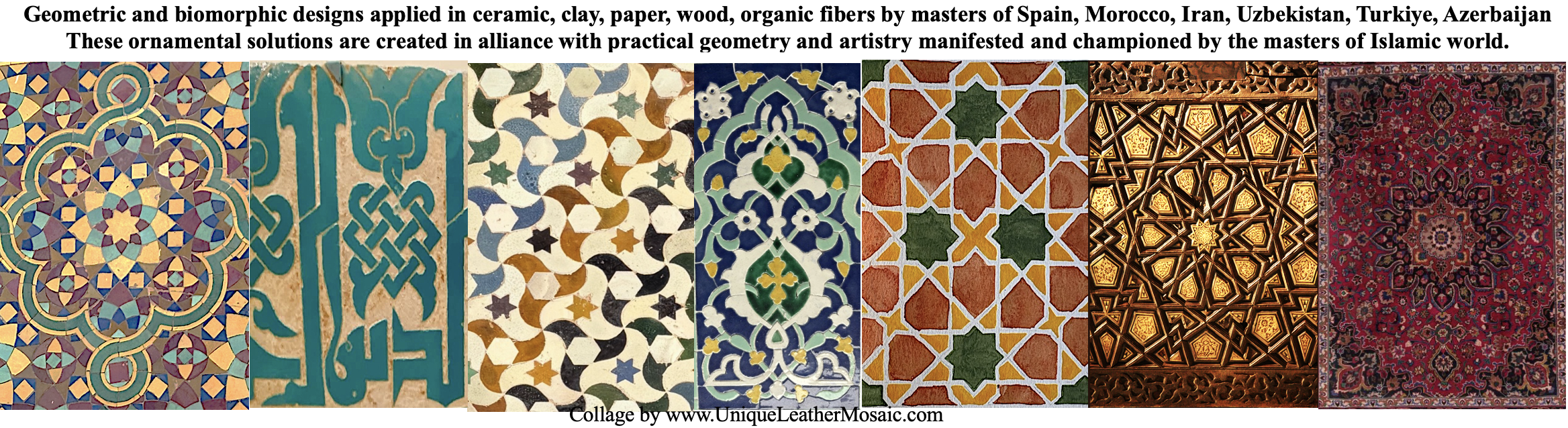
Specifically, the art of practical geometry is connecting individual’s humanity and internal energy through interplay of dots, lines, circles – visible or hidden. This unity is built on paramount importance of symmetry, balance, harmony, precision, order and the internal individual desire to seek for those. For centuries, guided by structure, spiritual energy and eternal potential of geometry, myriads of ornamental solutions have been mastered. They all offer deep engagement to the ones who create them and the ones who seek the learning. 

With knowledge that “geometry enlightens the intellect and sets one’s mind right” (Ibn Khaldun’s (1332-1406), we have been exploring the role of Islamic aesthetics and practical geometry in the ancient leather art of the (Volga) Tatars, the descendants of the Turkic nomads of EurAsia (Turkic Khaganates of 6-8th centuries) and the settled Volga Bulgars, whose indigenous lands are referred these days as Tatarstan Republic. Volga Bulgaria were the first northernmost civilization that in 922 officially accepted Islam under the mission of Ibn Fadlan, the envoy of Abbasid caliph al-Muqtadir. In 10-13th centuries, Volga Bulgaria had manifested itself as a powerful center for Islamic education, science, art and lifestyle.

The Volga Bulgars’ Islamic knowledge, esthetics and material culture had been transmitted through immense trading channels of those times, so-called Volga Trade route and Silk Road. People of Volga Bulgaria have continued being a backbone of Muslim networks despite of complex and endless military, political, religious, authoritarian, colonizing processes. The descendants of the Volga Bulgars are now called the Tatars. Representing the largest and the most spread-out ethnic minority in ~17 mln. sq. km. territory of Rossiyan Federation, the modern Tatars have been slowly recovering their collective memory loss of their own impressive Islamic history. The leather art of the modern (Volga) Tatars serves as a vessel that has protected the core from turbulent realities, the vessel that carries a powerful blend of Tengri’s connection with nature and Allah’s empowerment of humanity.

  • Two more worth sharing quotes:

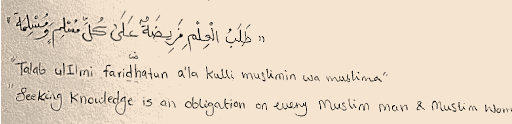
from Quran (hand-written and translated by Fadhila) on obligation of seeking the knowledge by both Muslim man and woman. This motto is worth following by any, fidel or infidel. The modern reality is increasingly and intentionally complex, and the survival in it is possible only with developed critical thinking.

from ibn al-Haytham’s (965-1040) “The Optics” (snapshotted from Windy Shaw’s book) on never-ending complexities of the world. Ibn Al-Haytham’s statement compliments the Quranic wisdom and emphasizes the constant search for the truth using the senses

Memory, Spirit and Legacy

Tатарчаны монда укый аласыз / Tatar version here

The memorial plaque dedicated to “Serp i Molot” plant and its legendary contributors was placed these days on the last remaining wall of the once-powerful plant. Located in historic Bishbalta (Tatarstan) for over 150 years (1851-2015), the plant supplied heavy machinery, conveyor belts and various tools to support livelihood of Russian Empire, of the USSR, Tatarstan, Russian Federation. 

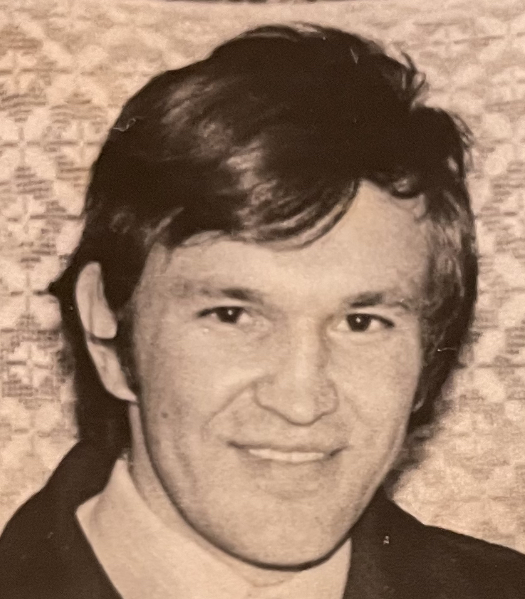
Putting the plaque up is an idea of Garafutdin Minegaziz uly Khisamutdinov, a labor veteran who dedicated over 20 years of his career to the plant. Starting as a locksmith at the age of 17, Garafutdin contributed his skills, excelled, and moved up the ladder to make the plant a success. The collapse of the Soviet Union turned the progressive industrial complex as well as the whole livelihood setup of the USSR upside down.

Many state ventures could not survive the turmoil and, thus, seized to exist.  “Serp i Molot” plant’s fate was not an exception. Although the change opened new opportunities for Garafutdin, his heart has been aching for such a powerful establishment with long history to come to an end on his watch. The plaque commemorates the plant’s existence and its contribution to the history of the city. It also pays a tribute to Garafutdin’s youth that was dedicated to “Serp i Molot” full-heartedly! 

Garafutdin’s partner and supporter of over 50 years, a mathematician by training and a teacher by trade, Zaituna Gafi kyzy Khisamutdinova took the pressure of caring for the household and three children while Garafutdin served in the leadership positions in the plant and the local district government.

Nowadays, the smile and the spirit, the most persistent attributes of Garafutdin and Zaituna, keep them energized to share and preserve the Tatar heritage and the history of Bishbalta.

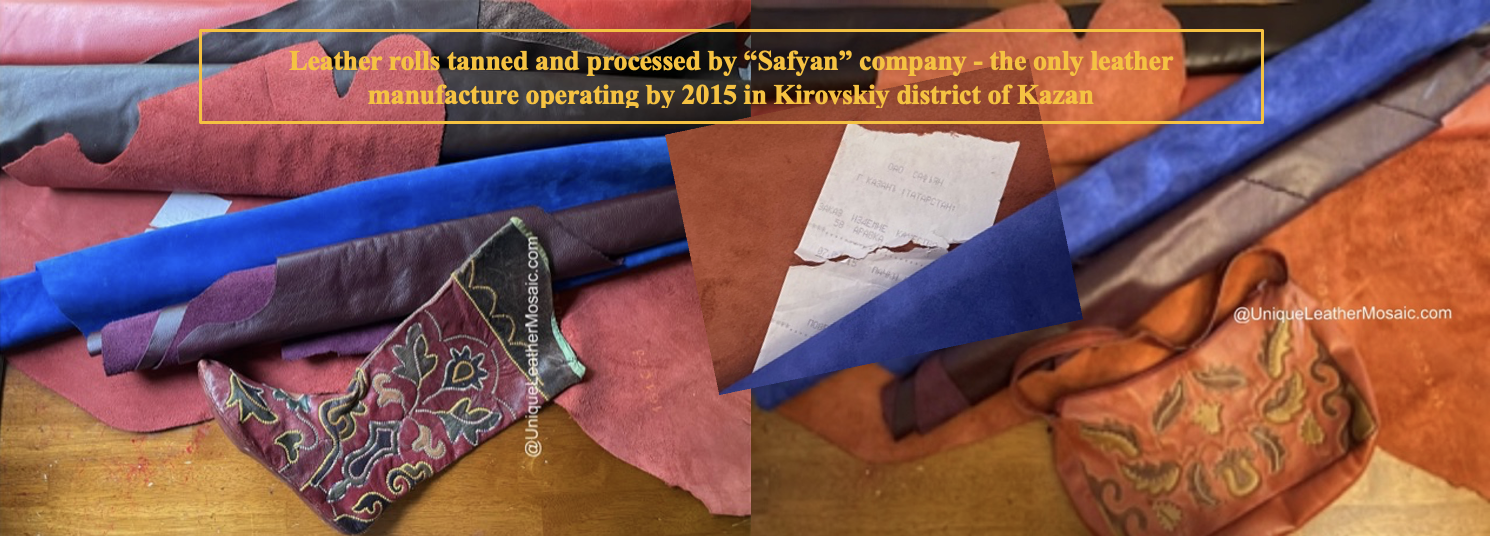
A bitter story of “Serp i Molot” plant is not the only one. In one of the used-to-be-industrial-heavy districts of Kazan, Kirovskiy, from mid- 19th to late 20th century, there were many large manufacturing and industrial plants supplying various goods to the vast country. Most of them ended their operations in early 21st century including the ones that were dedicated to leather production using tanning and dressing technologies developed in Volga Bulgaria (predecessor of Kazan Khanate and Tatarstan). At the verge of 19th and 20th centuries, the leather manufacturing was the second (after fabric weaving) high-volume-high-profit business in Kazan (“Tatar Industrialist”, S. Belov, 2017, p.5-6). By mid-20th century, only two leather processing and leather goods manufacturing plants operated in Kirovskiy district of Kazan city. Nowadays, the one that produces leather goods ranks 165th out of ~400 in Russian Federation, the leather-processing plant is mostly out of business. 

The legacy of famous high quality soft aromatic leather mastered in Volga Bulgaria that once were pride and fame of the Volga Bulgars (now referred as (Volga) Tatars) has been slowly vanishing in history. The leather tanned using the exceptional technology developed by the Volga Bulgars had been referred as bulgari in Middle Ages in Asia, Europe and America (“The Patterned Leather of Kazan”, L. Sattarova, 2004, p. 7-23). The word “bulgari” had been utilized as an umbrella term for the two types of leather: 1) “juft/yut (either from Persian جفت meaning “pair” or from Bulgarian «ӳт» meaning “leather”), and 2) “safyan/ sahtiyan” (from Persian ساختيا derived from ساخته “saht” meaning “fit/processed/made). Those terms, originally and primarily, had been referred to goat (safyan) and sheep (yut) hides tanned with sumac and willow bark, colored by plants-derived dyes and oiled by birch tar. In 18th – early 20th centuries, soft leather with distinctive aroma (acquired during the tanning and oiling with birch tar) that was manufactured using the technologies of the Volga Bulgars got referred as “Russia” leather in American and Western literature (“The Manufacture of Leather”, C.Davis, 1885, p.65-68).  

Leather processing is not a profitable business in Kazan anymore. The last leather manufacturing plant in Kirovsky district of Kazan (the successor of various pre-Soviet era profitable leather-tanning establishments of Azmetyev, Yunusovs, Apanayevs, etc.) has been operating on the smallest percentage of its capacity since the collapse of the Soviet Union. It was in-and-out-of-business for the last decade. The hope is on for the famous-aromatic-soft leather bulgari and the exceptionally-decorated-leather-sock-boots shchitekler to gain their momentum again, to be the staple of local economy, and to be a  celebration of (Volga Bulgar) Tatar legacy and handiwork.